Defining the project scope and problem statement clearly is crucial to the successful execution of any business or learning project.
Establishing a realistic, well-defined scope aligned with learning outcomes ensures focused efforts, efficient resource utilization, and measurable impact.
This involves setting SMART objectives, identifying key success metrics, and outlining data, tools, and resource needs.
Selecting a Realistic Business Problem Aligned with Learning Outcomes
Selecting a realistic business problem involves choosing an issue that aligns with organizational goals and can be addressed within project constraints.
The problem should support the intended learning outcomes or business objectives, balancing feasibility with potential impact.
Collaborating with stakeholders helps validate the problem’s importance and clearly define its scope. Focusing on realistic problems ensures practical solutions and maximizes both educational and organizational value.
Defining Project Objectives Using the SMART Framework
Effective project planning starts with SMART objectives. The key elements below ensure goals are well-defined, measurable, realistic, aligned with strategic priorities, and time-bound.
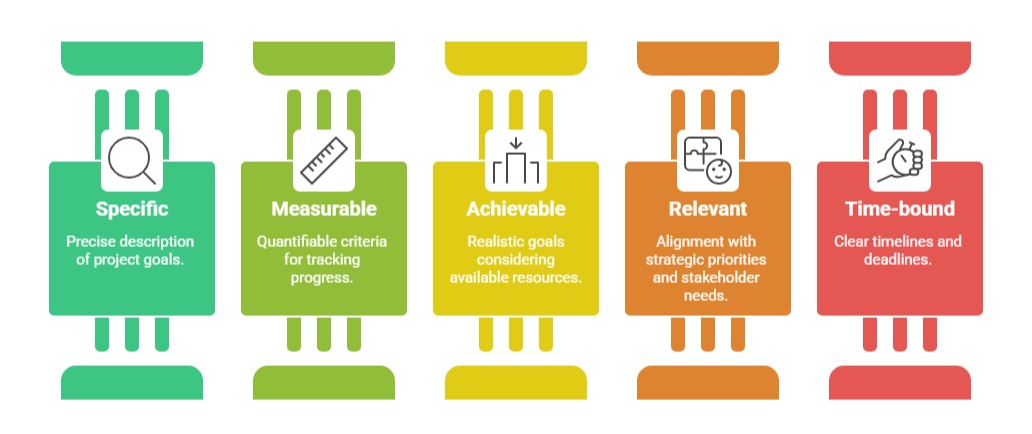
SMART objectives provide clarity, focus, and accountability throughout the project lifecycle.
Establishing Success Metrics and Business Impact Targets
Establishing success metrics and business impact targets involves defining key performance indicators (KPIs) that align with project goals and desired outcomes, such as increased revenue, reduced costs, or improved efficiency.
Both quantitative and qualitative measures are used to assess progress and determine success.
Baseline values and target thresholds are set according to organizational benchmarks, and continuous monitoring of these metrics provides real-time feedback for iterative improvement.
Clearly defined metrics enable objective evaluation and effective communication of the project’s value.
Outlining Data Sources, Tools, and Resource Requirements
Outlining data sources, tools, and resource requirements involves identifying both internal and external data essential for analysis and modeling.
It includes specifying the software, hardware, and analytical tools needed to achieve project objectives, as well as considering human resources, including skills, expertise, and team composition.
Budget, time, and infrastructure constraints must also be accounted for, alongside strategies to address data quality, accessibility, and security. Comprehensive resource planning ensures smooth project execution and helps mitigate operational risks.

Class Sessions
Sales Campaign

We have a sales campaign on our promoted courses and products. You can purchase 1 products at a discounted price up to 15% discount.