USD ($)
$
United States Dollar
Euro Member Countries
India Rupee
د.إ
United Arab Emirates dirham
ر.س
Saudi Arabia Riyal

Hypothesis Testing Framework

Lesson 17/52 | Study Time: 15 Min

Hypothesis testing is a cornerstone of data-driven business decision-making, providing a formal, statistical process to validate assumptions or claims using sample data.

By framing clear hypotheses and rigorously testing them, organizations minimize risks and make evidence-based choices, optimizing strategies like marketing campaigns, product development, and operational improvements.

Null and Alternative Hypotheses: Formulation and Business Context

Null Hypothesis (H0): Represents the default or status quo assumption, typically indicating no effect or difference.

Alternative Hypothesis (H1 or Ha): Proposes a change or effect that the analysis aims to support.

In business, for example, a company may hypothesize that a new advertising campaign (H1) increases sales, while the null hypothesis assumes it has no impact (H0). Testing aims to determine if observed data provide enough evidence to reject H0 in favor of H1.

Type I and Type II Errors: Significance Level and Power in Business Decisions

Type I Error (α): Incorrectly rejecting the null hypothesis when it is true (false positive). The significance level, typically set at 5%, controls this risk.

Type II Error (β): Failing to reject the null hypothesis when the alternative is true (false negative).

Power of Test (1-β): Probability of correctly detecting a true effect. Higher power reduces Type II errors.

Balancing these errors is crucial in business, where false positives may waste resources and false negatives may miss opportunities.

One-Tailed and Two-Tailed Tests: Choosing the Appropriate Direction
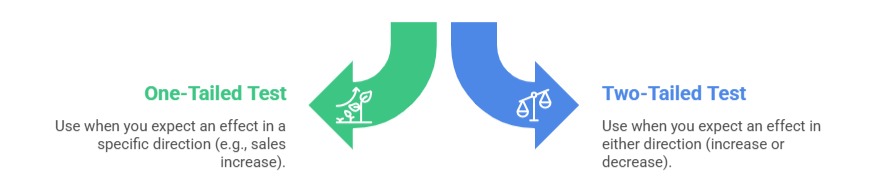

Choosing between them depends on business questions and hypotheses. One-tailed tests increase power but risk missing effects in the opposite direction.

P-Values and Statistical Significance Interpretation

P-Value: Probability of observing the test results assuming the null hypothesis is true.

Statistical Significance: Typically, p-values below the significance level (e.g., 0.05) lead to rejecting H0.


Interpreting p-values correctly is vital: a small p-value suggests strong evidence against H0 but does not measure effect size or business importance.

Evan Brooks

Evan Brooks

Product Designer
Profile

Class Sessions

1- Introduction to Business Analytics 2- Types of Business Analytics 3- Analytics Frameworks and Problem-Solving Approaches 4- Analytics Career Path and Professional Skills 5- Identifying and Defining Business Problems 6- Analytical Context and Business Alignment 7- SMART Objectives and Success Metrics 8- Stakeholder Engagement and Decision Framework 9- Introduction to Databases and SQL Fundamentals 10- Data Retrieval and Query Writing 11- Data Preparation and Cleaning 12- Data Organization and Transformation 13- Descriptive Statistics 14- Data Visualization Fundamentals 15- Probability Concepts for Business 16- Sampling and Data Collection Methods 17- Hypothesis Testing Framework 18- Statistical Tests for Business Applications 19- Real-World Business Applications of Hypothesis Testing 20- Confidence Intervals and Decision-Making 21- Excel Functions and Formulas 22- Pivot Tables and Advanced Reporting 23- Data Modeling and Analysis Tools 24- Scenario Analysis and Optimization 25- Data Visualization Principles and Design 26- Storytelling with Data 27- Tool Proficiency: Tableau and Power BI 28- Executive Communication and Presentation 29- Customer Analytics Fundamentals 30- Market Segmentation Strategies 31- Churn Analysis and Retention Modeling 32- Personalization and Customer Experience Optimization 33- Operational Analytics Framework 34- Demand Forecasting and Inventory Management 35- Supply Chain Optimization 36- Simulation and What-If Analysis 37- Fundamentals of Predictive Modeling 38- Regression Analysis for Forecasting 39- Time Series Forecasting 40- Business Applications of Predictive Modeling 41- Machine Learning Fundamentals 42- Classification Models 43- Real-World Machine Learning Applications 44- Machine Learning Considerations for Business 45- Financial Data Analysis 46- Cost Analysis and Optimization 47- Pricing Analytics 48- Investment and Risk Analysis 49- Project Scope and Problem Definition 50- End-to-End Analytics Workflow 51- Business Recommendation Development 52- Professional Presentation and Communication