Simulation and what-if analysis are powerful methods used in business to explore uncertainties, optimize decisions, and evaluate alternative strategies under varying conditions.
These techniques enable companies to model complex systems, assess risk, and support strategic planning using data-driven insights.
Monte Carlo Simulation for Uncertainty Modeling
Monte Carlo simulation uses random sampling and statistical modeling to estimate the probability distribution of potential outcomes in uncertain systems.
By running thousands of simulations, businesses can understand risks and variability in financial forecasts, project timelines, and inventory demand.
For example, a company analyzing project costs can model different cost scenarios and their likelihoods, helping to plan budgets with risk buffers.
Monte Carlo simulations provide probabilistic forecasts rather than single-point estimates, enabling nuanced decision-making.
Sensitivity Analysis: Testing Impact of Variable Changes on Operations
Sensitivity analysis evaluates how changes in input variables influence output results, identifying critical factors that drive performance. It explores one or multiple inputs systematically, measuring their effect sizes.
In business operations, sensitivity analysis helps prioritize resource allocation by focusing on variables that considerably affect profitability, cycle times, or customer satisfaction.
It also supports risk assessment by identifying assumptions that significantly impact outcomes.
Scenario Modeling: Evaluating Alternative Operational Strategies
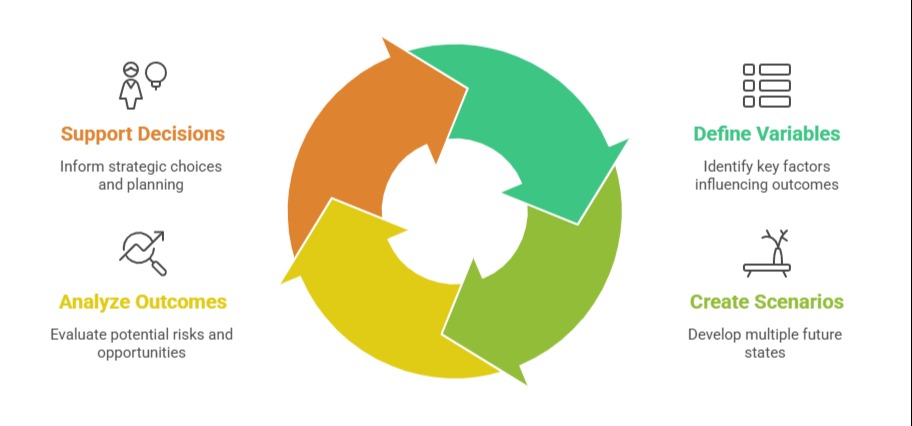
Scenario modeling involves creating and comparing multiple plausible future states or operational setups by adjusting sets of variables simultaneously.
Businesses use it to examine “what-if” cases such as best-case, worst-case, or most-likely scenarios.
This method supports contingency planning, capacity management, and strategic decision-making by revealing potential risks and opportunities across diverse conditions.
Decision Trees: Structuring Complex Operational Decisions
Decision trees are graphical models that map decisions, possible events, and outcomes in a structured format. They clarify complex decision pathways by showing choices, chance events, and consequences, often including probability and cost-benefit analysis.
In operational contexts, decision trees assist in selecting optimal routes for resource allocation, assessing trade-offs between alternatives, and visualizing risks. They are especially useful when decisions involve multiple stages or uncertain outcomes.

Class Sessions
Sales Campaign

We have a sales campaign on our promoted courses and products. You can purchase 1 products at a discounted price up to 15% discount.