USD ($)
$
United States Dollar
Euro Member Countries
India Rupee
د.إ
United Arab Emirates dirham
ر.س
Saudi Arabia Riyal

Demand Forecasting and Inventory Management

Lesson 34/52 | Study Time: 15 Min

Demand forecasting and inventory management are critical components of supply chain optimization, helping businesses predict customer demand accurately and maintain optimal stock levels.

By analyzing historical demand patterns and using robust forecasting techniques, companies can reduce costs associated with overstocking and stockouts.

These practices improve customer satisfaction through better product availability while optimizing cash flow and warehouse space.

Analyzing Historical Demand Patterns and Seasonality

Understanding past sales trends and seasonal fluctuations is the foundation of demand forecasting.

Businesses analyze time series data to identify patterns such as periodic spikes during holidays or low demand in off-seasons. These insights help anticipate future requirements more accurately.

For example, winter clothing retailers observe higher sales in colder months, adjusting inventory procurement accordingly to prevent shortages or excess stock.

Forecasting Techniques: Time Series Analysis and Trend Projection

Several forecasting techniques help project future demand:
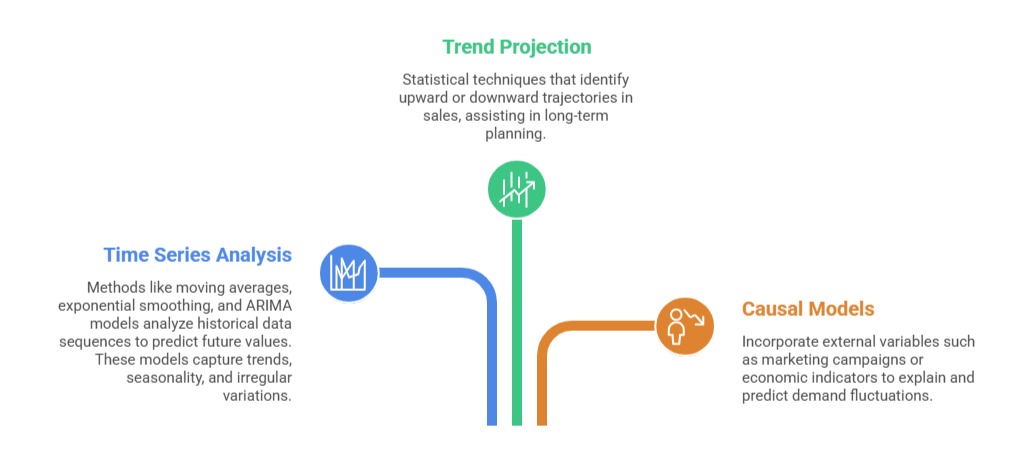

Combining methods often yields more robust forecasts supporting dynamic business environments.

Inventory Optimization: Balancing Stock Levels with Demand Uncertainty

Inventory optimization aims to balance holding costs and stockout risks.

Businesses maintain safety stock—extra inventory to cover unexpected demand spikes or supply delays—to ensure availability. Inventory policies like Just-in-Time (JIT) reduce holding costs while meeting demand promptly.

Using forecasting outputs, companies set reorder points and order quantities optimizing the trade-off between service levels and costs.

Reducing Stockouts and Overstock Situations Through Predictive Analytics

Predictive analytics use historical data and machine learning models to anticipate demand more precisely, enabling proactive inventory management:


1. Predict demand at SKU, location, and channel levels to allocate resources efficiently.

2. Identify slow-moving items to minimize excess stock and free capital.

3. Adjust procurement dynamically based on real-time sales and market conditions.


Such predictive capabilities minimize lost sales from stockouts and reduce waste from overstock, improving profitability.

Evan Brooks

Evan Brooks

Product Designer
Profile

Class Sessions

1- Introduction to Business Analytics 2- Types of Business Analytics 3- Analytics Frameworks and Problem-Solving Approaches 4- Analytics Career Path and Professional Skills 5- Identifying and Defining Business Problems 6- Analytical Context and Business Alignment 7- SMART Objectives and Success Metrics 8- Stakeholder Engagement and Decision Framework 9- Introduction to Databases and SQL Fundamentals 10- Data Retrieval and Query Writing 11- Data Preparation and Cleaning 12- Data Organization and Transformation 13- Descriptive Statistics 14- Data Visualization Fundamentals 15- Probability Concepts for Business 16- Sampling and Data Collection Methods 17- Hypothesis Testing Framework 18- Statistical Tests for Business Applications 19- Real-World Business Applications of Hypothesis Testing 20- Confidence Intervals and Decision-Making 21- Excel Functions and Formulas 22- Pivot Tables and Advanced Reporting 23- Data Modeling and Analysis Tools 24- Scenario Analysis and Optimization 25- Data Visualization Principles and Design 26- Storytelling with Data 27- Tool Proficiency: Tableau and Power BI 28- Executive Communication and Presentation 29- Customer Analytics Fundamentals 30- Market Segmentation Strategies 31- Churn Analysis and Retention Modeling 32- Personalization and Customer Experience Optimization 33- Operational Analytics Framework 34- Demand Forecasting and Inventory Management 35- Supply Chain Optimization 36- Simulation and What-If Analysis 37- Fundamentals of Predictive Modeling 38- Regression Analysis for Forecasting 39- Time Series Forecasting 40- Business Applications of Predictive Modeling 41- Machine Learning Fundamentals 42- Classification Models 43- Real-World Machine Learning Applications 44- Machine Learning Considerations for Business 45- Financial Data Analysis 46- Cost Analysis and Optimization 47- Pricing Analytics 48- Investment and Risk Analysis 49- Project Scope and Problem Definition 50- End-to-End Analytics Workflow 51- Business Recommendation Development 52- Professional Presentation and Communication

Sales Campaign

Sales Campaign

We have a sales campaign on our promoted courses and products. You can purchase 1 products at a discounted price up to 15% discount.