Statistical tests are fundamental tools in business analytics, enabling firms to rigorously evaluate differences, associations, or effects within their data.
These tests help confirm whether observed results are meaningful or due to chance, guiding decisions in marketing strategies, product development, quality control, and beyond.
Key tests include t-tests for comparing two groups, chi-square tests for categorical relationships, ANOVA for multiple group comparisons, and effect size measurements to assess practical significance.
T-Tests: Comparing Means Between Two Groups (A/B Testing)
The t-test is used to determine if the means of two independent or related groups significantly differ. It assesses if changes, such as new product features or marketing campaigns, result in measurable performance improvements.
1. Independent t-test: Compares means of two unrelated groups (e.g., sales in two regions).
2. Paired t-test: Compares same-group means before and after an intervention (e.g., customer satisfaction pre- and post-service change).
In business, t-tests underpin A/B testing where two variants are compared to identify superior strategies.
Chi-Square Tests: Analyzing Categorical Data and Independence
The chi-square test evaluates relationships between categorical variables, checking if distributions differ from expectations or if variables are independent.
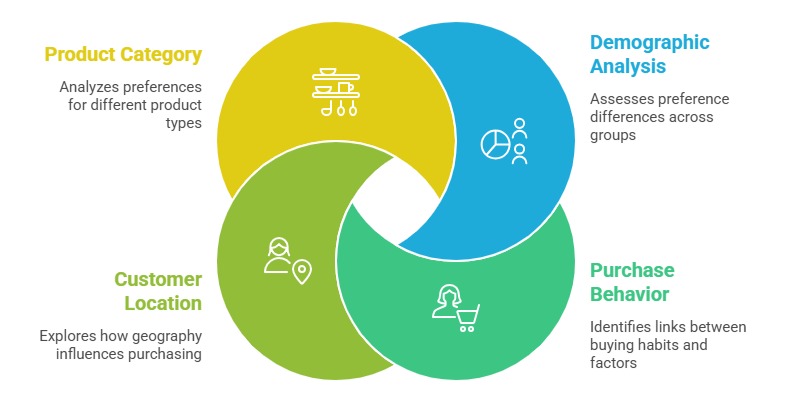
Example: A retailer testing if brand preference varies by region uses chi-square to validate targeting strategies.
ANOVA (Analysis of Variance): Comparing Multiple Groups Simultaneously
ANOVA extends hypothesis testing to more than two groups, examining if at least one group mean differs significantly.
1. It helps compare sales performance across multiple store locations, product variations, or time periods.
2. Enables efficient analysis by testing all groups simultaneously rather than multiple pairwise tests.
ANOVA supports complex experiment designs, facilitating better business decisions by revealing overall group differences.
Effect Size Measurement and Practical Significance
While statistical tests indicate whether differences are likely not due to chance, effect size quantifies the magnitude of those differences, indicating real-world impact.
1. Common metrics include Cohen’s d and correlation coefficients.
2. Effect sizes are categorized as small, medium, or large, guiding business relevance.
3. They help avoid overemphasis on statistically significant but practically trivial results.
Effect size evaluation complements hypothesis testing, ensuring decisions are both statistically and operationally meaningful.

Class Sessions
Sales Campaign

We have a sales campaign on our promoted courses and products. You can purchase 1 products at a discounted price up to 15% discount.