Databases are central to storing, organizing, and managing data for efficient access and analysis. Relational databases, the most common type used in business environments, organize data into structured tables, making it easy to retrieve and relate information.
Relational Database Concepts and Structure
A relational database stores data in tables (also called relations), which consist of rows and columns:
Rows (Tuples): Represent individual records or entities, such as a customer, order, or product.
Columns (Attributes): Define the properties or fields of the entity, like Customer_ID, Name, or Purchase_Date.
Each table has a primary key, a unique identifier for its rows, ensuring each record can be uniquely found. Tables are related through keys, allowing data to be combined and queried efficiently. The relational model emphasizes:
1. Atomicity: Each data value is indivisible (no nested or multi-valued fields).
2. Data Integrity: Rules ensure accuracy and consistency of data.
3. Normalization: Structuring tables to reduce redundancy and dependency.
Relational databases use schemas to define the structure of tables and relationships, often derived from conceptual designs like ER diagrams.
SQL Basics: SELECT, WHERE, ORDER BY
SQL is used to query and manipulate data in relational databases. Key SQL commands include:
1. SELECT: Retrieves data from one or more tables.
Example: SELECT Customer_ID, Name FROM Customers;
2. WHERE: Filters rows based on specified conditions.
Example: SELECT * FROM Orders WHERE Order_Date = '2025-01-01';
3. ORDER BY: Sorts query results by one or more columns.
Example: SELECT Name FROM Customers ORDER BY Name ASC;
These commands allow users to perform simple to complex queries, helping to extract meaningful insights.
Understanding Database Architecture and Data Models
Relational database architecture separates data storage from logical data models:
Logical Level: Defines what data is stored and how relationships between data points are formed, expressed through tables and relationships.
Physical Level: Describes how data is actually stored in hardware, file systems, or cloud storage.
This separation enables flexibility in managing data and application development. Common data models include:
1. Hierarchical: Data is organized in a tree-like structure.
2. Network: Allows multiple relationships between records.
3. Relational: Uses tables and relationships, prevailing in business environments.
Types of Databases: SQL Server, MySQL, PostgreSQL, Oracle
Several popular relational database management systems (RDBMS) are widely used in enterprises:
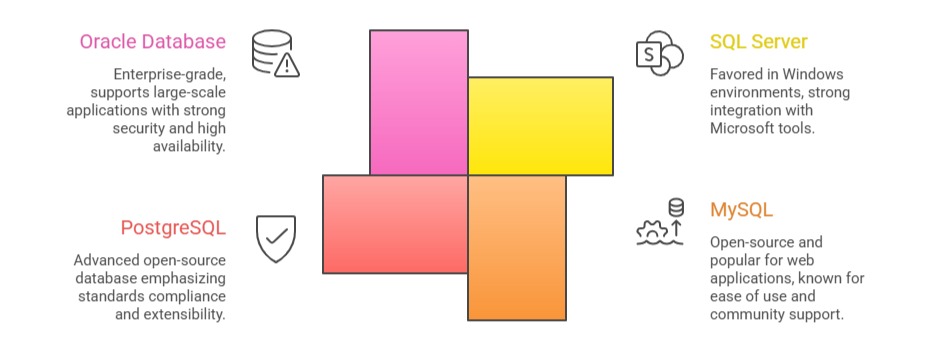
All use SQL as the foundational query language but vary in features, scalability, and licensing.

Class Sessions
Sales Campaign

We have a sales campaign on our promoted courses and products. You can purchase 1 products at a discounted price up to 15% discount.