Investment and risk analysis are fundamental processes in strategic financial management, guiding businesses in evaluating opportunities, planning for uncertainties, and maximizing returns.
Through capital budgeting, scenario analysis, risk identification, and ROI calculations, companies systematically assess the viability and profitability of investments while proactively managing financial risks.
Capital Budgeting Decisions: Evaluating Investment Opportunities
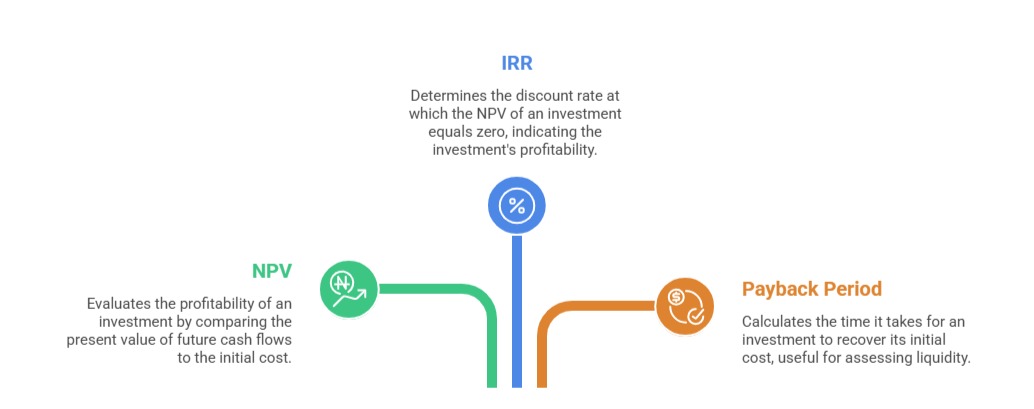
Capital budgeting involves evaluating long-term investments or projects to determine which options offer the best financial and strategic returns.
Using methods such as Net Present Value (NPV), Internal Rate of Return (IRR), and the Payback Period, organizations estimate future cash flows, discount them to present value, and compare these values against initial costs to assess profitability.
This process helps prioritize projects that align with strategic objectives and meet financial performance criteria.
Example: A company assessing new manufacturing equipment factors expected cost savings, installation costs, and project lifespan.
Scenario Analysis for Financial Planning
Scenario analysis evaluates how different future conditions such as best-case, worst-case, and most-likely scenarios—affect financial outcomes.
It helps organizations forecast revenue, costs, cash flow, and returns under varying assumptions related to market dynamics, operational shifts, or external disruptions.
By combining quantitative modeling with qualitative judgment, scenario analysis supports the development of strong contingency plans. This approach enhances strategic flexibility and promotes risk-informed decision-making.
Risk Assessment: Identifying Financial Vulnerabilities
Risk assessment identifies financial vulnerabilities arising from market volatility, credit exposures, operational failures, or regulatory changes.
It employs techniques such as qualitative evaluations, statistical analyses like Value at Risk, and stress testing to measure potential impacts.
By understanding these risks, businesses can implement mitigation strategies including diversification, hedging, or insurance. Effective risk quantification also supports informed capital allocation and helps define an organization’s risk appetite.
Return on Investment (ROI) Calculations and Business Case Development
Return on Investment (ROI) measures the profitability of an investment by calculating net profit as a percentage of the initial cost, helping organizations evaluate the financial viability of various projects.

High-ROI initiatives are typically prioritized because they align with business objectives and justify resource allocation.
A strong business case incorporates ROI calculations along with qualitative benefits, potential risks, and strategic alignment to support informed decision-making.
Ongoing monitoring of realized ROI ensures continuous improvement, accountability, and better planning for future investments.

Class Sessions
Sales Campaign

We have a sales campaign on our promoted courses and products. You can purchase 1 products at a discounted price up to 15% discount.