Hypothesis testing is a powerful statistical tool widely used across various business domains to make informed decisions and validate strategies. By testing assumptions with data, businesses can reduce risks, optimize operations, and enhance customer satisfaction.
A/B Testing for Marketing Campaigns and Pricing Decisions
A/B testing involves comparing two versions of a marketing campaign, webpage, or product pricing to determine which performs better.
Application: By dividing customers randomly into two groups and exposing each to different versions, businesses use hypothesis testing to assess statistically significant differences in outcomes such as click-through rates or sales.
Example: An e-commerce company tests if offering free shipping (variant A) increases sales compared to no free shipping (variant B). Hypothesis testing evaluates if observed differences are due to the strategy rather than chance.
Benefit: Enables data-driven marketing strategies that improve customer engagement and revenue optimization.
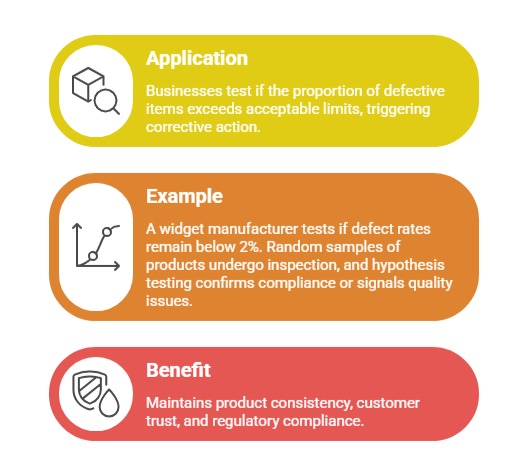
Quality Control: Testing if Defect Proportions Exceed Threshold
Hypothesis testing is essential in manufacturing and service operations to ensure products meet quality standards.
Process Improvement: Validating Operational Changes with Statistical Evidence
Organizations use hypothesis testing to evaluate the effectiveness of process changes like new workflows, technologies, or training.
Application: By comparing key performance indicators (e.g., throughput time, error rates) before and after intervention, hypothesis testing statistically assesses improvements.
Example: A call center implements a new script and tests if average call handling time decreases significantly, supporting continued investment and broader rollout.
Benefit: Provides evidence-based validation of operational enhancements, facilitating continuous improvement.
Market Research Applications: Validating Consumer Preferences and Behaviors
Hypothesis testing supports market researchers in understanding customer attitudes, preferences, and responses to marketing efforts.
Application: Surveys or experiments generate data analyzed to test assumptions about brand awareness, purchase intentions, or product satisfaction.
Example: A beverage company hypothesizes that a new advertising campaign increases brand awareness. Pre- and post-campaign survey results are tested to confirm effectiveness.
Benefit: Informs product development, positioning, and promotional strategies.

Class Sessions
Sales Campaign

We have a sales campaign on our promoted courses and products. You can purchase 1 products at a discounted price up to 15% discount.