Identifying and defining business problems is a critical first step in any analytics or improvement initiative.
Proper problem recognition helps organizations understand gaps between current performance and desired outcomes, enabling targeted actions for resolution.
Clear problem statements provide a foundation for focused analysis, ensuring that resources and efforts address the most impactful issues.
Problem Recognition
Problem recognition involves observing discrepancies between how things are and how they ideally should be. It may arise through performance gaps, market feedback, customer complaints, or declining financial indicators.
These gaps highlight inefficiencies, lost opportunities, risk exposures, or unsatisfactory outcomes requiring investigation.
Examples of detected problems:
1. Sales declining below targets
2. Production delays causing missed deadlines
3. Increasing customer churn rates
4. Rising operational costs impacting profitability
Recognizing a problem early allows organizations to address issues before they escalate, preserving competitive advantage and stakeholder confidence.
Problem Categorization
Once problems are recognized, categorizing them helps prioritize and tailor analyses. Common categories include:
1. Cost Optimization: Identifying inefficiencies to reduce expenses without sacrificing quality or output.
2. Revenue Improvement: Exploring ways to increase sales, customer acquisition, or average transaction value.
3. Risk Mitigation: Understanding vulnerabilities and uncertainties to minimize potential losses or compliance issues.
4. Efficiency Enhancement: Streamlining processes, reducing waste, and improving operational workflows.
This categorization informs the selection of appropriate analytical methods and resource allocation for maximal business impact.
Clarifying Ambiguous Problem Statements and Scope Management
Ambiguously defined problems can misdirect resources and cause analytic efforts to be unfocused or ineffective. Clear problem articulation and scope management are essential to maintaining alignment between analytics and business objectives.
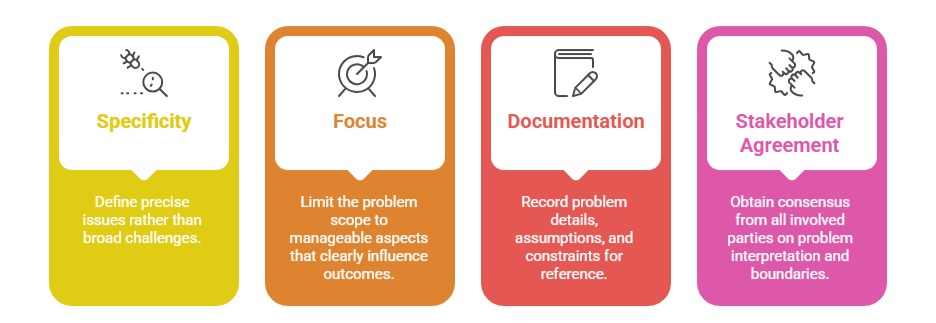
Effective scope control prevents project creep and supports timely, actionable results.
Techniques for Problem Articulation
Five Whys Analysis: This iterative technique involves asking "why" five times (or until the root cause is found), moving beyond symptoms to uncover fundamental problems.
For example:
Problem: Customer orders are delayed.
Why? Because production lines are frequently halted.
Why? Because equipment failures occur often.
Why? Because maintenance schedules are irregular.
Why? Because the maintenance team is understaffed.
Why? Because of budget cuts.
Addressing the root cause (understaffing) is more effective than just fixing equipment temporarily.
Root Cause Identification: Beyond the Five Whys, root cause analysis systematically investigates all plausible causes through data collection, cause-and-effect diagrams (Fishbone diagrams), and process mapping. It ensures comprehensive understanding and prevents misdiagnosis.