Microsoft Excel is a powerful tool for business analytics, enabling data retrieval, summarization, and complex calculations through various functions and formulas. Mastery of advanced Excel functions enhances efficiency in analyzing large datasets, identifying trends, and generating actionable insights.
Advanced Functions: VLOOKUP, INDEX-MATCH, SUMIF, COUNTIF
VLOOKUP: Searches for a value in the first column of a table and returns a value in the same row from another column. Commonly used to fetch related data from tables.
Example: Looking up a product price based on product ID.
INDEX-MATCH: A flexible alternative to VLOOKUP, combining INDEX to return a value from a position and MATCH to find the position of a lookup value. Offers more accuracy and flexibility, especially when columns are added or rearranged.
Example: Fetching employee details from dynamic tables.
SUMIF: Adds values in cells that meet a given criteria.
Example: Calculating total sales for a specific region.
COUNTIF: Counts the number of cells that meet a specific condition.
Example: Counting customers who purchased more than once.
Conditional Formatting for Visual Data Exploration and Pattern Recognition
Conditional formatting applies visual cues such as colors or icons to highlight data patterns, anomalies, or key metrics quickly:
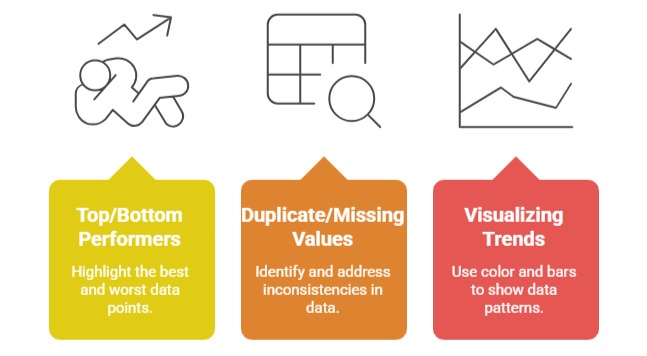
This feature simplifies data interpretation and helps prioritize actions.
Array Formulas and Dynamic Calculations for Complex Analyses
Array formulas perform multiple calculations on one or more items in arrays, enabling complex data manipulation:
1. Processing multiple ranges or criteria without helper columns.
2. Performing matrix operations or multi-condition aggregations.
These formulas dynamically update as input data changes, providing powerful, flexible analytics capabilities.
Financial and Statistical Functions Applicable to Business Scenarios
Financial Functions: NPV (Net Present Value), IRR (Internal Rate of Return), PMT (Loan Payment), FV (Future Value) help evaluate investments, cash flows, and financing decisions.
Statistical Functions: AVERAGE, MEDIAN, STDEV, VAR, CORREL support summarizing data, measuring variability, and assessing relationships critical for business analysis.
Using these functions accelerates financial modeling, budgeting, forecasting, and risk assessment.