USD ($)
$
United States Dollar
Euro Member Countries
India Rupee
د.إ
United Arab Emirates dirham
ر.س
Saudi Arabia Riyal

Malware Behavior Analysis (Dynamic vs Static)

Lesson 29/44 | Study Time: 25 Min

Malware behavior analysis is a fundamental practice in cybersecurity aimed at understanding the functionality, impact, and indicators of compromise of malicious software.

Effective malware analysis supports threat detection, incident response, and the development of mitigation strategies.

Two primary approaches dominate malware analysis: static and dynamic. Static analysis involves examining the malware without executing it, focusing on code and structure.

Dynamic analysis involves running the malware in a controlled environment to observe its behavior.

Static Malware Analysis

Static analysis inspects malware artifacts without execution, offering a safe and quick method to extract insights.


Key Aspects of Static Analysis:


1. File Examination: Analyze executable files, scripts, or binaries.

2. Disassembly and Decompilation: Use tools to convert binary code into assembly or higher-level language for inspection.

3. Signature and Hash Matching: Compare files against known malware databases to identify variants.

4. String Analysis: Extract readable text strings within binaries that may reveal URLs, commands, or payload details.

5. Structure and Header Analysis: Inspect file headers, PE (Portable Executable) sections, and embedded resources.

6. Code Flow and Pattern Recognition: Analyze control flow graphs to understand program structure and suspicious patterns.


Benefits: Absence of any risk of system infection, allowing safe examination of potentially harmful files. This approach also enables early intelligence generation before a full sandbox environment is set up, making it especially useful for processing and analyzing large batches of samples efficiently.


Tools:


1. IDA Pro, Ghidra (disassemblers)

2. Strings utility

3. YARA rules (pattern matching)

4. PEStudio (file metadata analysis)

Dynamic Malware Analysis

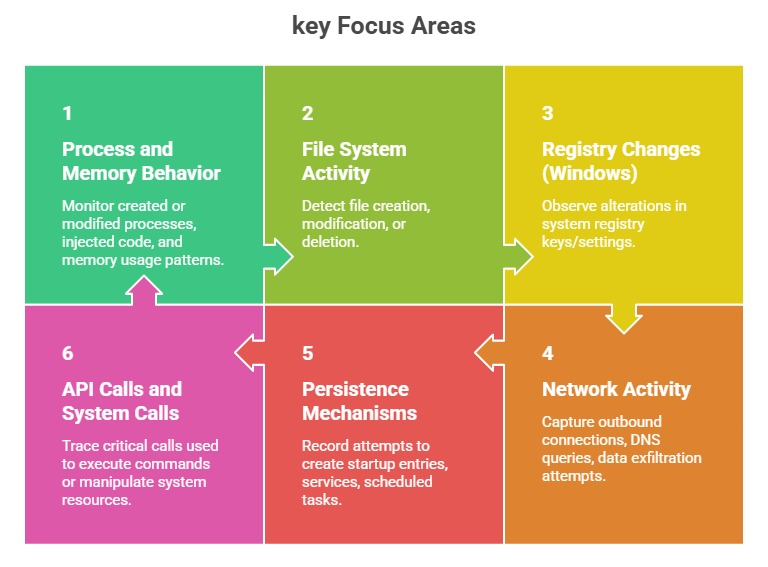
Dynamic analysis involves executing malware within a controlled, instrumented environment (sandbox) to observe its real-time behavior.
or 

Benefits: Uncovering runtime behavior and tactics that may be hidden through code obfuscation, offering deeper visibility into how malware actually operates. It also helps detect payloads that execute only under specific environmental conditions and provides rich indicators of compromise (IOCs), enabling stronger detection and response efforts.


Tools:


1. Cuckoo Sandbox, Any.Run

2. Process Monitor, Wireshark

3. Sysinternals Suite

4. Frida for live instrumentation

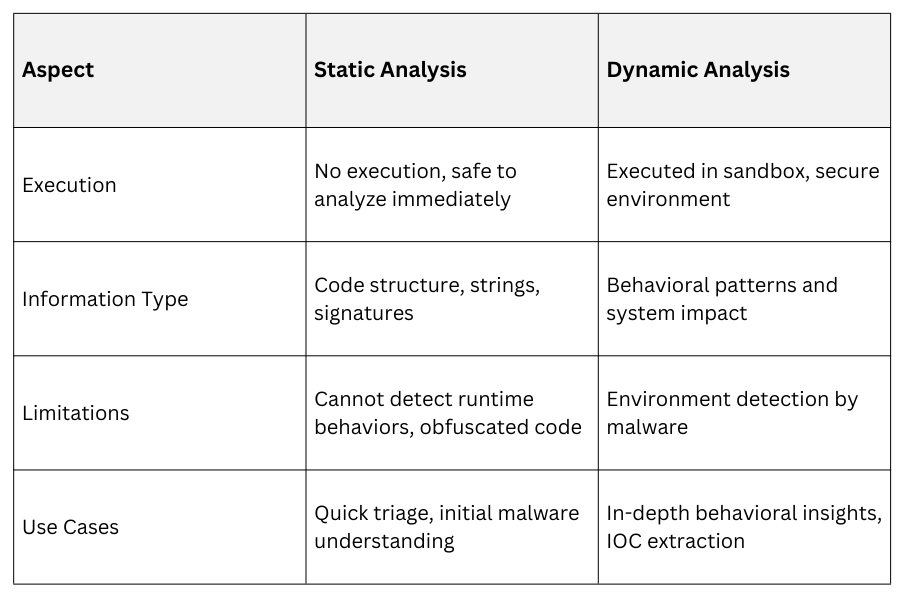
Complementary Nature of Static and Dynamic Analysis

Best Practices for Malware Analysis


1. Combine static and dynamic methods to gain comprehensive understanding.

2. Use isolated, instrumented environments for dynamic analysis to prevent spread.

3. Automate with sandbox technologies for scalability.

4. Archive analysis artifacts and reports for threat intelligence sharing.

5. Continuously update analysis tools to cope with evolving malware techniques.

Jake Carter

Jake Carter

Product Designer
Profile

Class Sessions

1- Deep Passive Reconnaissance 2- Active Reconnaissance Techniques 3- Traffic Analysis & Packet Crafting Fundamentals 4- Identifying Attack Surface Expansion Paths 5- Advanced Network Mapping & Host Discovery 6- Bypassing Firewalls & IDS/IPS 7- Man-in-the-Middle Attacks (ARP Spoofing, DNS Manipulation) 8- VLAN Hopping, Port Security Weaknesses, and Network Segmentation Testing 9- Windows & Linux Privilege Escalation: Advanced Enumeration & Kernel-Level Attack Paths 10- Exploiting Misconfigurations & File/Service Permission Abuse 11- Bypassing UAC, sudo, and Restricted Shells 12- Credential Dumping & Token/Key Abuse 13- Persistence Techniques (Registry, Scheduled Tasks, SSH Keys) 14- Tunneling & Port Forwarding (SOCKS Proxy, SSH Tunnels, Chisel Basics) 15- Pivoting in Multi-Layered Networks 16- Data Exfiltration Concepts & OPSEC Considerations 17- Server-Side Attacks (Advanced SQL Injection, Template Injection, Server-Side Template Injection - SSTI) 18- Authentication & Authorization Attacks (JWT Abuse, Session Misconfigurations) 19- SSRF, XXE, Deserialization & Logic Flaw Identification 20- Advanced API Security Testing (Token Handling, Rate-Limiting Bypass Concepts) 21- Wi-Fi Security Attacks (WPA3 Considerations, Enterprise Networks) 22- Rogue APs & Evil Twin Concepts 23- Mobile App Security Overview (Android & iOS Attack Surface, Static/Dynamic Testing) 24- IoT Device Weaknesses (Firmware Analysis Basics, Insecure Protocols, Hardcoded Credentials) 25- Cloud Service Models & Shared Responsibility (AWS, Azure, GCP basics) 26- Cloud Misconfigurations (IAM, Storage Buckets, Exposed Services) 27- Container & Kubernetes Security (Namespaces, Privilege Escalations, Misconfigurations) 28- Virtualization Weaknesses & Hypervisor Attack Concepts 29- Malware Behavior Analysis (Dynamic vs Static) 30- Exploit Development Concepts (Buffer Overflow Fundamentals, Shellcode Basics) 31- Reverse Engineering Essentials (Strings, Disassembly, Logic Flow Understanding) 32- Detection & Evasion Techniques (Sandbox Evasion Concepts) 33- Automating Recon & Scans (Python/Bash/PowerShell Basics) 34- Writing Custom Enumeration Scripts 35- Tool Customization (Modifying Payloads, Extending Existing Tools Ethically) 36- Data Parsing, Reporting & Workflow Automation 37- Threat Intelligence Integration & TTP Mapping 38- Attack Path Mapping (MITRE ATT&CK Alignment) 39- Social Engineering Campaign Planning (Ethical Boundaries & Simulations) 40- Blue Team Evasion Concepts (OPSEC, Log Evasion Principles) 41- Structuring Professional Penetration Test Reports 42- Mapping Findings to Risk Ratings (CVSS, Impact Assessment) 43- Presenting Findings to Executives and Technical Teams 44- Prioritizing Remediation and Security Hardening Guidance