USD ($)
$
United States Dollar
Euro Member Countries
India Rupee
د.إ
United Arab Emirates dirham
ر.س
Saudi Arabia Riyal

Credential Dumping & Token/Key Abuse

Lesson 12/44 | Study Time: 20 Min

Credential dumping and token/key abuse represent critical attacks within cybersecurity that enable adversaries to harvest authentication data and misuse access tokens or cryptographic keys to escalate privileges, move laterally, and maintain persistence within compromised environments.

It refers to extracting stored credentials such as hashed passwords, plaintext credentials, or secrets from operating systems or applications.

Token and key abuse involve exploiting access tokens or cryptographic keys issued during authentication to impersonate users or services without needing to know their passwords. 

Credential Dumping: Extracting Sensitive Authentication Data

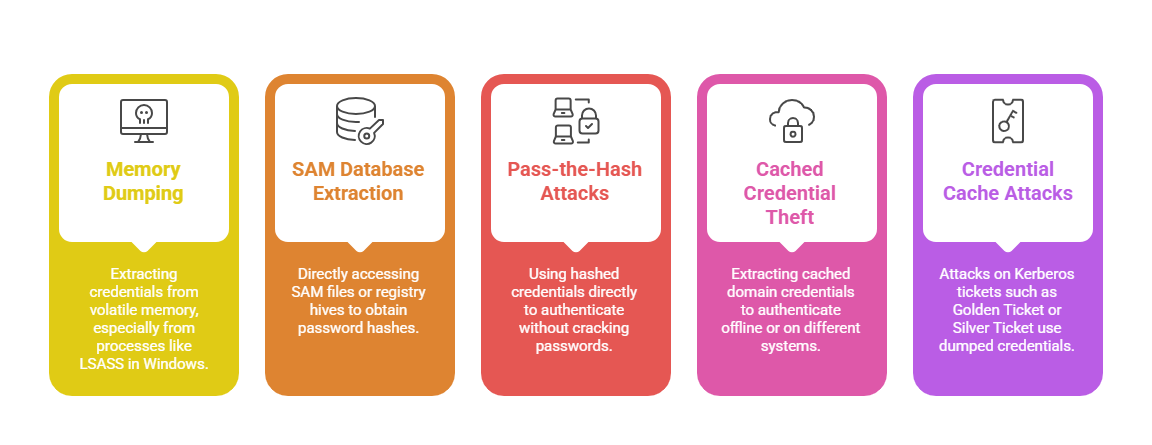
Credential dumping encompasses techniques used to retrieve credentials stored on a system. These credentials can be leveraged to gain unauthorized access to other systems or services, thereby facilitating lateral movement and privilege escalation.


Common Targets for Credential Dumping


1. Windows Security Accounts Manager (SAM) database

2. Local Security Authority Subsystem Service (LSASS) memory

3. Cached domain credentials and password hashes

4. Kerberos tickets and tokens stored in memory

5. Linux /etc/shadow and other authentication-related files


Techniques and Tools

Token and Key Abuse: Leveraging Authentication Artifacts

After successful authentication, systems often issue tokens or keys (e.g., Kerberos tickets, OAuth tokens, API keys) to maintain session continuity.

Attackers who steal these tokens or keys can impersonate users or services to interact with systems with their permissions, bypassing direct credential usage.


Types of Tokens and Keys:


1. Kerberos Tickets: Tickets that authenticate users and services in Active Directory environments.

2. OAuth Tokens: Used for delegated access in cloud services and APIs.

3. JWT (JSON Web Tokens): Used in modern web applications for stateless authentication.

4. API Keys and Secrets: Access credentials for automated and application integrations.


Abuse Techniques:


1. Pass-the-Ticket (PtT): Using stolen Kerberos tickets to gain access to resources as the legitimate user or admin.

2. Token Replay or Theft: Capturing valid tokens from memory or network traffic and reusing them.

3. Token Forgery: Creating or modifying tokens to escalate privileges or extend access.

4. Key Extraction & Use: Extracting keys from insecure storage or memory to gain unauthorized service or API access.

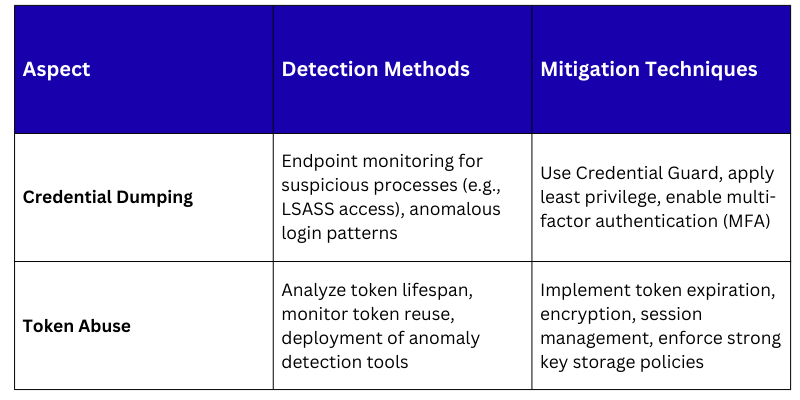
Detection and Mitigation Strategies
Best Practices


1. Employ endpoint security solutions capable of detecting credential dumping activities.

2. Restrict access to critical system processes like LSASS and monitor abnormal access attempts.

3. Implement token binding and short token lifetimes to reduce replay risks.

4. Force re-authentication and token revocation in case of artifacts compromise.

5. Educate users and administrators about phishing and social engineering mitigation.

Jake Carter

Jake Carter

Product Designer
Profile

Class Sessions

1- Deep Passive Reconnaissance 2- Active Reconnaissance Techniques 3- Traffic Analysis & Packet Crafting Fundamentals 4- Identifying Attack Surface Expansion Paths 5- Advanced Network Mapping & Host Discovery 6- Bypassing Firewalls & IDS/IPS 7- Man-in-the-Middle Attacks (ARP Spoofing, DNS Manipulation) 8- VLAN Hopping, Port Security Weaknesses, and Network Segmentation Testing 9- Windows & Linux Privilege Escalation: Advanced Enumeration & Kernel-Level Attack Paths 10- Exploiting Misconfigurations & File/Service Permission Abuse 11- Bypassing UAC, sudo, and Restricted Shells 12- Credential Dumping & Token/Key Abuse 13- Persistence Techniques (Registry, Scheduled Tasks, SSH Keys) 14- Tunneling & Port Forwarding (SOCKS Proxy, SSH Tunnels, Chisel Basics) 15- Pivoting in Multi-Layered Networks 16- Data Exfiltration Concepts & OPSEC Considerations 17- Server-Side Attacks (Advanced SQL Injection, Template Injection, Server-Side Template Injection - SSTI) 18- Authentication & Authorization Attacks (JWT Abuse, Session Misconfigurations) 19- SSRF, XXE, Deserialization & Logic Flaw Identification 20- Advanced API Security Testing (Token Handling, Rate-Limiting Bypass Concepts) 21- Wi-Fi Security Attacks (WPA3 Considerations, Enterprise Networks) 22- Rogue APs & Evil Twin Concepts 23- Mobile App Security Overview (Android & iOS Attack Surface, Static/Dynamic Testing) 24- IoT Device Weaknesses (Firmware Analysis Basics, Insecure Protocols, Hardcoded Credentials) 25- Cloud Service Models & Shared Responsibility (AWS, Azure, GCP basics) 26- Cloud Misconfigurations (IAM, Storage Buckets, Exposed Services) 27- Container & Kubernetes Security (Namespaces, Privilege Escalations, Misconfigurations) 28- Virtualization Weaknesses & Hypervisor Attack Concepts 29- Malware Behavior Analysis (Dynamic vs Static) 30- Exploit Development Concepts (Buffer Overflow Fundamentals, Shellcode Basics) 31- Reverse Engineering Essentials (Strings, Disassembly, Logic Flow Understanding) 32- Detection & Evasion Techniques (Sandbox Evasion Concepts) 33- Automating Recon & Scans (Python/Bash/PowerShell Basics) 34- Writing Custom Enumeration Scripts 35- Tool Customization (Modifying Payloads, Extending Existing Tools Ethically) 36- Data Parsing, Reporting & Workflow Automation 37- Threat Intelligence Integration & TTP Mapping 38- Attack Path Mapping (MITRE ATT&CK Alignment) 39- Social Engineering Campaign Planning (Ethical Boundaries & Simulations) 40- Blue Team Evasion Concepts (OPSEC, Log Evasion Principles) 41- Structuring Professional Penetration Test Reports 42- Mapping Findings to Risk Ratings (CVSS, Impact Assessment) 43- Presenting Findings to Executives and Technical Teams 44- Prioritizing Remediation and Security Hardening Guidance