Virtualization technology underpins modern IT infrastructure by allowing multiple virtual machines (VMs) to run on a single physical host, utilizing hypervisors to manage resource allocation and isolation.
While virtualization brings significant efficiency and scalability benefits, it also introduces unique security challenges.
Virtualization weaknesses and hypervisor attacks exploit flaws within the virtualization layer to break isolation, gain unauthorized access to other VMs or the host, and manipulate or disrupt virtual environments.
Key Virtualization Components and Security Focus
Virtualization architecture is composed of several layers, each introducing unique security challenges. Below is a breakdown of the primary components and their security focus areas.
1. Hypervisors: The core virtualization software that manages VMs. Two primary types:
Type 1 (Bare-Metal): Runs directly on physical hardware (e.g., VMware ESXi, Microsoft Hyper-V).
Type 2 (Hosted): Runs on top of a host OS (e.g., Oracle VirtualBox, VMware Workstation).
2. Virtual Machines (VMs): Isolated guest operating systems running on top of hypervisors.
3. Virtual Network Components: Virtual switches, routers, and network interface cards (vNICs) that enable VM communication.
Common Virtualization Weaknesses
Understanding the common security gaps in virtualization is essential for maintaining a resilient infrastructure. The following points highlight the key weaknesses organizations must watch for.
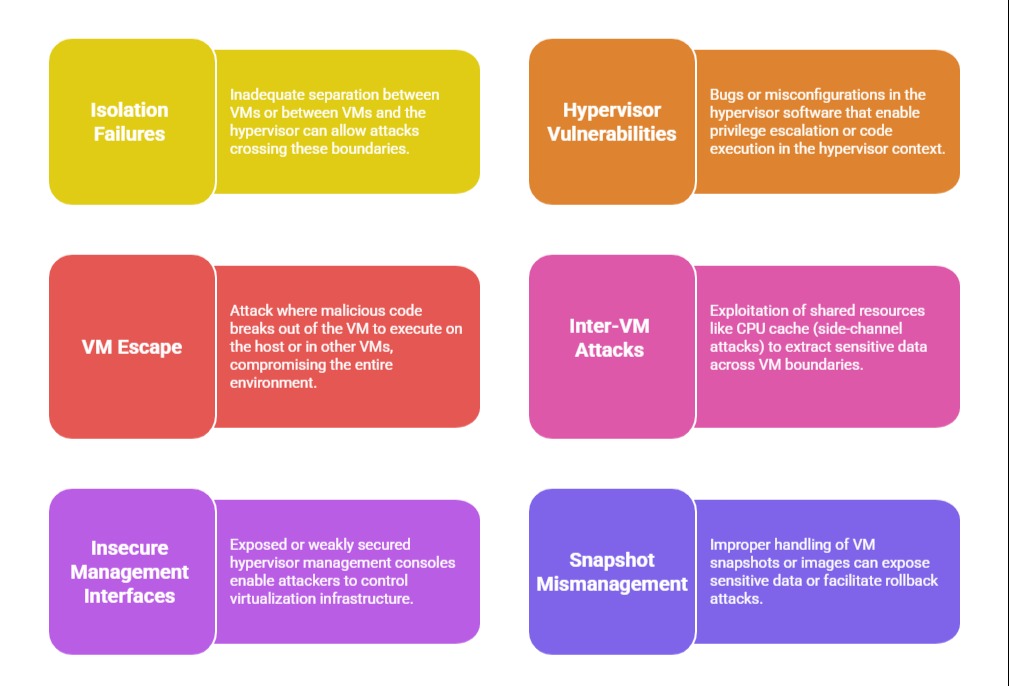
Hypervisor Attack Concepts
Since the hypervisor controls all virtual machines, any compromise can have severe consequences. Listed below are common attack approaches aimed at exploiting hypervisor weaknesses.
1. VM Escape Techniques: Attackers exploit hypervisor vulnerabilities or misconfigurations to break VM isolation. This may involve leveraging bugs in device drivers, shared memory, or hypercall interfaces.
2. Hypervisor Rootkits: Malicious hypervisors or rootkits installed beneath or alongside legitimate hypervisors to manipulate guest VMs stealthily.
3. Side-Channel Attacks: Exploiting shared CPU caches or other hardware resources to infer data processed by other VMs.
4. Denial of Service (DoS): Attacks targeting hypervisor resources to disrupt services of multiple VMs simultaneously.
5. Management Plane Compromise: Gaining unauthorized access to hypervisor management interfaces to orchestrate wide-reaching attacks across VMs.
Mitigation Strategies
A hardened virtualization stack can significantly limit attacker opportunities. Below are core mitigation techniques that address common vulnerabilities in these environments.
1. Regular Hypervisor Patching and Updates: Keeping hypervisor software current reduces exploitable vulnerabilities.
2. Strict Access Controls: Secure management consoles with strong authentication, role-based access control, and limited network exposure.
3. VM Isolation Practices: Employ hardware-assisted virtualization features and minimize VM-to-VM communication.
4. Security Monitoring: Implement dedicated monitoring for hypervisor and VM logs to detect anomalous behavior.
5. Resource Management Controls: Limit snapshot usage and properly secure and audit VM images and backups.
6. Use of Security Extensions: Leverage vendor-specific security mechanisms like Intel VT-x, AMD-V, and Trusted Platform Modules (TPMs).

Class Sessions
Sales Campaign

We have a sales campaign on our promoted courses and products. You can purchase 1 products at a discounted price up to 15% discount.