Traffic analysis and packet crafting are fundamental skills in ethical hacking and cybersecurity that involve examining and manipulating network traffic to understand, test, and secure systems.
Traffic analysis focuses on observing network data flows to infer valuable information such as communication patterns, protocols used, and potential vulnerabilities.
Packet crafting, on the other hand, is the process of creating and sending custom network packets to test how systems respond under various conditions or to exploit weaknesses.
Together, these techniques help ethical hackers simulate attacks, evaluate defenses, and strengthen network security by proactively identifying flaws.
Traffic Analysis – Understanding Network Communications
Traffic analysis involves monitoring and interpreting network packets as they traverse a network. By studying headers, payloads, timing, and flow characteristics, security professionals can detect suspicious activities, diagnose issues, or map network topology.
1. Packet Capture: Capturing traffic using tools like Wireshark or tcpdump allows deep inspection of packets for detailed analysis.
2. Header Examination: Analyzing packet headers reveals source/destination IP addresses, protocols, ports, packet size, flags, and other metadata crucial for understanding communication.
3. Traffic Patterns: Observing frequency, timing, and volume of packets highlights unusual spikes or anomalies that may indicate attacks or misconfigurations.
4. Protocol Analysis: Understanding how different protocols operate (TCP, UDP, ICMP, HTTP, DNS) enables accurate interpretation of captured traffic.
5. Flow Analysis: Using NetFlow or sFlow data assists in summarizing large traffic volumes to detect trends or bottlenecks.
6. Encrypted Traffic: Techniques for analyzing encrypted packets focus on metadata and behavior since payloads are inaccessible without keys.
Packet Crafting – Custom Packet Generation
Packet crafting enables the creation and modification of raw network packets for testing purposes.
It is a critical practice for vulnerability assessment, protocol testing, and simulating attacks, providing insights into how systems react to malformed or unexpected inputs.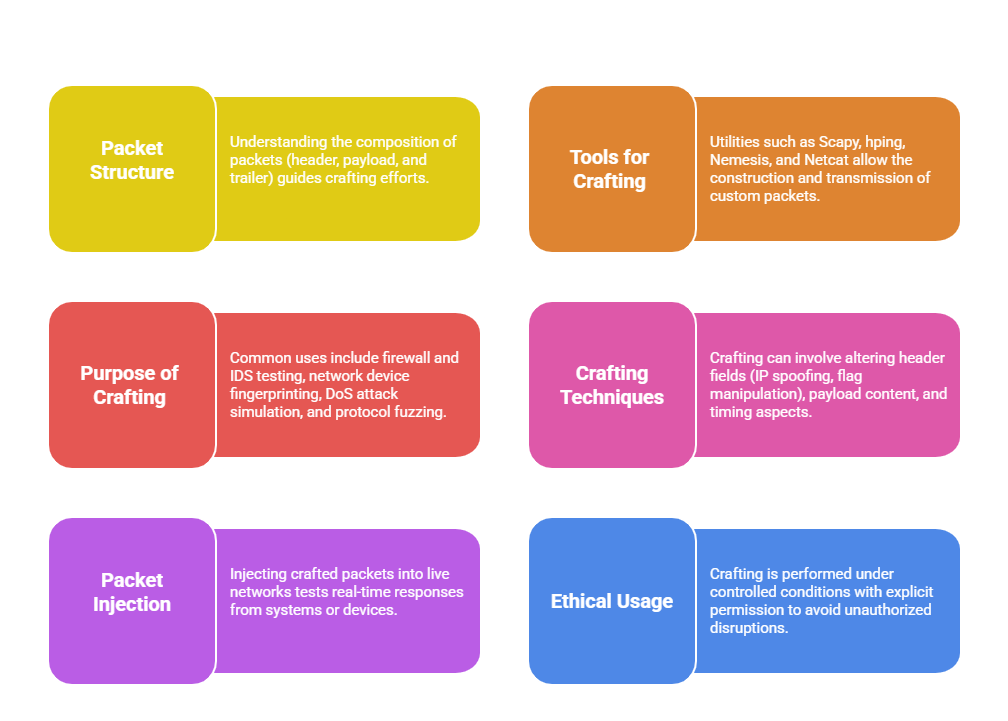
Practical Applications
When applied effectively, these techniques enhance both security posture and operational insight. Below are the primary practical applications.
1. Intrusion Detection: Identifying malicious traffic signatures and attack patterns.
2. Network Troubleshooting: Diagnosing connectivity, latency, or configuration problems.
3. Security Testing: Evaluating firewall rules and IDS responses through crafted probes
4. Protocol Analysis: Understanding protocol behavior under abnormal conditions.
5. Attack Simulation: Replicating attacks like SYN floods, spoofing, or malformed packet injection to test resilience.
Best Practices and Considerations
1. Always obtain explicit authorization before performing active techniques like packet crafting.
2. Use traffic analysis to inform crafting activities for targeted and efficient testing.
3. Maintain detailed records of all crafted packets and analysis results for reporting.
4. Monitor network performance impacts during testing to avoid disruptions.
5. Stay updated on emerging protocols and encryption standards affecting traffic visibility.

Class Sessions
Sales Campaign

We have a sales campaign on our promoted courses and products. You can purchase 1 products at a discounted price up to 15% discount.