In the past, business leaders relied heavily on intuition, experience, and gut feelings to make important decisions. While these qualities still matter, today's competitive landscape demands something more concrete—evidence.
Data has become the foundation of modern decision-making, enabling organizations and individuals to move from assumptions to certainty.
From Guesswork to Evidence
Decision-making without data is like driving blindfolded, you might reach your destination, but the journey will be risky and inefficient. Data provides the visibility needed to navigate complex situations with confidence.
Traditional decision-making often suffers from:
1. Cognitive biases: Personal preferences clouding judgment.
2. Limited perspective: Making choices based on incomplete information.
3. Emotional influence: Letting feelings override facts.
4. Inconsistency: Different people reaching different conclusions from the same situation.
Data-driven decision-making addresses these challenges by grounding choices in objective evidence rather than subjective opinion.
Key Benefits of Data-Driven Decisions
1. Objectivity and Accuracy
Data removes personal bias from the equation. When a marketing team debates which ad campaign to launch, customer engagement metrics provide clear answers. Numbers don't have opinions—they reflect reality.
2. Speed and Efficiency
With the right data infrastructure, decisions that once took weeks can happen in hours. Automated dashboards display real-time metrics, allowing managers to respond quickly to changing conditions. A restaurant chain can adjust inventory across locations overnight based on yesterday's sales data.
3. Risk Reduction
Every decision carries risk, but data helps quantify and minimize it. Financial institutions analyze credit histories before approving loans. Manufacturers test product designs using simulation data before investing in production. Data illuminates potential pitfalls before they become costly mistakes.
4. Measurable Outcomes
Data doesn't just inform decisions, it also measures their success. By tracking key performance indicators (KPIs), organizations can determine whether their choices produced desired results and adjust accordingly. This creates a continuous improvement cycle.
Data-Driven vs. Data-Informed Decisions
There's an important distinction worth noting:
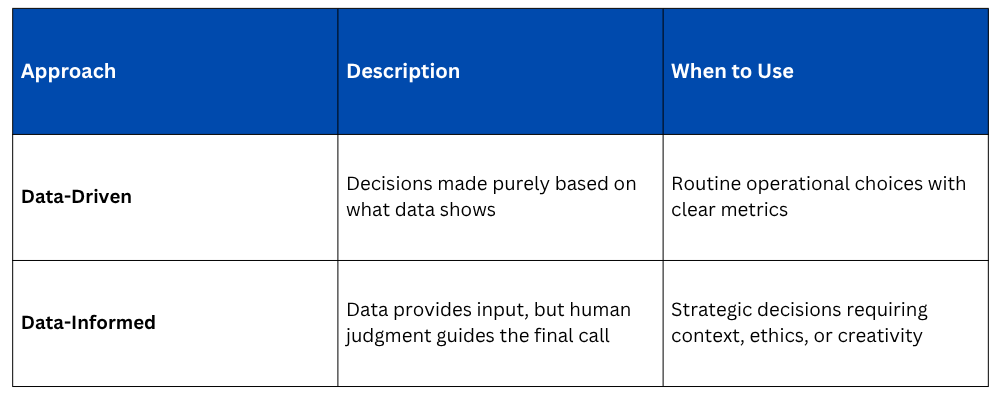
The best decision-makers blend both approaches. Data provides the foundation, but experience and expertise interpret what the numbers truly mean.
Real-World Impact Across Industries
1. Healthcare
Doctors use patient data and medical research to diagnose conditions and recommend treatments. Instead of relying solely on symptoms, they analyze test results, genetic information, and treatment outcomes from similar cases. This evidence-based medicine improves patient survival rates and recovery times.
2. Retail and E-Commerce
Amazon revolutionized shopping by analyzing customer behavior data. Their recommendation engine accounts for roughly 35% of total sales by suggesting products based on browsing history, past purchases, and similar customer patterns. This wouldn't be possible without sophisticated data analysis.
3. Finance
Investment firms analyze market trends, company financials, and economic indicators before allocating billions of dollars. Data models predict stock performance, identify undervalued assets, and flag potential fraud—protecting both investors and institutions.
4. Education
Schools track student performance data to identify struggling learners early. Teachers adjust instruction based on assessment results, ensuring students receive support before falling too far behind. Data reveals which teaching methods work best for different learning styles.
5.Government and Policy
Public health officials used data extensively during the COVID-19 pandemic to track infection rates, allocate medical resources, and determine when to implement or lift restrictions. Census data guides infrastructure investment, ensuring roads, schools, and hospitals are built where populations need them most.
Overcoming Decision-Making Challenges with Data
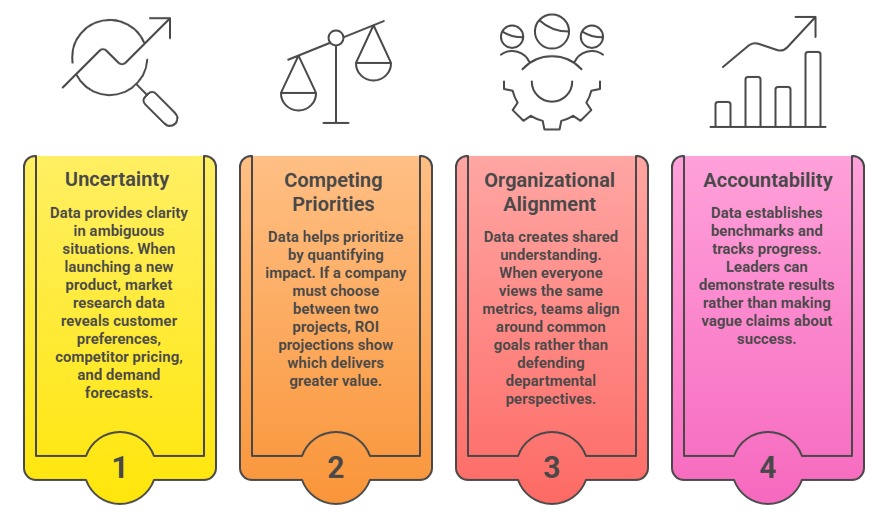
The Human Factor
Despite data's power, it doesn't replace human judgment, it enhances it. Successful decision-makers understand that:
1. Context matters: A sudden sales spike might indicate success or a data entry error.
2. Ethics guide choices: Some profitable decisions might be morally questionable.
3. Creativity sparks innovation: Data shows what is; imagination reveals what could be.
4. Communication is essential: The best insights mean nothing if stakeholders don't understand them.
Data tells you that customer satisfaction dropped 15%. Human insight explains that it happened because you changed the return policy and suggests how to fix it.
Building a Data-Driven Culture
Organizations that excel at data-driven decision-making share common characteristics:
1. Accessibility: Data is available to those who need it, not locked in silos.
2. Literacy: Employees understand how to read and interpret data.
3. Trust: People believe the data is accurate and current.
4. Action orientation: Insights lead to concrete changes, not just reports.
5. Continuous learning: Organizations refine their approach based on results.

Class Sessions
Sales Campaign

We have a sales campaign on our promoted courses and products. You can purchase 1 products at a discounted price up to 15% discount.