Data analysis is one of the most valuable skills in today's data-driven world.
Whether you're making business decisions, understanding customer behavior, or solving complex problems, the ability to extract meaningful insights from raw data has become essential across industries.
Understanding Data Analysis
Data analysis is the process of inspecting, cleaning, transforming, and interpreting data to discover useful information, draw conclusions, and support decision-making.
Think of it as detective work with numbers—you're given clues (raw data), and your job is to piece them together to reveal the complete picture.
At its core, data analysis answers questions like:
1. What happened?
2. Why did it happen?
3. What patterns exist?
4. What might happen next?
For example, a retail store might analyze sales data to understand which products sell best during specific seasons, helping them stock inventory more effectively.
The Data Analysis Process
Data analysis isn't just about running calculations. It follows a systematic workflow:
1. Define the Question: Start with a clear objective. What problem are you trying to solve? What do you want to learn?
2. Collect Data: Gather relevant information from databases, surveys, sensors, or other sources.
3. Clean the Data: Real-world data is messy. Remove duplicates, fix errors, and handle missing values.
4. Analyze the Data: Apply statistical methods, create summaries, and look for patterns or trends.
5. Visualize Results: Present findings through charts and graphs that make insights easy to understand.
6. Communicate Insights: Share your conclusions with stakeholders in a clear, actionable format.
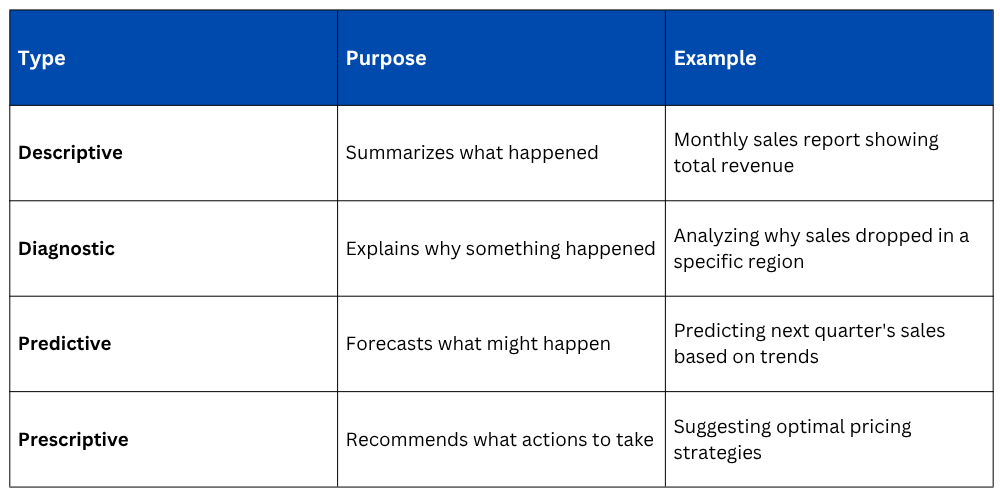
Types of Data Analysis
Different questions require different analytical approaches:
Why Data Analysis Matters
In the modern world, organizations generate massive amounts of data every second. Without analysis, this data is just noise. Data analysis transforms it into strategic advantage:
1. Better Decisions: Replace guesswork with evidence-based insights.
2. Identify Opportunities: Spot trends before competitors do.
3. Solve Problems: Pinpoint root causes rather than symptoms.
4. Measure Performance: Track progress toward goals with concrete metrics.
5. Reduce Costs: Find inefficiencies and optimize resources.
Consider healthcare: analyzing patient data helps doctors identify disease patterns, predict outbreaks, and personalize treatment plans—potentially saving lives.
Real-World Applications
Data analysis powers countless aspects of daily life:
1. E-commerce: Recommendation systems suggest products based on browsing history.
2. Finance: Fraud detection algorithms identify suspicious transactions.
3. Marketing: Campaign performance analysis shows which ads generate the best ROI.
4. Sports: Player statistics help coaches make strategic decisions.
5. Transportation: Traffic pattern analysis optimizes delivery routes.
Tools and Technologies
While the concepts remain constant, modern data analysis relies on powerful tools. Python has emerged as a leading choice because it offers:
-Picsart-CropImage.png)
The Human Element
Despite advanced algorithms and automation, human judgment remains irreplaceable in data analysis. Analysts must:
1. Ask the right questions
2. Understand business context
3. Recognize data limitations
4. Interpret results critically
5. Communicate findings effectively
A computer can calculate averages, but only a human can determine whether that average is meaningful or misleading in a specific context.

Class Sessions
Sales Campaign

We have a sales campaign on our promoted courses and products. You can purchase 1 products at a discounted price up to 15% discount.