Artificial Intelligence (AI) has increasingly become a valuable asset for software developers, operations teams, and security professionals by assisting in automating script writing tasks.
Among scripting languages, Python and Bash remain foundational for automation, system administration, data processing, and security operations. AI-assisted script writing leverages natural language understanding and generative models to support and accelerate these scripting efforts.
It offers conceptual guidance, code snippets, troubleshooting suggestions, and even entire script generation based on user input prompts or partial scripts. This synergy improves productivity, reduces errors, and democratizes scripting across experience levels.
AI Assistance in Python Script Writing
Python’s versatility, readability, and extensive libraries make it a popular scripting language, particularly in automation, data science, and security tooling. AI assists Python scripting by:
1. Natural Language to Code: Users describe desired tasks in plain English, and AI generates corresponding Python code snippets, minimizing syntax or logic errors.
2. Code Completion and Suggestions: AI-powered editors suggest function calls, parameters, and idiomatic usage based on context.
3. Error Detection and Debugging: AI helps identify common code errors and suggests fixes, facilitating faster script refinement.
4. Library Utilization: Recommends appropriate Python libraries or frameworks for particular use cases (e.g., requests for HTTP, paramiko for SSH automation).
5. Modular Code Generation: AI assists in breaking problems into reusable functions or classes, promoting maintainable script writing.
6. Documentation Generation: Auto-generates docstrings and comments for better code clarity and future maintenance.
Python’s expressive syntax complements AI’s generative abilities, making the development cycle more efficient and accessible.
AI Assistance in Bash Script Writing
Bash scripting remains fundamental in Linux and Unix system administration, DevOps, and automation workflows. AI aids Bash scripting through:
1. Command Generation: Translates task descriptions into sequences of Bash commands or pipelines for file manipulation, system control, or environment configuration.
2. Syntax Advice: Provides real-time corrections and best practice suggestions for script syntax (loops, conditionals, variable expansions).
3. Error Diagnosis: Detects common pitfalls like quoting errors or unintended globbing and recommends solutions.
4. Automation Workflow Suggestions: Helps construct multi-step scripts integrating utilities such as awk, sed, grep, and cron.
5. Cross-Platform Considerations: Advises on portability or environment-specific issues inherent in shell scripting.
AI accelerates Bash scripting proficiency, especially for those less familiar with shell intricacies.
Best Practices and Ethical Considerations
Maximizing the benefits of AI-assisted code generation demands human supervision and security-conscious practices. Listed below are key ethical and operational considerations.
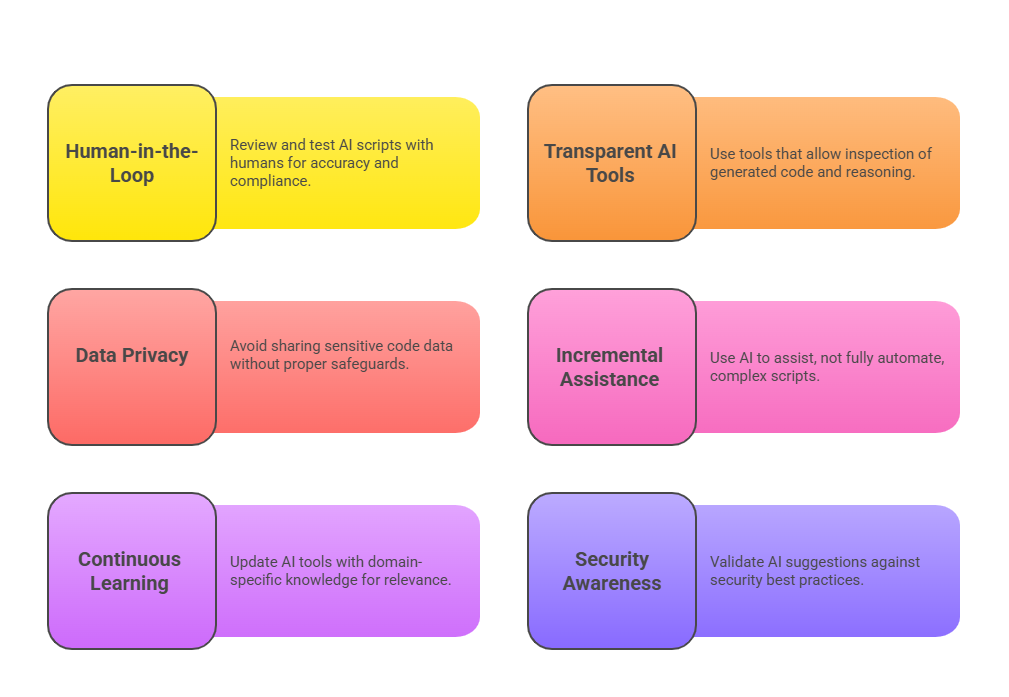 Adhering to these principles ensures responsible and maximally beneficial use of AI scripting aids.

Class Sessions
Sales Campaign

We have a sales campaign on our promoted courses and products. You can purchase 1 products at a discounted price up to 15% discount.