Vulnerability classification and prioritization are critical steps in cybersecurity risk management, helping organizations identify and address the most pressing security weaknesses before they can be exploited.
Traditionally, these processes involved manual assessment by security experts, often relying on standardized frameworks such as the Common Vulnerability Scoring System (CVSS). However, the rapid increase in the volume and complexity of vulnerabilities, combined with dynamic IT environments, has necessitated more sophisticated approaches.
Artificial intelligence (AI) has emerged as a powerful tool to automate and enhance vulnerability classification and prioritization, enabling faster, more accurate, and context-aware risk assessments.
Understanding Vulnerability Classification
Vulnerability classification involves categorizing vulnerabilities based on attributes such as severity, exploitability, impact, and affected assets. AI facilitates this by analyzing vulnerability descriptions, metadata, and historical data:
1. Natural Language Processing (NLP): AI systems process unstructured vulnerability reports, extracting relevant information such as affected software, attack vectors, and impact descriptions.
2. Feature Extraction: Machine learning models identify key features including CVSS scores, vulnerability type (e.g., buffer overflow, SQL injection), and affected components.
3. Similarity Analysis: AI compares new vulnerabilities with known patterns or previous incidents to classify related threats efficiently.
4. Automated Labeling: Using supervised learning, AI assigns categories or severity levels to vulnerabilities, aiding in consistent and rapid classification.
Role of AI in Vulnerability Prioritization
Prioritization ranks vulnerabilities according to their risk to the organization, guiding remediation efforts to maximize security impact with limited resources. AI enhances prioritization by incorporating multiple data points and contextual factors:
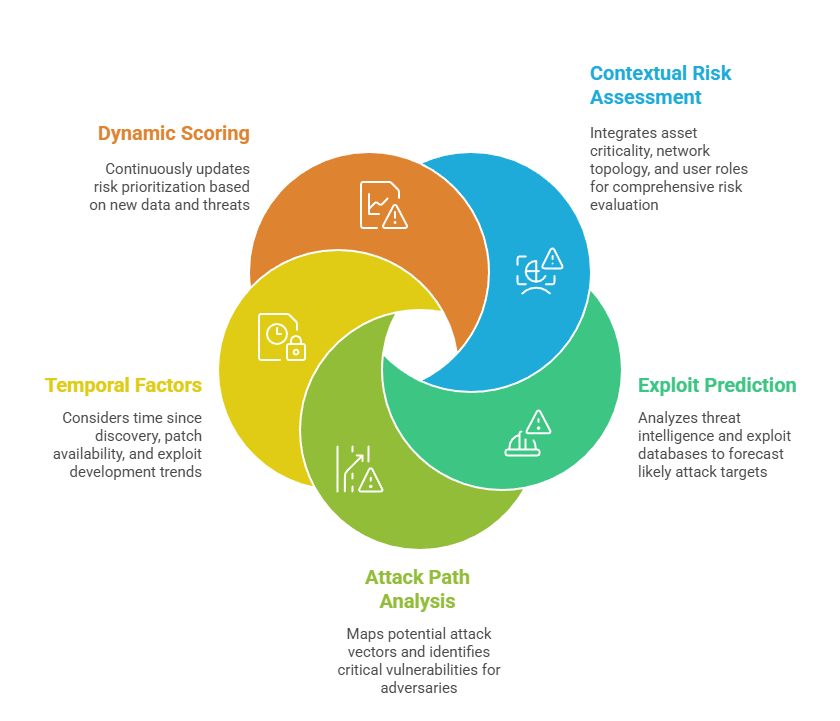
Techniques and Models Used
AI-driven systems use diverse analytical approaches to classify vulnerabilities, detect trends, and map attack paths. The following points highlight the main techniques and models involved.
1. Supervised Learning: Trains on labeled datasets of vulnerabilities with known risk levels to classify and prioritize new vulnerabilities.
2. Unsupervised Learning: Discovers patterns and clusters in vulnerability data without pre-existing labels, identifying emerging threat groups.
3. Reinforcement Learning: Adjusts prioritization strategies based on feedback from incident outcomes and security interventions.
4. Graph Neural Networks: Model relationships among assets, vulnerabilities, and attack paths for holistic risk assessment.
Benefits of AI in Vulnerability Classification & Prioritization
From speed to predictive defense, AI strengthens the entire vulnerability management lifecycle. The following points highlight the primary benefits of using AI to prioritize vulnerabilities.
1. Speed: Automates classification and prioritization, reducing the time from vulnerability discovery to action.
2. Accuracy: Decreases human error and inconsistency through data-driven, repeatable processes.
3. Context-Aware Decisions: Incorporates organizational context for more relevant risk assessments.
4. Scalability: Handles large volumes of vulnerabilities in complex environments.
5. Proactive Defense: Predicts exploit likelihood helping focus on vulnerabilities most likely to be attacked.
Challenges and Best Practices
Ensuring accurate, interpretable, and continuously learning AI models is essential for risk-focused vulnerability management. Below are the main challenges and best practices to achieve consistent results.
.png)

Class Sessions
Sales Campaign

We have a sales campaign on our promoted courses and products. You can purchase 1 products at a discounted price up to 15% discount.