Configuration weaknesses are a significant source of vulnerabilities in modern IT environments. These weaknesses often result from misconfigurations, oversights, or outdated settings in systems, networks, and applications, leaving organizations exposed to potential breaches.
Traditionally, security teams manually audit configurations, which can be labor-intensive, error-prone, and often limited in scope given the complexity of modern infrastructure. With advancements in artificial intelligence (AI), automated configuration weakness detection has become a powerful approach to identify and remediate vulnerabilities proactively.
AI-assisted detection tools analyze vast configurations, logs, and network traffic patterns to uncover weaknesses that could be exploited by malicious actors, thereby strengthening the overall security posture.
Understanding AI-Assisted Configuration Weakness Detection
Configuration weaknesses refer to improper or insecure settings in hardware, software, and network components that degrade security. Examples include open ports, weak authentication, overly permissive access controls, unpatched systems, and misconfigured cloud environments.
Identifying these weaknesses manually becomes increasingly difficult due to the scale and dynamic nature of modern infrastructure. AI-powered tools address this challenge by employing machine learning algorithms and pattern analysis to detect deviations from best practices and security standards:
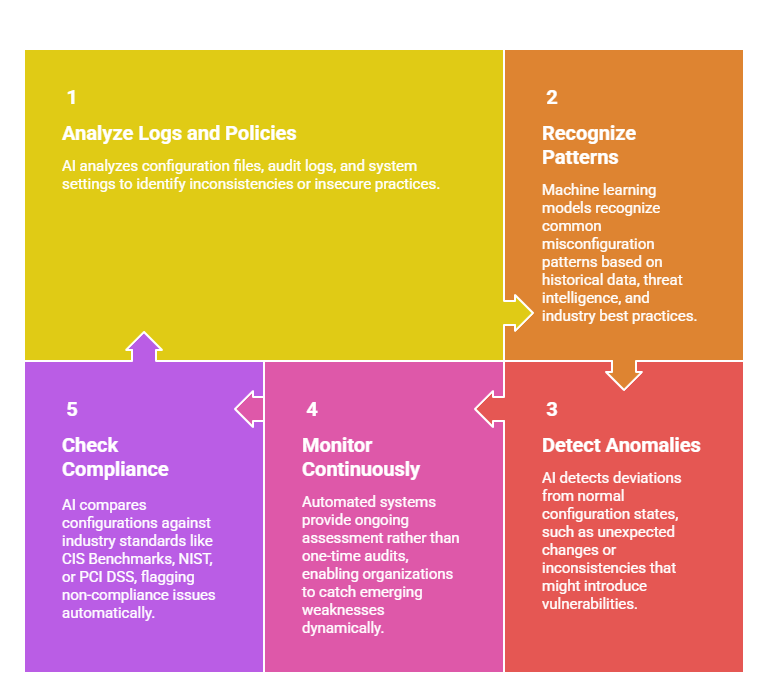
Techniques Employed in AI-Based Configuration Weakness Detection
Advanced learning models and analytical tools allow AI to classify, predict, and visualize insecure system setups. Listed below are the major techniques used in AI-based configuration weakness detection.
1. Supervised Learning: Models trained on labeled datasets of secure versus insecure configurations learn to classify new configurations automatically.
2. Unsupervised Learning: Anomaly detection algorithms identify unusual configuration patterns without pre-labeled data, ideal for discovering unknown weaknesses.
3. Natural Language Processing (NLP): NLP techniques analyze policies, documentation, and audit reports to extract compliance violations or security concerns.
4. Graph Analysis: Visualizes relationships between system components, identifying overly permissive access paths or isolated vulnerabilities.
5. Reinforcement Learning: Continuously improves detection accuracy by learning from feedback during security assessments and incident responses.
Benefits of AI-Assisted Detection of Configuration Weaknesses
By automating routine reviews and providing continuous monitoring, AI enables proactive and scalable security management. Here are the essential benefits that showcase its role in detecting and addressing configuration weaknesses.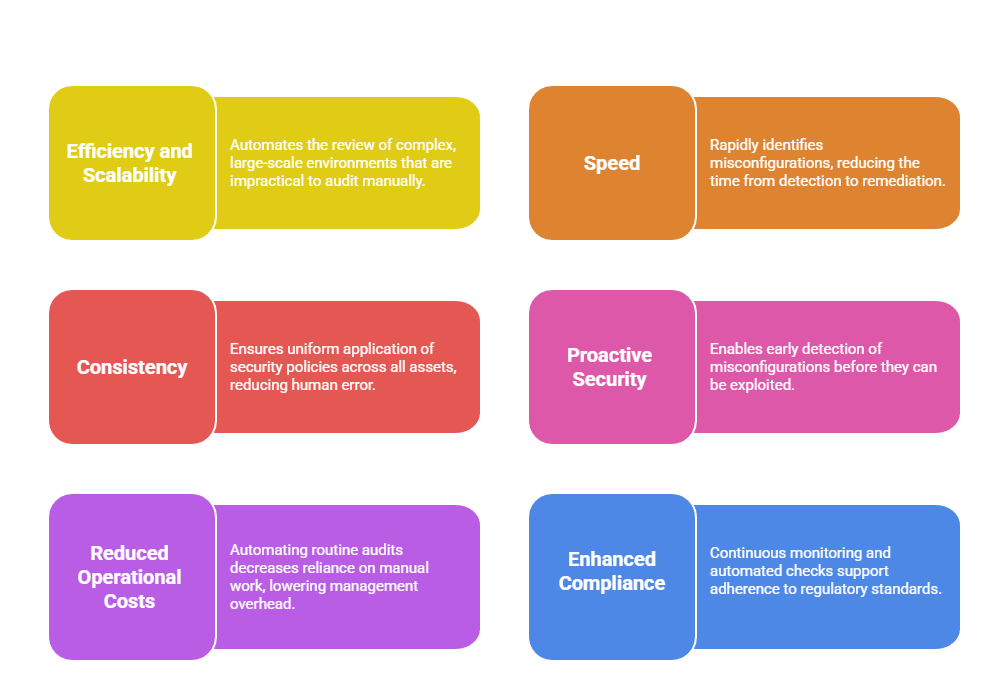
Challenges and Best Practices
AI can accelerate misconfiguration detection, but success depends on mitigating false positives, maintaining adaptability, and ensuring privacy. Below are the core challenges and best practices to ensure reliable implementation.
1. Data Quality and Completeness: Effective AI detection depends on accurate, up-to-date configuration data; incomplete data can lead to false negatives.
2. False Positives: Overly sensitive models may flag benign configurations as weaknesses, requiring tuning and expert validation.
3. Adaptability: As infrastructure evolves, models must be retrained regularly to maintain accuracy.
4. Explainability: AI decisions should be transparent to gain trust and facilitate remediation.
5. Integration: Tools must seamlessly integrate with existing security workflows and automation platforms.
6. Privacy Concerns: Proper handling of configuration and audit data is essential to prevent information leaks or privacy violations.
