As organizations scale across cloud, on-premise, and hybrid environments, data becomes increasingly fragmented across disparate storage locations, applications, and processing systems.
Data Fabric offers a unified, intelligent, and automated architecture for seamless data access, integration, governance, and orchestration across complex ecosystems.
It acts as an intelligent connective layer that not only links data sources but also embeds capabilities like metadata enrichment, automated quality monitoring, policy enforcement, and adaptive data delivery.
This modern architecture ensures that analytics workloads, machine learning models, and business applications receive trusted, context-aware data when needed.
Modern data management techniques complement this framework by introducing advanced strategies such as data virtualization, active metadata management, data observability, decentralized governance, schema evolution automation, and intelligent data cataloging.
These methods help reduce data redundancy, accelerate data preparation, and ensure compliance with evolving regulations.
Data Fabric differs from traditional ETL-centric systems by enabling real-time integration without physically moving or replicating massive data volumes making it scalable for big-data and cloud-native environments.
Data Fabric
Data Fabric offers a unified and intelligent framework to seamlessly integrate, manage, and govern data across distributed systems.
It enables real-time access, automation, and secure analytics without duplicating or moving data unnecessarily.
1. Unified Data Access Across Distributed Systems
Data Fabric connects data stored in cloud warehouses, edge devices, on-premise servers, and SaaS tools into a single logical view.
It automatically discovers datasets, reconciles schemas, and applies metadata-driven integration policies.
This eliminates the need for manually stitching data pipelines for each source and reduces engineering overhead.
Example: A global logistics company uses Data Fabric to unify shipment data from different continents into one live dashboard.
2. Metadata-Driven Intelligence and Automation
Data Fabric uses active metadata—technical, operational, and business metadata—to automate data flows.
It learns usage patterns, data lineage, and quality signals to recommend optimal pathways for analytics workloads.
This allows the system to dynamically adjust routes when sources change or new nodes are added.
Example: A telecom provider uses automated lineage tracking to diagnose data pipeline failures instantly.
3. Embedded Data Governance and Policy Enforcement
Policies such as access control, masking, encryption, and retention are applied consistently across distributed environments.
Centralized policy management reduces compliance risks in highly regulated sectors.
The system ensures that sensitive fields stay protected while enabling analytics teams to operate freely.
Example: A bank uses Data Fabric to enforce GDPR and PCI-DSS rules across its customer data ecosystem.
4. Real-Time and Batch Interoperability
Data Fabric supports simultaneous real-time streaming and batch ingestion pipelines without redesigning architecture.
It dynamically optimizes data flows depending on workload type, latency requirements, and system load.
This hybrid capability makes it ideal for AI-driven environments that need fresh insights.
Example: Retail companies use Data Fabric to merge point-of-sale streams with historical purchasing records for demand forecasting.
5. Reduced Data Duplication and Optimized Storage
Instead of replicating massive datasets across multiple systems, Data Fabric uses virtualization to access data in place.
This significantly reduces storage costs and mitigates version conflicts.
Organizations maintain a single source of truth even when data physically resides in multiple locations.
Example: Healthcare networks use virtualization to access patient history stored across hospitals without copying files.
Modern Data Management Techniques
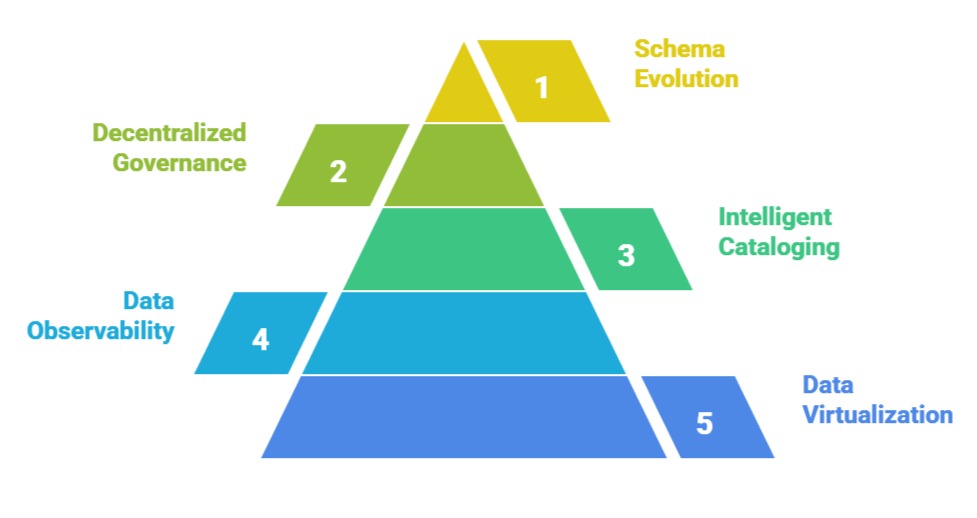 1. Data Virtualization
Provides real-time access to data without moving or reformatting it.
Ideal for complex analytics where multiple sources are required instantly.
Example: A manufacturing firm pulls IoT sensor readings and ERP data together for performance monitoring.
2. Data Observability
Monitors data reliability, freshness, schema drift, and pipeline health.
Helps detect anomalies before they affect ML model outputs or dashboards.
Example: FinTech platforms use observability tools to prevent incorrect transaction scoring due to corrupted feeds.
3. Active Metadata & Intelligent Cataloging
Automatically identifies new datasets, tracks relationships, and tags them with business context.
Drastically speeds up discovery for analysts and data scientists.
Example: E-commerce companies discover unutilized clickstream datasets for conversion optimization.
4. Decentralized Data Governance (Data Mesh Principles)
Teams manage data domains independently while following global standards.
Promotes scalability and reduces dependency on centralized IT teams.
Example: A multinational corporation creates domain teams for finance, HR, marketing, etc., each responsible for its own data quality.
5. Schema Evolution & Automated Quality Checks
Automatically handles structural changes such as column additions or datatype modifications.
Ensures pipelines remain stable even during frequent updates.
Example: Streaming customer behavioral data evolves over time without breaking recommendation models.
Importance of Data Fabric & Modern Data Management Techniques
Data Fabric and modern data management techniques provide a unified, intelligent approach to handling distributed and diverse datasets.
They enable seamless access, real-time analytics, and secure governance, driving efficiency, scalability, and faster insights for enterprises.
1. Enables Seamless Access Across Distributed Data Ecosystems
Data Fabric is crucial because modern enterprises store data across cloud platforms, on-premise servers, SaaS tools, and edge devices, creating fragmented silos.
A unified fabric eliminates barriers by providing a logical, connected view of all sources without physically relocating data.
This allows analysts, engineers, and AI systems to query datasets instantly, regardless of where they originate.
The importance lies in dramatically reducing integration delays and engineering dependency.
Organizations can explore, consume, and operationalize data in real time instead of waiting for ETL cycles.
This unification boosts innovation by allowing cross-domain insights that were previously inaccessible.
2. Essential for Scalable AI, ML, and Real-Time Analytics
As AI and ML require high-quality, fresh, and context-aware data, Data Fabric plays a central role in maintaining continuous, trustworthy data flows.
By automating lineage tracking, quality scoring, and metadata-driven optimization, it ensures models are not trained on outdated or inconsistent information.
This greatly reduces risks associated with model drift or prediction errors.
Data Fabric enables streaming integration, which is critical for applications such as fraud detection, personalization, and forecasting.
Its ability to adapt pipelines dynamically makes it indispensable for next-generation analytics ecosystems.
3. Strengthens Compliance, Security, and Data Governance
Regulated sectors like finance, healthcare, and telecom need uniform enforcement of security and privacy policies.
Data Fabric embeds governance within the data layer, ensuring encryption, masking, and access controls apply consistently across every source.
This centralized yet adaptive governance reduces compliance breaches caused by inconsistent system-level rules.
It ensures that sensitive fields are always protected even when data is accessed for analytics or machine learning.
Therefore, it becomes a key enabler for safe data democratization.
4. Reduces Redundancy and Optimizes Storage Costs
Traditional architectures rely heavily on replicating or transferring data between systems, leading to unnecessary storage expansion and version inconsistencies.
Data Fabric minimizes duplication through virtualization and smart caching, enabling users to interact with datasets in place.
This reduces both infrastructure costs and environmental footprint, making it beneficial for large enterprises handling petabyte-scale datasets.
It also avoids delays caused by copying or restructuring data. As organizations scale, this cost-efficient approach becomes increasingly valuable.
5. Accelerates Data Discovery and Improves Productivity
Active metadata, automated cataloging, and intelligent tagging drastically shorten the time needed to locate and understand datasets.
Analysts and data scientists no longer waste days searching for relevant tables or interpreting undocumented schemas.
With contextual metadata and automated profiling, decision-makers receive accurate data faster.
This improves project turnaround times and boosts organizational agility. Companies leveraging Data Fabric report higher productivity across all data-centric roles.
Challenges & Limitations of Data Fabric & Modern Data Management Techniques
1. High Initial Complexity and Architectural Overhead
Implementing Data Fabric requires deep understanding of existing systems, data flows, governance rules, and business domains.
Designing a unified architecture across such heterogeneous environments is complex and often demands specialized skill sets.
Organizations may struggle with migration planning, metadata harvesting, and dependency mapping.
The learning curve can be steep for teams unfamiliar with metadata-driven automation.
This complexity often extends implementation timelines and requires significant upfront investment.
2. Integration Difficulties with Legacy Systems
Many enterprises rely on outdated databases, custom APIs, and older data warehouses that lack modern connectivity or metadata standards.
Integrating such systems into a universal fabric can require custom connectors or significant retrofitting.
When legacy tools do not support automation, data lineage tracking and quality enforcement become harder to apply.
These gaps can reduce the effectiveness of the fabric and increase maintenance efforts. As a result, full interoperability is not always immediately achievable.
3. Metadata Quality Issues Can Impair Automation
Data Fabric relies heavily on active metadata for routing, optimization, and governance.
If metadata is outdated, incomplete, or inconsistent, the entire automation layer suffers.
Poor metadata can cause inaccurate lineage tracking, incorrect data mappings, or misclassified sensitivity levels.
This results in operational bottlenecks and trust issues among users.
Ensuring high-quality metadata at scale requires discipline and continuous management, which many organizations underestimate.
4. Potential Performance Bottlenecks with Virtualization
While data virtualization reduces duplication, it can introduce latency if underlying systems are slow or geographically distant.
Heavy queries on remote sources may lead to performance degradation during real-time analytics.
Caching solutions help, but they can’t eliminate all latency constraints.
For compute-intensive workloads, virtualization might not match the speed of pre-loaded data warehouses. Companies must balance convenience with performance trade-offs.
5. Requires Strong Cross-Functional Governance and Culture Shift
Successful Data Fabric adoption requires collaboration among engineering, analytics, security, compliance, and business teams.
Many organizations struggle because responsibilities remain siloed, and there is no unified ownership of data quality or governance consistency.
Teams need cultural alignment for metadata upkeep, policy enforcement, and domain collaboration.
Without this shift, Data Fabric may fail to deliver its intended benefits, despite technology readiness.
6. Licensing, Tools, and Maintenance Costs Can Be High
Commercial Data Fabric platforms, observability suites, and metadata management tools often require substantial licensing fees.
Maintaining them at enterprise scale also demands ongoing operational staff and support contracts.
For smaller companies, these long-term costs may outweigh the benefits.
Budgeting realistically is essential to avoid partial or failed implementations.

Class Sessions
Sales Campaign

We have a sales campaign on our promoted courses and products. You can purchase 1 products at a discounted price up to 15% discount.