Adversarial Machine Learning (AML) is a critical area within modern AI research that focuses on identifying, understanding, and defending against deliberate attacks on machine learning models.
As ML systems are integrated into vital domains such as autonomous transportation, digital finance, biometric authentication, and healthcare diagnostics, their vulnerabilities become attractive targets for malicious manipulation.
Adversarial attacks typically involve subtle, carefully engineered perturbations designed to mislead models without altering human perception.
These manipulations can cause image classifiers to misidentify objects, sentiment systems to misjudge tone, or fraud detectors to overlook suspicious behavior.
Security in ML systems encompasses not only detecting these threats but also building resilient workflows that protect data integrity, minimize performance degradation, and ensure reliable decision-making even under adversarial pressure.
This includes developing robust architectures, secure training pipelines, and continuous monitoring mechanisms that detect anomalies and suspicious patterns.
As attack strategies evolve—ranging from evasion and poisoning attacks to model extraction and inference manipulation ML practitioners must adopt a multi-layered defense strategy to safeguard applications.
Adversarial Threats and Security Challenges in Machine Learning
Adversarial threats pose significant risks to machine learning systems, ranging from subtle input manipulations to sophisticated data poisoning and model theft.
Understanding these attacks and implementing robust defensive strategies is essential for ensuring secure, reliable, and trustworthy AI deployments.
1. Evasion Attacks (Adversarial Inputs)
Evasion attacks occur when attackers craft small, imperceptible modifications to input data that cause a model to generate incorrect predictions.
These attacks exploit model weaknesses in decision boundaries, particularly in high-dimensional tasks like image classification or text analysis.
They often bypass traditional cybersecurity systems because perturbations appear harmless to humans.
Example: Adding microscopic noise to a stop sign image causing an autonomous vehicle’s system to classify it as a speed-limit sign.
2. Data Poisoning Attacks
These attacks target the training phase by injecting malicious samples into datasets to influence the model’s behavior.
Poisoned data may alter gradients, distort learned patterns, or embed backdoors, allowing attackers to trigger unauthorized actions later.
This type of attack is highly dangerous because its impact persists across retraining cycles.
Example: Introducing mislabeled medical images during model training, leading to misdiagnosis of future patient scans.
3. Model Extraction and Intellectual Property Theft
Attackers query ML models repeatedly to approximate their decision patterns, effectively reconstructing proprietary algorithms.
This threatens organizations relying on commercial ML services and exposes models to further automated attacks.
Extractions enable adversaries to replicate functionalities without investing in data collection or training.
Example: Rebuilding a sentiment classifier by repeatedly querying an NLP API and training a surrogate model.
4. Model Inversion and Privacy Leakage
Model inversion attacks attempt to recover sensitive information from a trained model by exploiting prediction confidence scores.
These attacks can reconstruct private attributes or infer personal details from aggregated patterns, posing severe privacy risks.
Example: Recovering blurred facial features of individuals from a facial recognition system using output probabilities.
5. Backdoor and Trojan Attacks
Backdoor attacks plant hidden triggers during training that remain dormant until specific patterns appear at inference time.
Once activated, the model outputs an attacker-controlled prediction. These threats are challenging to detect because the main performance metrics remain unchanged.
Example: Embedding a yellow sticker pattern in training data that forces a malware classifier to label malicious code as safe when the sticker appears.
6. Robustness and Defensive Strategies
Defending against adversarial attacks requires combining multiple techniques: adversarial training, gradient masking, input sanitization, anomaly detection, and model monitoring.
Robust systems evaluate model behavior under varied adversarial conditions to identify failure points.
Example: Training a vision model using adversarial samples generated through FGSM or PGD to toughen decision boundaries.
7. Security Auditing and ML Governance
Continuous auditing ensures that ML pipelines remain protected across data acquisition, feature engineering, deployment, and maintenance.
Security governance frameworks align ML workflows with risk management guidelines and ensure compliance with industry regulations.
Example: Performing routine vulnerability assessments in financial fraud detection models to identify potential feature manipulation risks.
Importance of Adversarial Machine Learning & Security in ML Systems
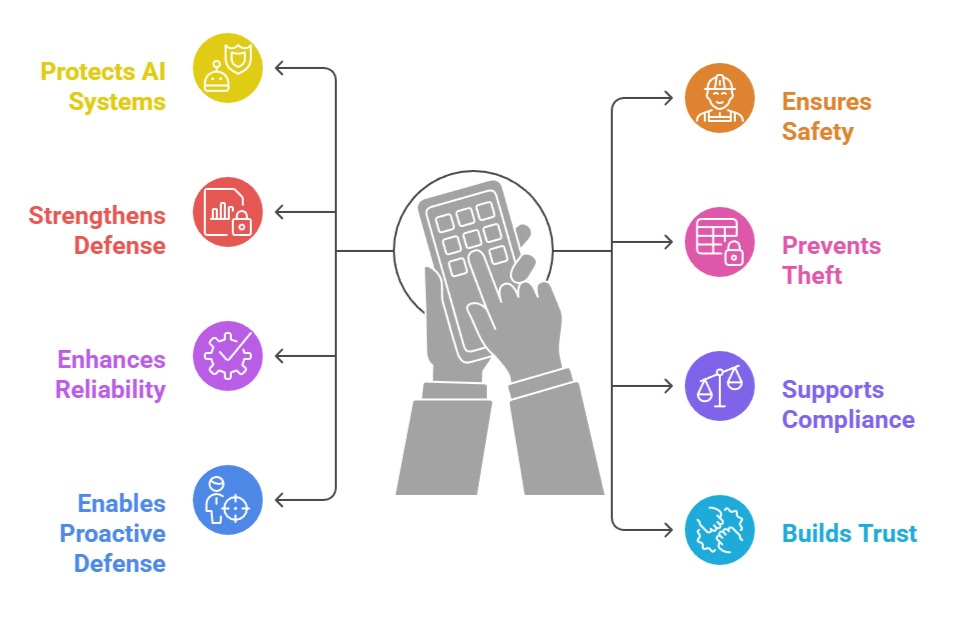 1. Protects AI Systems from Malicious Manipulation
Adversarial ML is essential because modern models are vulnerable to subtle, human-imperceptible modifications that can drastically change predictions.
Attackers can exploit these weaknesses to force incorrect outputs in safety-critical domains such as healthcare, finance, and transportation.
Understanding adversarial behavior helps organizations identify weak points before real attackers discover them.
It also ensures models do not become easy targets for automated exploitation tools that search for vulnerabilities at scale.
By mastering adversarial analysis, practitioners strengthen trust and reliability in AI systems deployed in public or hostile environments.
2. Ensures Safety in High-Risk Real-World Deployments
In environments such as autonomous driving, biometric authentication, and remote sensing, a single adversarial input can trigger catastrophic failures.
Securing ML systems helps prevent manipulated signals from causing unsafe actions—for example, misclassifying road signs or bypassing facial recognition systems.
As more decision-making responsibility shifts to AI, enforcing robust behavior becomes a critical safety requirement.
Understanding adversarial ML provides a framework for assessing model stability under unpredictable conditions. This makes it vital for industries regulated around safety, such as aviation, healthcare, and robotics.
3. Strengthens Defense Against Data Poisoning Threats
Data poisoning attacks target training pipelines rather than deployed models, making them difficult to detect without specialized knowledge.
They can introduce hidden triggers, incorrect labels, or targeted distribution shifts that degrade model performance over time.
Learning adversarial ML equips practitioners to construct strong data validation protocols, provenance tracking, and automated anomaly detectors that protect datasets from tampering.
These safeguards are essential when training on large, remotely collected, or user-generated data.
Without such protection, organizations risk deploying compromised models that behave unpredictably.
4. Prevents Model Theft and Reverse Engineering
Attackers frequently attempt model extraction, copying the behavior of deployed systems by repeatedly querying prediction APIs.
Knowledge of adversarial ML helps teams build secure interfaces that limit leakage of decision boundaries or confidence signals.
This protects proprietary architectures and valuable intellectual property from being cloned, replicated, or monetized by attackers.
Understanding attack strategies also informs better API rate-limiting, output masking, and authentication requirements.
Protecting ML assets is especially important for companies that rely on unique models as a competitive advantage.
5. Enhances Reliability Under Distribution Shifts
Adversarial robustness research improves a model’s ability to handle unexpected inputs and atypical data patterns that differ from the training distribution.
Real-world environments rarely match clean laboratory settings, making robustness a practical requirement rather than an academic concept.
Techniques rooted in adversarial ML—such as robust loss functions and stress-testing—help models generalize better under noisy, corrupted, or intentionally manipulated data.
This leads to more stable decision-making across varying conditions.
Robust models are better suited for deployment in open, dynamic environments with constant distribution drift.
6. Supports Compliance, Governance, and Ethical AI Standards
As global policies increasingly mandate reliability, transparency, and resilience in AI systems, adversarial ML becomes a crucial component of compliance.
Regulatory frameworks emphasize the need for models that behave predictably and resist manipulation, especially in critical industries like finance and public services.
Robustness evaluation is now part of many AI auditing procedures.
Mastering adversarial ML enables organizations to meet certification requirements, reduce risk, and demonstrate responsible AI practices.
This contributes directly to user trust and public acceptance of automated decision systems.
7. Enables Proactive Defense Rather than Reactive Fixes
Organizations that understand adversarial ML can embed security from the earliest stages of model development rather than attempting to patch vulnerabilities after deployment.
This proactive approach leads to stronger defenses and greatly reduces response costs associated with attacks.
Early integration of adversarial techniques also improves coordination between data scientists and cybersecurity teams, strengthening the overall AI infrastructure.
Anticipating threats allows companies to stay ahead of attackers, whose methods evolve rapidly.
This shift from reaction to anticipation is foundational for long-term AI resilience.
8. Builds Public Trust in AI-driven Decisions
AI systems deployed in society must earn user confidence, especially when making impactful decisions.
Demonstrating that models can withstand adversarial manipulation reassures users that results are fair, consistent, and safeguarded from tampering.
A secure system minimizes the likelihood of unexpected failures that could damage the credibility of organizations or the technology itself.
Transparent, robust models contribute to responsible deployment and greater confidence from customers, regulators, and stakeholders.
Adversarial ML therefore plays a central role in shaping the societal perception of AI reliability.
Best Practices for Building Secure ML Pipelines
Building secure ML pipelines is essential to protect models and data from malicious attacks, tampering, and exploitation.
Following best practices ensures robustness, reliability, and trustworthiness throughout the model lifecycle.
1. Secure and Validate Data Sources
A secure ML pipeline begins with guaranteeing that the data feeding into training and inference is authentic, consistent, and free from malicious alterations.
This involves using cryptographic checksums, data provenance tracking, and access restrictions so attackers cannot inject poisoned examples.
Regular validation strategies—like statistical drift monitoring—can reveal anomalies that indicate targeted tampering.
Ensuring that datasets originate from trusted channels prevents hidden triggers, mislabeled entries, and manipulated distributions from influencing the learning process.
Organizations can strengthen this step by integrating automated QC checks and anomaly detection systems at ingestion time.
2. Implement Adversarial Training
Adversarial training strengthens models by exposing them to crafted attacks during learning, forcing them to generalize across perturbed samples.
Instead of solely relying on clean data, the network learns to withstand gradients that try to distort predictions.
This enhances boundary stability, making it harder for attackers to fool the system with subtle noise.
Integrating attacks such as PGD or FGSM into training loops creates more durable models that perform reliably in hostile environments.
Though computationally expensive, adversarial training remains one of the most effective defenses against evasion tactics.
3. Use Input Sanitization and Preprocessing Filters
Input sanitization methods reduce the risk of adversarial noise by smoothing, denoising, or transforming inputs before the model processes them.
Techniques like JPEG compression, random resizing, diffusion-based purification, and feature squeezing disrupt adversarial perturbations.
These methods can weaken attack gradients and remove abnormal patterns without significantly affecting prediction quality.
By filtering every request at runtime, systems add an extra defensive layer that makes direct evasion more difficult.
Sanitization is particularly effective in image-based systems used for security, biometrics, or autonomous sensors.
4. Deploy Continuous Monitoring and Anomaly Detection
Real-time monitoring systems track incoming data, model outputs, and behavioral changes to detect patterns that suggest adversarial influences.
This may include abnormal confidence distributions, input clusters far from training data, or repeated malicious queries.
These monitoring pipelines allow quick detection of extraction attempts, targeted misclassifications, or distribution shifts.
Integrating logging, dashboards, and alerting mechanisms ensures immediate response when something falls outside normal behavior.
Such monitoring also supports forensic analysis in case of a successful attack.
5. Secure Model Access and API Endpoints
Restricting model access prevents unauthorized queries that could be used for extraction, probing, or brute-force adversarial generation.
Rate limiting, authentication, encrypted communication, and query auditing ensure that only legitimate users can interact with deployed models.
Minimizing the model information exposed in prediction APIs—such as hiding confidence scores—reduces opportunities for attackers to reverse-engineer model decision boundaries.
Strong endpoint security is especially critical for cloud-based AI services and public APIs.
6. Use Model Hardening & Regularization Techniques
Hardening methods like gradient masking, defensive distillation, label smoothing, and certified robustness constraints limit the effectiveness of attack gradients.
These techniques re-shape the model’s learning process to make it less sensitive to small perturbations.
While no method perfectly eliminates vulnerability, combining multiple strategies can significantly reduce attack success rates.
Model hardening is often used as part of a layered defense approach alongside monitoring and adversarial training.
7. Perform Routine Security Audits and Red-Team Testing
Security audits evaluate ML assets the same way cybersecurity teams examine networks through penetration testing, red teaming, and vulnerability scans.
Red-team exercises simulate real attackers attempting to deceive or extract the model using white-box or black-box techniques.
These tests reveal weak points before adversaries discover them, enabling proactive improvement.
Continuous auditing ensures that defenses evolve at the same pace as attack methods.
Advanced Adversarial Defense Algorithms (FGSM, PGD, TRADES, etc.)
Advanced adversarial defense algorithms strengthen machine learning models against malicious attacks by enhancing robustness and resilience.
Techniques like FGSM, PGD, TRADES, and others provide both practical and theoretical safeguards against perturbations across diverse applications.
1. Fast Gradient Sign Method (FGSM)
FGSM is both an attack and defense strategy. In defensive contexts, it generates adversarial samples by adding noise aligned with the gradient sign, helping models learn to resist direct perturbations.
FGSM is computationally efficient, making it suitable for large-scale adversarial training pipelines.
The method provides a strong baseline defense by exposing models to one-step gradient-based distortions.
Example: Training a CNN with FGSM-generated adversarial images to make classification boundaries more resilient.
2. Projected Gradient Descent (PGD)
PGD is considered one of the strongest first-order adversarial training defenses. It applies iterative perturbations with small step sizes, followed by projection back into a valid image space.
Because PGD attacks are more powerful than FGSM, training against PGD-augmented data leads to significantly stronger model robustness.
This iterative method better simulates real-world adversarial pressure.
Example: ResNet architectures trained with PGD adversaries show consistent robustness under heavy image perturbations.
3. TRADES (Tradeoff-inspired Adversarial Defense)
TRADES introduces a balance between natural accuracy and adversarial robustness by separating the loss into two components clean accuracy and robust accuracy.
It focuses on controlling the Kullback–Leibler divergence between clean and adversarial predictions, ensuring the model doesn’t overly sacrifice real-world accuracy for robustness.
TRADES is widely used in large-scale deployments because it provides a mathematically grounded robustness guarantee.
Example: TRADES-based defense in financial anomaly detection systems to maintain performance under stealthy attack attempts.
4. Defensive Distillation
This method uses a teacher–student architecture where the student model learns softened outputs from the teacher, making gradients less exploitable for attackers.
Distillation smooths the decision boundaries, reducing the impact of noise-based manipulations.
Example: Protecting NLP classifiers from gradient-based token substitution attacks.
5. Certified Robustness Methods
These techniques offer theoretical guarantees that certain perturbations will not change model predictions.
Methods like randomized smoothing create probabilistic bounds that safeguard against a range of adversarial noise.
Example: Using randomized smoothing for medical imaging models to guarantee robustness against minor pixel-level tampering.
6. Gradient Masking & Feature Squeezing
These lightweight defenses make it difficult for attackers to compute effective gradients or hide adversarial perturbations through reduced precision or neighborhood compression.
Example: Using feature squeezing to defend IoT vision sensors from real-time adversarial patches.