Advanced deep learning techniques have reshaped how complex models are designed, optimized, and deployed, enabling systems to learn from limited data, focus on the most informative patterns, and process long-range dependencies with remarkable efficiency.
These methods emerged as solutions to challenges such as high computational demands, data scarcity, slow training, and the inability of traditional architectures to interpret intricate structures in text, imagery, and sequences.
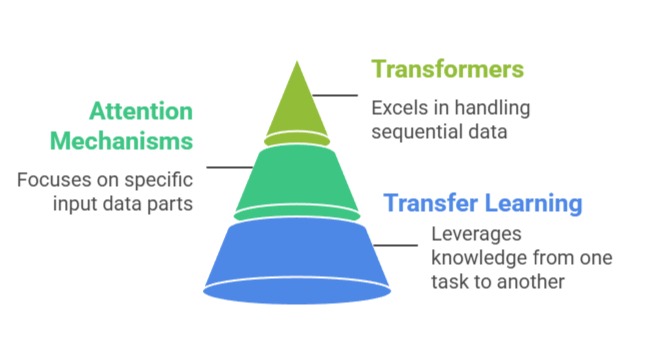
Transfer Learning accelerates model development by reusing pre-learned representations, minimizing training cost while boosting performance in tasks with restricted datasets.
Attention Mechanisms enhance neural networks by allowing them to selectively prioritize crucial features instead of processing all information uniformly, thereby producing context-aware predictions.
Transformers, built entirely on self-attention, solve the limitations of recurrent models by enabling parallelism and capturing long-term relationships without sequential bottlenecks.
Together, these techniques have become foundational in deep learning, powering state-of-the-art breakthroughs in natural language processing, computer vision, speech recognition, medical imaging, and generative AI systems.
Their combination allows models to adapt faster, interpret information more intelligently, and achieve high accuracy on tasks previously considered computationally infeasible.
Transfer Learning
Transfer learning is a powerful technique that accelerates model development by reusing knowledge from previously trained models.
It enables faster training, better generalization, and strong performance even when labeled data is limited.
1. Reusing Pretrained Knowledge
Transfer learning enables models to leverage features learned from massive datasets such as ImageNet or large language corpora, drastically reducing the need for extensive training data.
Instead of learning from scratch, models inherit robust representations like edges, textures, or semantic relationships, which are then fine-tuned for specialized tasks.
This approach is especially beneficial in domains like medical imaging, where annotated data is expensive and scarce.
By freezing early layers and updating only higher-level parameters, practitioners achieve faster convergence and improved generalization with minimal computational cost.
For example, using a pretrained ResNet for tumor detection significantly boosts accuracy compared to training a CNN from the ground up.
2. Domain Adaptation Benefits
Transfer learning helps models adapt to new environments even when the source and target distributions differ.
Techniques like feature alignment and adversarial adaptation ensure the model learns domain-invariant patterns, making predictions more resilient to shifts in lighting, background, or language style.
This is crucial in real-world applications such as autonomous driving, where a model trained in one region must perform reliably in different geographies.
Domain-adaptive models deliver consistent results despite changes in data characteristics, preventing drastic accuracy drops.
For instance, a face recognition system fine-tuned across cultures maintains stable performance across diverse demographic groups.
Attention Mechanisms
Attention mechanisms are a foundational concept in modern deep learning that enable models to focus on the most relevant information within an input.
They improve both performance and interpretability by guiding networks toward meaningful patterns and contextual relationships.
1. Selective Feature Prioritization
Attention mechanisms give neural networks the ability to highlight the most relevant parts of the input while suppressing unimportant details.
Instead of treating all information equally, they compute dynamic weights that guide the model toward critical features.
This technique enhances interpretability because users can inspect which inputs influenced a decision.
Attention is widely used in machine translation, where the model focuses on specific words while generating each output token.
For example, in translating “I love deep learning” to French, the network selectively attends to “love” when generating “aime,” ensuring grammatical consistency and semantic accuracy.
2. Contextual Dependency Modeling
Attention allows models to capture long-distance relationships that are difficult for RNNs or LSTMs to preserve.
By computing interactions between all input positions, the network understands context more thoroughly, improving predictions in tasks where meaning depends on wider structure.
This is essential for document summarization or sentiment analysis, where key phrases may appear far apart.
The resulting representations are more context-aware and robust, enabling nuanced understanding of text or images.
For instance, in image captioning, attention highlights the object of interest—like a bicycle—while generating descriptive sentences.
Transformers
Transformers are a revolutionary deep learning architecture that has reshaped how models process sequential and structured data.
Their attention-driven design enables fast, scalable, and highly accurate learning across a wide range of applications.
1. Self-Attention Based Architecture
Transformers eliminate the sequential processing constraints of RNNs by using self-attention layers that capture global relationships in parallel.
This design drastically accelerates training and enables models to consider the entire sequence at once.
Positional encodings help preserve order information, ensuring the model interprets sequences correctly.
Transformers excel in text generation, speech recognition, and even protein folding due to their ability to model intricate dependencies.
For example, BERT learns bidirectional context by analyzing both left and right neighboring words simultaneously, improving tasks such as question answering or classification.
2. Scalability and Performance Efficiency
Transformers scale exceptionally well with larger datasets and model sizes, enabling architectures like GPT-4 or Vision Transformers (ViTs) to achieve remarkable results.
Their modular structure allows stacking multiple layers without gradient degradation, making training deeper networks feasible.
Transformers also support multimodal learning, combining text, vision, and audio into a unified framework.
This versatility powers systems like image-to-text caption generators or multi-language conversational models.
For example, ViTs outperform CNNs on many classification benchmarks using only patch embeddings and self-attention.

Class Sessions
Sales Campaign

We have a sales campaign on our promoted courses and products. You can purchase 1 products at a discounted price up to 15% discount.