Practical applications in image recognition and speech recognition demonstrate how machine learning models interpret visual and audio data to perform tasks such as object detection, facial recognition, and voice-based transcription.
These applications highlight the real-world impact of deep learning techniques in areas like healthcare diagnostics, virtual assistants, security systems, and smart devices.
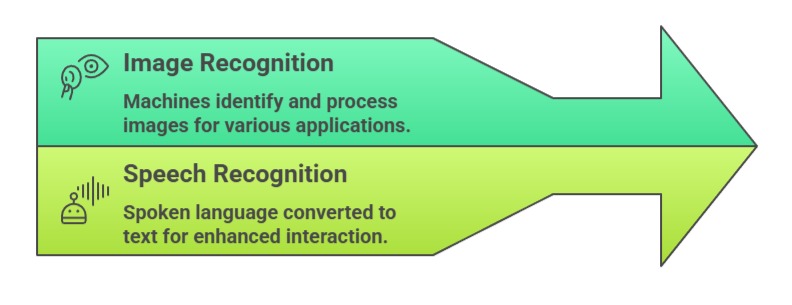
Image Recognition
Image recognition focuses on enabling machines to interpret and understand visual information from images or video.
Using deep learning, these systems can automatically learn visual patterns and perform accurate identification, detection, and analysis at scale.
1. Feature Extraction Through Deep Convolutional Layers
Modern image recognition systems rely on deep convolutional layers to automatically capture edges, textures, shapes, and object-level representations without manual engineering.
As images propagate through multiple layers, models gradually refine hierarchical features, allowing them to distinguish subtle visual patterns in real-world scenes.
High-performing architectures such as ResNet or EfficientNet refine feature extraction with residual connections and optimized depth scaling.
In practical deployments like quality inspection in factories, CNNs identify micro-defects that human eyes might overlook.
The ability to extract meaningful visual cues autonomously makes deep networks essential for large-scale visual interpretation.
This layered learning process enables recognition systems to perform robustly even under variations like lighting shifts, perspective distortions, or partial occlusions.
2. Real-Time Object Identification and Localization
Beyond classification, image recognition utilizes deep models to detect and locate multiple entities within a frame, enabling systems to understand visual context dynamically.
Frameworks like YOLO, SSD, and Mask R-CNN process images at high speed while pinpointing object boundaries with remarkable precision.
These models support live applications such as autonomous vehicles, which must detect pedestrians, traffic signs, and obstacles instantly.
Their ability to maintain accuracy during rapid movement or complex environments proves crucial for mission-critical tasks.
In retail analytics, detectors track shopper movement patterns to optimize store layouts and product placement.
Real-time localization allows industries to transition from reactive operations to proactive, vision-driven workflows.
Example (Image Recognition): Autonomous drones use image recognition to identify safe landing zones by analyzing terrain textures, obstacles, and depth cues.
The model learns from thousands of aerial images, ensuring safer navigation in unpredictable outdoor environments.
3. Data Augmentation and Robust Generalization
Deep learning–based image recognition systems heavily rely on data augmentation techniques to improve their ability to generalize across unseen conditions.
By introducing transformations such as rotation, cropping, brightness shifts, and random distortions, models learn to recognize objects regardless of environmental variability.
This expanded diversity helps prevent overfitting and ensures stable performance even when images differ significantly from those in the training set.
In domains like medical imaging, augmentation is crucial because collecting large datasets is often impractical due to privacy and resource constraints.
The technique also strengthens resilience against adversarial noise and subtle image manipulations. As a result, augmented models maintain high fidelity across diverse real-world deployments, ensuring reliability in scenarios where accuracy is critical.
4. Multi-Modal Image Understanding
Modern image recognition systems increasingly integrate multi-modal learning, combining vision with text, metadata, or sensor information to generate richer interpretations.
Models like CLIP and vision transformers unify visual cues with language embeddings to understand complex scenes holistically.
This synergy enables systems to classify objects more precisely, identify relationships between elements, and even generate descriptive captions.
In e-commerce platforms, such integration helps match product images with descriptive tags more accurately, improving search and recommendation experiences.
Multi-modal reasoning also enhances safety in autonomous navigation by associating visual cues with semantic understanding. This approach marks a shift from simple classification toward contextual visual intelligence.
Speech Recognition
Speech recognition enables computers to convert spoken language into accurate text or commands.
Powered by deep learning, modern systems achieve high accuracy by modeling both acoustic signals and linguistic context.
1. Acoustic Modeling With Deep Neural Architectures
Speech recognition systems build acoustic models that transform raw audio waves into meaningful linguistic representations.
Deep neural architectures—such as 1D CNNs, Bidirectional LSTMs, or Transformer-based encoders—capture phonetic structures, tone variations, and temporal dependencies with exceptional detail.
These models handle noise, accents, and speech variability by learning robust mappings between signal sequences and phoneme probabilities.
The shift from handcrafted acoustic features to end-to-end deep models has significantly improved recognition accuracy across diverse languages.
In smart assistant devices, acoustic models adapt continuously to user-specific speaking habits, enabling personalized interactions.
This capability is crucial in environments like call centers, where speech analytics must remain reliable under fluctuating audio conditions.
2. Language Modeling and Contextual Understanding
Modern speech recognition systems combine acoustic signals with language models that interpret context, predict next words, and ensure grammatical coherence.
Transformer architectures such as BERT, Whisper, or wav2vec 2.0 integrate semantic reasoning with audio cues, enabling systems to transcribe complex conversations with high precision.
These models resolve ambiguities by analyzing surrounding words, making transcripts more natural and meaningful.
In applications like medical dictation, contextual modeling prevents errors in terminology that could have critical implications.
The ability to blend linguistic structure with auditory patterns elevates speech recognition to human-like comprehension, supporting intelligent virtual agents and real-time communication tools around the world.
Example (Speech Recognition) : In automated customer support, speech recognition systems convert spoken queries into structured text, enabling chatbots to resolve issues instantly.
The use of contextual deep models ensures the system differentiates between similar-sounding phrases based on sentence intent.
3. End-to-End Speech-to-Text Frameworks
End-to-end architectures have transformed speech recognition by eliminating the need for separate phoneme models, feature extraction modules, and language decoders.
Systems like RNN-Transducers, sequence-to-sequence architectures, and Transformer encoders directly map raw speech waveforms to text outputs.
This unified pipeline simplifies training and enhances performance by allowing models to learn optimal internal representations of speech patterns.
End-to-end systems also adapt more effectively to dialects, speaking rates, and spontaneous conversations.
In industries such as media transcription, this results in faster, more accurate captioning for live broadcasts and multilingual content.
Their streamlined design has accelerated adoption of speech recognition across mobile apps and real-time services.
4. Noise Reduction and Speaker Adaptation Mechanisms
Advanced speech recognition models incorporate noise suppression, echo cancellation, and speaker normalization to maintain clarity in unpredictable environments.
Deep learning filters isolate relevant speech signals while suppressing background noise such as traffic, crowd voices, or machinery.
Speaker adaptation techniques further enhance accuracy by adjusting model parameters based on individual voice characteristics.
This adaptability is essential for applications like vehicle voice assistants, where audio quality varies significantly depending on cabin acoustics.
Enhanced noise handling also improves accessibility tools for users with speech impairments, ensuring consistent performance across diverse speaking styles.
These mechanisms collectively increase robustness and usability in real-world auditory conditions.

Class Sessions
Sales Campaign

We have a sales campaign on our promoted courses and products. You can purchase 1 products at a discounted price up to 15% discount.