Language models form the backbone of modern Natural Language Processing (NLP), enabling machines to understand, generate, and interact with human language in a meaningful way.
At their core, language models learn patterns from text data and use these patterns to predict the likelihood of words, phrases, or sentences.
This predictive capability allows them to perform a wide range of tasks—from simple text completion to complex reasoning, dialogue generation, summarization, translation, and semantic understanding.
As the volume of digital text grows exponentially, language models have become essential tools for building intelligent systems that can interpret unstructured language data with high accuracy.
Traditional models relied on n-gram statistics, which captured only short-range dependencies and suffered from sparsity issues.
The shift toward neural networks introduced paradigms like Word Embeddings, Recurrent Neural Networks (RNNs), and Long Short-Term Memory (LSTM) architectures, which improved the ability to model sequential context.
However, the real breakthrough arrived with Transformers, which allowed models to learn global relationships across entire sequences simultaneously.
This innovation paved the way for advanced architectures like BERT and GPT, which are pretrained on massive corpora and fine-tuned for specific downstream tasks using relatively small labeled datasets.
Modern language models not only process text but also infer intent, interpret ambiguity, and generate human-like responses, making them integral to search engines, virtual assistants, recommendation systems, chatbots, and content generation platforms.
Their scalability and adaptability allow them to excel across domains such as healthcare, finance, education, law, and entertainment.
With continuous advancements in training techniques, model scaling, reinforcement learning, and prompt engineering, language models are rapidly evolving into sophisticated reasoning systems capable of supporting decision-making and enhancing human productivity.
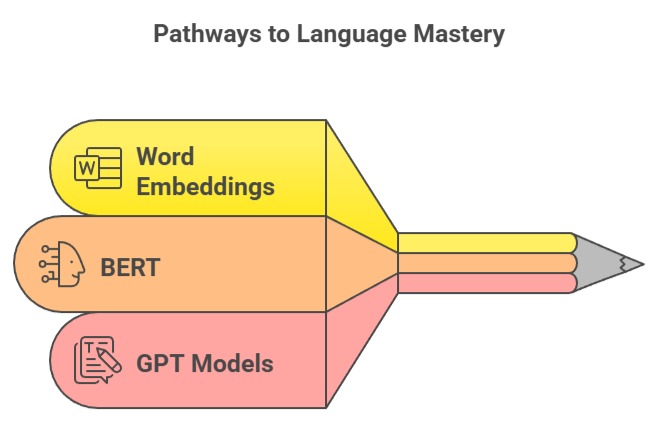
Word Embeddings
Word embeddings form the foundation of modern natural language processing by transforming textual words into meaningful numerical representations.
They enable machines to capture semantic and syntactic patterns in language, making text data usable for advanced learning models.
1. Representation of Words in Continuous Vector Space
Word embeddings convert words into dense numerical vectors that capture semantic relationships by placing similar terms close together in multi-dimensional space.
Unlike traditional one-hot encoding, embeddings reduce sparsity and allow models to understand subtle associations between concepts. They are learned either through neural networks or via co-occurrence statistics.
This representation enhances downstream tasks like classification, sentiment analysis, and topic detection by providing richer contextual signals. Since embeddings store meaning geometrically, operations like vector arithmetic yield intuitive analogies.
Example: “King – Man + Woman ≈ Queen” using Word2Vec.
2. Capturing Contextual Proximity and Syntactic Structure
Embeddings encode not only meaning but also grammatical roles by observing how words appear in sentences.
Techniques like GloVe and FastText incorporate position-based or subword information to represent morphology and variations.
This enables models to generalize well to misspellings, compound words, and rare terms.
The ability to compute similarity scores helps in clustering, recommendation, and search applications.
Example: FastText recognizes similarity between “play,” “player,” and “playing.”
BERT (Bidirectional Encoder Representations from Transformers)
BERT is a landmark NLP model that leverages transformer-based architectures to understand language context in a truly bidirectional manner.
It serves as a powerful backbone for a wide range of text understanding tasks by combining deep contextual learning with efficient fine-tuning.
1. Deep Bidirectional Representation Learning
BERT revolutionizes NLP by analyzing text in both forward and backward directions simultaneously, enabling deeper comprehension of sentence meaning.
It uses multi-layer Transformer encoders to study context from surrounding words rather than relying on purely left-to-right predictions.
Masked language modeling allows BERT to infer missing words while understanding the full context.
This bidirectional nature makes it extremely powerful for tasks requiring nuanced interpretation such as QA, inference, and entity extraction.
Example: BERT can interpret the difference between “He opened the bank account” and “He sat by the river bank.”
2. Pretraining + Fine-tuning Paradigm
BERT is pretrained on massive corpora and later fine-tuned for domain-specific tasks with minimal labeled data.
This approach reduces training time drastically while improving accuracy for real-world applications like document classification, conversation systems, and semantic search.
Its architecture supports task-specific heads, making it adaptable to numerous applications.
Example: Fine-tuning BERT for legal document tagging or medical terminology extraction.
GPT Models (Generative Pre-trained Transformers)
GPT models are powerful generative language models built on transformer architectures that specialize in producing human-like text.
They leverage large-scale pretraining to support a wide range of natural language understanding and generation tasks with minimal additional training.
1. Autoregressive Text Generation Architecture
GPT models generate text by predicting the next token based on previously observed content, making them ideal for free-form generation tasks.
They rely on Transformer decoders to capture long-range dependencies while preserving sequential order.
This structure enables GPT models to produce coherent narratives, summaries, answers, code, and dialogue without needing explicitly labeled datasets.
Their generative ability makes them suitable for creative writing, chatbot systems, and content expansion.
Example: GPT writing an entire paragraph from a short prompt such as “Explain climate change impacts.”
2. Adaptability Through Prompting and Few-shot Learning
GPT models excel at generalizing with minimal examples due to their large-scale pretraining across diverse text sources.
They can shift behavior through prompt engineering, making them versatile for translation, reasoning, sentiment extraction, and multi-turn conversation.
Their ability to adapt without retraining significantly lowers development barriers for complex NLP tasks.
Example: Providing two examples of question-answer pairs allows GPT to follow the pattern for new queries.
Real-World Use Cases of Language Models
Language models are transforming industries by enabling machines to understand, generate, and reason over human language at scale.
They power practical applications across customer service, search, healthcare, finance, media, and law by automating complex language-driven workflows.
1. Customer Support Automation
Language models power intelligent customer support systems that handle user queries with near-human fluency.
They can analyze customer messages, detect intent, retrieve relevant information, and generate clear, context-aware replies.
Businesses use these systems to reduce wait times and offer 24/7 support without relying solely on large human teams.
Modern large language models can escalate complex issues to human agents with complete conversation summaries, improving resolution efficiency.
They also assist support staff by suggesting responses in real time, increasing accuracy and reducing workload.
With multilingual capabilities, language models make global customer service more accessible.
Example: AI chat assistants used by banks and e-commerce platforms for troubleshooting and account inquiries.
2. Search Engines and Information Retrieval
Language models significantly enhance search engines by understanding user intent rather than relying purely on keyword matching.
They interpret natural language queries, analyze semantic similarity, and rank pages based on contextual relevance.
This leads to more accurate and personalized search results, even for vague or conversational queries.
Large models also improve snippet generation, question answering, and topic clustering.
Many platforms utilize transformer-based embeddings to represent documents and queries in a unified vector space, improving retrieval precision.
Example: Google uses BERT-like models to interpret complex search queries and improve result relevance.
3. Healthcare Documentation and Clinical Decision Support
In healthcare, language models streamline documentation by converting doctor–patient conversations into structured medical records.
They can extract symptoms, medications, diagnoses, and lab results from unstructured text with high precision.
Clinicians use them to summarize patient histories, draft discharge notes, and analyze lengthy reports.
Advanced models can even support medical decision-making by retrieving evidence-based literature and highlighting potential conflicts or risks.
This reduces administrative burden and enhances patient care quality.
Example: AI transcription assistants used in hospitals to generate clinical notes automatically.
4. Financial Analysis and Fraud Detection
Language models help financial institutions analyze transaction logs, customer messages, annual reports, and regulatory fillings.
They detect irregular patterns, classify risk factors, and flag suspicious linguistic signals that may indicate fraudulent activity.
LLMs also assist analysts by summarizing long financial statements, extracting key indicators, and generating insights for investment decisions.
Their ability to track sentiment across news articles and social media helps in market prediction and risk assessment.
Example: Automated fraud detection systems that scan communication data for deceptive intentions.
5. Content Creation and Media Automation
Modern language models are widely used in journalism, marketing, and entertainment for generating articles, scripts, product descriptions, and social media posts.
They adapt tone, style, and vocabulary to match brand identity and target audiences. In newsrooms, they assist writers by drafting summaries, rewriting sections, or suggesting headlines.
In creative industries, models help brainstorm plot ideas, generate dialogue, or build interactive storytelling experiences. This accelerates production while maintaining high-quality output.
Example: AI tools generating personalized marketing emails for millions of users.
6. Legal Document Analysis
Legal professionals use language models to analyze contracts, identify clauses, and detect compliance issues across large collections of documents.
These systems can highlight obligations, deadlines, and potential risks, saving hours of manual review.
By understanding legal language and structure, models assist lawyers in drafting agreements, summarizing cases, and preparing briefs.
They also help predict case outcomes by analyzing historical judgments.
Example: AI-powered contract-review platforms used by law firms and enterprises.

Class Sessions
Sales Campaign

We have a sales campaign on our promoted courses and products. You can purchase 1 products at a discounted price up to 15% discount.