Natural Language Processing (NLP) plays a central role in enabling machines to understand, interpret, and generate human language across real-world environments.
Its applications now extend from communication services and automated assistance to highly specialized fields such as healthcare, policymaking, cybersecurity, and scientific research.
Modern NLP systems rely on deep learning, contextual language models, and advanced text analytics to operate reliably in dynamic, high-stake situations.
They process conversations, documents, reports, and unstructured text to extract insights, deliver recommendations, or automate decision-driven tasks.
However, as NLP becomes embedded in daily life and organizational ecosystems, ethical considerations have become equally important.
Issues related to fairness, transparency, privacy, accountability, and societal impact influence how these systems should be designed and deployed.
Ensuring that NLP-driven tools behave responsibly—without discriminating, leaking sensitive data, or generating misleading outputs—is now a core requirement.
Real-World Applications
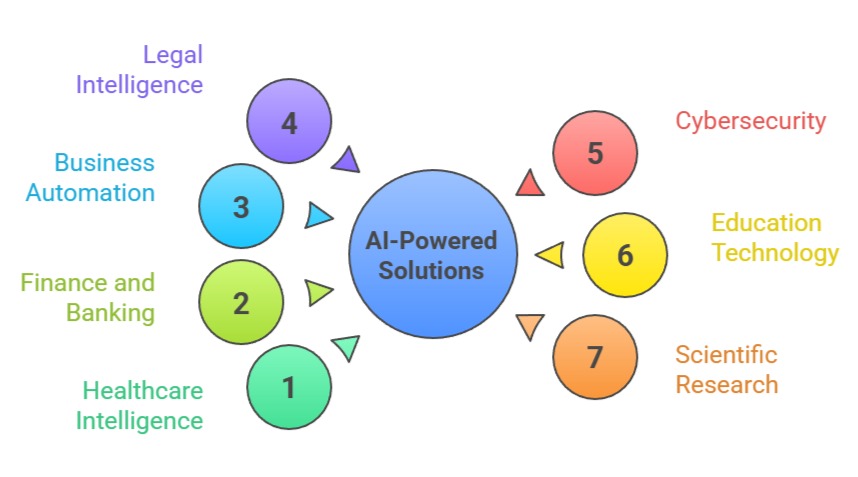
1. Healthcare Intelligence
NLP assists clinicians by organizing medical notes, mapping symptoms, and extracting structured information from lengthy documents.
It supports diagnostic workflows by identifying risk markers from clinical narratives and synthesizing relevant evidence from scientific literature.
Hospitals use NLP-based systems to monitor patient feedback, analyze radiology reports, and streamline administrative documentation.
These models reduce paperwork burdens and enhance decision accuracy in time-sensitive cases.
For instance, NLP can flag signs of adverse drug reactions from prescription logs.
The healthcare domain benefits greatly from automated summarization, coding assistance, and real-time triage, improving both patient outcomes and operational efficiency.
2. Finance, Banking, and Risk Assessment
Financial institutions rely heavily on NLP to interpret regulatory guidelines, evaluate client communications, and detect fraudulent intentions.
NLP-powered sentiment analysis supports investment strategies by tracking market behavior from news feeds, social media, and corporate filings.
Fraud detection systems analyze linguistic cues in text-based interactions to spot suspicious patterns.
Automated report generation simplifies tasks such as preparing compliance summaries or credit evaluation documents.
For example, a bank may use NLP to analyze loan applications and highlight inconsistencies or high-risk indicators.
These tools enhance accuracy and reduce manual workload in a domain where precision is critical.
3. Business Automation and Customer Experience
Enterprises use NLP through conversational agents, document-processing pipelines, and automated service desks.
These systems interpret user messages, classify requests, and respond with context-driven solutions, making operational workflows more efficient.
NLP enhances product recommendation engines, ticket classification systems, and review analysis tools.
E-commerce platforms, for instance, leverage NLP to filter user complaints, categorize queries, and generate personalized shopping suggestions.
By reducing response times and minimizing human intervention, NLP helps businesses maintain consistency across large volumes of customer interactions.
Its reliability in managing repetitive communication tasks leads to higher customer satisfaction.
4. Legal and Compliance Intelligence
NLP streamlines legal research by scanning large volumes of laws, case files, and contracts to identify relevant clauses or precedents.
Law firms use NLP-based tools to detect contractual risks, highlight compliance gaps, and classify legal documents automatically.
These systems reduce the time lawyers spend reviewing repetitive sections, allowing them to focus on strategic analysis.
Court administration departments also use NLP for summarizing judgments and extracting key decisions from lengthy case histories.
For example, a compliance engine can alert companies when new regulations affect their reporting obligations.
This application strengthens accuracy and speeds up legal review processes, lowering operational burden.
5. Cybersecurity and Threat Monitoring
Modern cybersecurity teams rely on NLP to detect phishing attempts, malicious messages, and suspicious patterns in communication logs.
The system analyzes grammar patterns, writing style, and semantic signals that differentiate human-written text from crafted malicious content.
NLP models also monitor dark-web conversations to identify potential data breaches or criminal planning.
For instance, a system can flag emails that mimic corporate communication by evaluating linguistic discrepancies.
NLP-powered surveillance tools help organizations prevent cyberattacks by identifying risks early and triaging them quickly.
This application makes security workflows more adaptive and proactive than traditional rule-based systems.
6. Education Technology and Intelligent Tutoring
Educational platforms use NLP to personalize learning paths, analyze student essays, and provide constructive feedback based on content quality and clarity.
Intelligent tutoring systems read student queries, assess their understanding, and deliver tailored explanations or study materials.
For example, NLP can evaluate whether a student’s reasoning in an answer aligns with expected learning outcomes.
It can also detect sentiment or confusion, allowing the system to recommend reinforcement exercises.
Teachers benefit from automated grading and topic extraction that reduces administrative workload.
As a result, learning experiences become more adaptive and accessible to diverse learners.
7. Scientific Research and Knowledge Discovery
Researchers use NLP to analyse thousands of academic papers, patents, and experimental reports to identify new research patterns or emerging scientific trends.
NLP systems perform tasks like extracting hypotheses, summarising literature, and generating structured datasets from unstructured scientific text.
For example, biomedical NLP tools scan research articles to highlight protein interactions or disease markers. This accelerates discovery by reducing the time spent reviewing large volumes of text manually.
It also promotes interdisciplinary research by connecting related findings across different scientific fields.
NLP-supported systems thus enhance productivity and expand the depth of scientific exploration.
Ethics in NLP
Ethics in NLP focuses on ensuring that language technologies are developed and deployed in a responsible, fair, and trustworthy manner.
It addresses the social, legal, and moral implications of how machines understand and generate human language.
1. Fairness and Bias Mitigation
NLP systems may unintentionally reproduce societal biases present in their training data.
These biases can lead to unfair treatment or inaccurate predictions, especially regarding gender, ethnicity, or socioeconomic factors.
Ensuring fairness requires continuous auditing, balanced datasets, and transparent evaluation mechanisms.
Models must be stress-tested on diverse population groups to detect and correct skewed behaviour.
For instance, a screening tool used for hiring decisions must avoid favouring certain linguistic styles associated with particular demographics.
Ethical deployment demands that systems deliver equitable outcomes regardless of user background.
2. Data Privacy and Security
NLP systems frequently handle sensitive information such as personal messages, medical histories, or financial records.
Protecting this data from leakage or misuse is essential. Robust encryption, access controls, anonymization, and secure data pipelines are required to prevent exposure.
Ethical NLP implementation mandates that users understand how their data is collected and processed.
For example, a virtual assistant handling banking information must ensure that conversations are not stored in ways that compromise user confidentiality.
Strict data governance frameworks are necessary to maintain trust and regulatory compliance.
3. Transparency and Accountability
Users should understand how NLP systems arrive at specific decisions or responses.
Lack of clarity can create mistrust, especially in high-impact environments such as education, healthcare, or legal services.
Developers must implement mechanisms that allow users to trace model behavior, identify errors, and request corrections.
Accountability also involves assigning responsibility when NLP systems produce harmful or misleading outputs.
For instance, a document classification tool used in legal workflows should provide explanations for why a document is flagged as relevant or irrelevant.
Clear documentation, ethical guidelines, and monitoring procedures help ensure responsible use.
Ethical and Societal Challenges in Natural Language Processing
Ethical and societal challenges in Natural Language Processing examine the broader consequences of deploying language technologies at scale.
These challenges emphasize the need to balance innovation with responsibility, inclusivity, and long-term sustainability.
1. Misuse and Manipulation Risks
NLP models can be misused to generate misinformation, impersonate individuals, or create deceptive content at scale.
Malicious actors may use them to craft fake news, manipulate public opinion, or produce fraudulent emails that appear authentic.
These systems can also generate deepfake text that damages reputations or misguides communities.
Without proper safeguards, open-access NLP tools can unintentionally support harmful activities.
For example, an automated model creating fake reviews may distort consumer decisions.
Addressing this challenge requires responsible release practices, model-usage monitoring, and strict enforcement of ethical boundaries.
2. Cultural Sensitivity and Inclusivity
NLP tools often perform poorly for dialects, indigenous languages, and culturally-specific expressions because these languages are underrepresented in training datasets.
As a result, speakers of minority languages may receive inaccurate or biased responses.
This lack of representation creates accessibility barriers and reinforces linguistic inequality.
For instance, a chatbot trained primarily on Western English may misunderstand regional idioms or cultural references from other communities.
Ethical NLP development requires inclusivity expanding linguistic coverage, collecting diverse datasets, and acknowledging cultural nuances. Doing so ensures that technology serves broader populations fairly.
3. Environmental Impact of Large Language Models
Training large NLP models consumes significant computational power, increasing energy usage and carbon emissions.
This environmental cost is often overlooked when evaluating the benefits of AI systems.
Organizations deploying large-scale NLP models must balance performance with sustainability by optimizing training pipelines, using energy-efficient hardware, or applying model compression techniques.
For example, distillation can reduce model size without sacrificing accuracy.
Ethical considerations now extend beyond human impact to ecological responsibility. Addressing this challenge aligns NLP development with global sustainability goals.
4 Overreliance and Reduced Human Oversight
As NLP tools become more capable, organisations may over-delegate critical decisions to automated systems.
Overreliance reduces human judgment in important areas such as medical advice, financial approvals, or legal interpretation.
When users trust the system blindly, errors may go unnoticed, resulting in serious consequences.
For instance, an automated tool assessing insurance claims may overlook context that only a human investigator can accurately interpret.
Ethical use requires clearly defining boundaries between AI assistance and human decision-making.
Human oversight ensures that systems remain accountable, reliable, and aligned with real-world needs.

Class Sessions
Sales Campaign

We have a sales campaign on our promoted courses and products. You can purchase 1 products at a discounted price up to 15% discount.