AI governance, ethics, and socio-technical impacts form the foundational framework that ensures advanced machine learning systems operate responsibly, transparently, and in alignment with societal expectations.
As AI becomes deeply embedded in critical processes ranging from healthcare diagnostics to urban infrastructure there is a growing need for structured oversight that guides how models are designed, deployed, and monitored.
Governance emphasizes aligning AI development with laws, industry standards, and risk-based management principles, while ethics focuses on decision-making that respects human values, autonomy, and fairness.
Socio-technical impacts examine how algorithmic decisions influence communities, cultural behaviors, economic opportunities, and overall social fabric.
Together, these dimensions help organizations anticipate harm, strengthen trust, and maintain accountability as AI evolves into more autonomous and powerful forms.
Modern AI systems operate in environments where data quality, automation scale, and model interpretability directly affect human lives.
Therefore, the goal is not only to create high-performing algorithms but also to ensure that these systems remain safe, inclusive, and aligned with public interest.
A well-designed governance strategy provides clear checks and balances, ethical guidelines ensure value-focused design choices, and socio-technical assessments reveal unintentional consequences that emerge from how people interact with technology.
AI Governance
AI governance ensures that artificial intelligence systems are developed, deployed, and monitored responsibly, ethically, and in compliance with regulations.
It establishes policies, accountability, and transparency to manage risks and maintain trust throughout the AI lifecycle.
1. Establishing Clear Governance Policies
AI governance begins with codified policies describing how systems are built, validated, deployed, and monitored.
These policies act as organizational guardrails that define acceptable practices for data sourcing, model updates, and risk assessment.
They prevent arbitrary decisions by standardizing procedures across teams. For instance, finance firms use strict policy guidelines to ensure automated scoring models cannot be modified without audit trails.
Governance policies also help align internal development with external regulatory frameworks like the EU AI Act.
Ultimately, these structured rules reduce uncertainty, enhance accountability, and ensure consistent quality across the AI lifecycle.
2. Role-based Accountability Structures
Governance assigns specific responsibilities to engineers, product managers, compliance officers, and domain experts.
This prevents ambiguity during incidents by defining who oversees performance audits, who validates datasets, and who approves deployment.
Clear accountability establishes traceability critical for high-risk applications like medical imaging diagnostics.
When a model misbehaves, role-based ownership enables quick identification of failure points.
Such structures also support ethical escalation channels, allowing teams to flag risks early.
This design promotes transparency and encourages responsible collaboration across technical and non-technical units.
3. Continuous Monitoring and Post-Deployment Audits
AI governance requires constant surveillance of deployed models to ensure behaviors remain stable as real-world conditions change.
Models in retail forecasting, for example, may drift due to seasonality shifts or unusual market dynamics. Audits examine fairness metrics, accuracy changes, data leakage, or unintended correlations.
Continuous oversight prevents quietly accumulating risks and ensures the system performs within expected ethical and operational boundaries.
This approach also identifies emerging vulnerabilities that arise from adversarial threats and distribution shifts.
4. Model Documentation and Transparency Standards
Governance frameworks enforce rigorous documentation, including model cards, data sheets, lineage records, and version logs.
These artifacts allow teams to retrace the logic behind each decision, enabling regulatory compliance and external audits.
For example, hospitals use transparency reports to explain how triage models prioritize patients.
Documentation improves stakeholder trust, especially when systems affect sensitive outcomes.
It also ensures future developers can interpret legacy models correctly, preventing knowledge loss in long-term projects.
5. Alignment with Regulatory and Industry Standards
Governance requires strict alignment with privacy laws, AI-specific regulations, and sector-specific guidelines.
This may involve GDPR compliance, medical device standards, or ethical certification frameworks.
Adhering to these rules reduces legal risks and protects user rights during algorithmic decision-making.
For example, autonomous driving systems undergo regulatory safety certification before being allowed on public roads.
Regulatory alignment also improves the credibility of AI products in global markets, offering organizations a competitive edge through responsible innovation.
AI Ethics
AI ethics focuses on guiding the development and deployment of artificial intelligence in a manner that is fair, transparent, and socially responsible.
It emphasizes protecting human welfare, ensuring accountability, and fostering trust through equitable and explainable systems.
1. Fairness and Non-Discrimination Principles
AI ethics prioritizes building models that avoid reinforcing societal inequities.
This means examining biases in training datasets, feature selection, and evaluation metrics.
For example, an HR screening model may unintentionally favor applicants from specific backgrounds if historic hiring data reflects biased practices.
Ethical fairness frameworks require diverse dataset curation, bias audits, and fairness constraints during training.
This ensures that decisions remain equitable and socially responsible across demographic groups.
2. Respect for User Autonomy and Consent
Ethical AI mandates that users understand how their data will be used and retain control over their digital identity.
Transparent consent mechanisms ensure individuals can opt-in or opt-out of data-driven services.
For example, health apps must clearly disclose how biometric data will be processed and for what purpose.
Ethical autonomy also requires allowing users to challenge decisions made by algorithms, particularly in sensitive contexts like credit approvals or medical recommendations.
3. Minimizing Harm and Protecting Human Welfare
A core ethical goal is to ensure that algorithms do not unintentionally harm individuals or communities.
This involves evaluating safety risks, unintended consequences, and psychological impacts before deployment.
For instance, generative AI chatbots used for mental health guidance must not provide misleading or harmful recommendations.
Ethical guidelines encourage risk assessments, red-teaming exercises, and human-in-the-loop systems to prevent harm.
By designing with caution, developers ensure AI enhances well-being rather than exposing users to avoidable dangers.
4. Ethical Transparency and Explainability
Ethics demands that AI systems offer clarity about how outcomes are produced.
Users affected by algorithmic decisions deserve understandable explanations, especially in healthcare, education, and legal processes.
For example, if a loan application is rejected, the model must communicate the reasoning in a clear, actionable manner.
Explainability promotes informed decision-making and helps identify hidden biases.
It also strengthens user trust in autonomous systems, making them more acceptable in real-world environments.
5. Accountability for Ethical Failures
When an AI system causes harm or produces unfair results, organizations must accept responsibility and take corrective action.
Ethical accountability frameworks define processes for reporting issues, evaluating failures, and compensating affected individuals.
For example, if a facial recognition system misidentifies individuals leading to wrongful detainment, the deploying agency must address procedural flaws and provide remediation.
Accountability reinforces the message that developers and decision-makers share responsibility for safe and ethical outcomes.
Socio-Technical Impacts
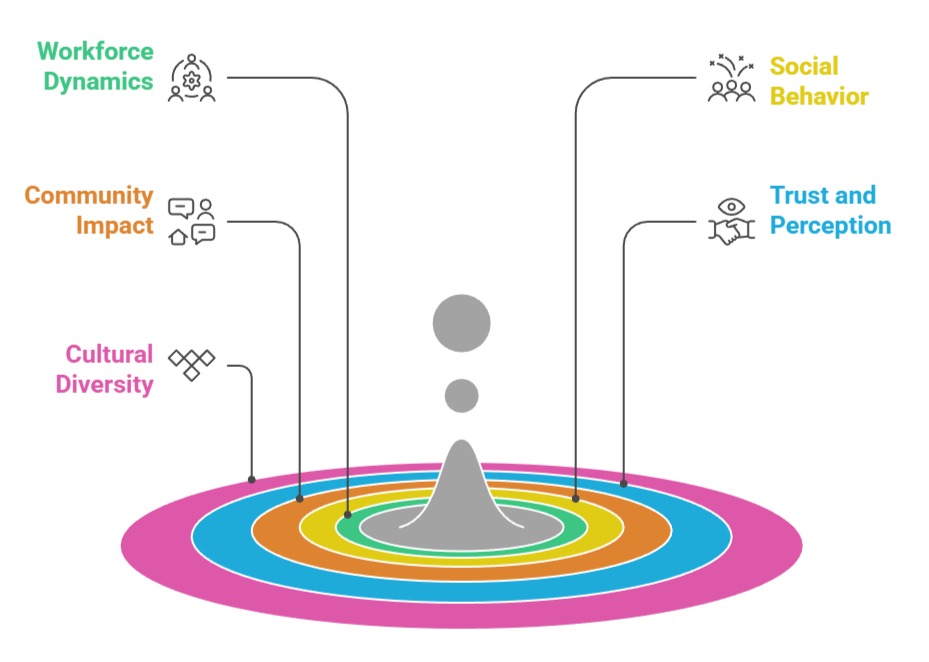 1. Effects on Workforce Dynamics and Job Structures
AI reshapes industries by automating routine tasks and redefining labor demands.
While it can enhance productivity, it may also displace certain roles, requiring workers to retrain or shift to new domains.
For example, AI-powered inventory systems reduce manual stock auditing in retail, altering workforce requirements.
Socio-technical evaluation helps organizations anticipate disruptions and introduce supportive transition programs.
Considering human factors ensures that automation enhances rather than destabilizes workforce ecosystems.
2. Influence on Social Behavior and Human Interaction
AI-driven platforms modify how people communicate, consume information, and form relationships.
Recommendation algorithms influence cultural trends, public opinions, and even political ideologies.
For instance, social media algorithms amplify content that aligns with user preferences, shaping societal narratives.
Studying these effects helps mitigate echo chambers, misinformation loops, and polarization.
Understanding behavior patterns allows developers to balance personalized experiences with societal well-being.
3. Community-Level Impact and Equity Considerations
Different communities respond differently to automated systems depending on local infrastructure, culture, and access to technology.
For example, an AI-based loan approval system may disadvantage communities with historically limited digital footprints.
Socio-technical analysis reveals these disparities and informs equity-focused redesign strategies.
By recognizing uneven impacts, organizations can ensure AI adoption supports diverse populations rather than widening existing gaps.
4. Shifts in Trust, Public Perception, and Social Legitimacy
Public trust determines whether communities accept or reject AI initiatives. Trust is influenced by system transparency, reliability, and perceived fairness.
Autonomous vehicles, for example, face hesitation due to concerns about safety, real-time decision-making, and accountability during accidents.
Socio-technical assessments gauge public sentiment to adjust policies, communication strategies, and design choices.
Strengthening social legitimacy ensures long-term adoption and minimizes resistance.
5. Cultural and Ethical Diversity Across Global Deployments
AI deployed across regions interacts with varying cultural norms, ethical priorities, and regulatory expectations.
A facial expression recognition tool trained on Western expressions may not generalize across cultures.
Socio-technical evaluations highlight these mismatches and encourage inclusive dataset design and culturally aware model adaptation.
This ensures global AI solutions remain respectful, context-sensitive, and effective across diverse populations.

Class Sessions
Sales Campaign

We have a sales campaign on our promoted courses and products. You can purchase 1 products at a discounted price up to 15% discount.