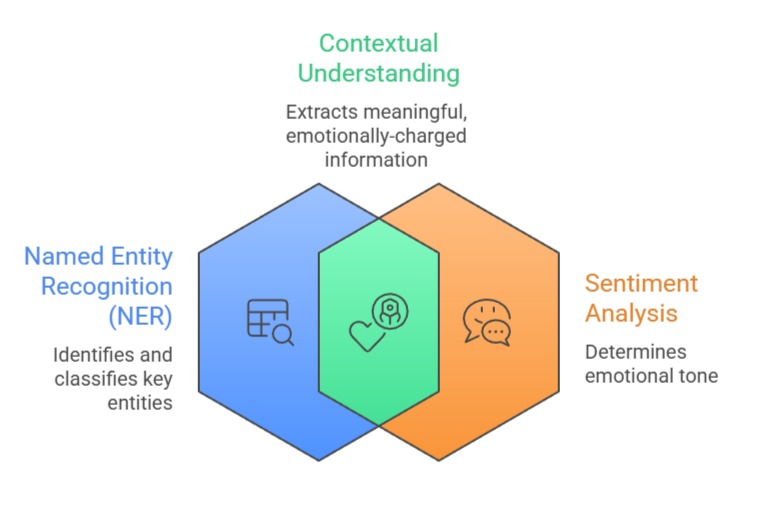
Named Entity Recognition and Sentiment Analysis are two of the most fundamental and widely used components of modern NLP pipelines.
Together, they enable machines to understand not just the structure of language but also the deeper meaning behind textual content.
NER focuses on pinpointing and categorizing specific elements—like individuals, corporate bodies, dates, products, and geographical locations—within unstructured text.
This transforms raw data into structured insights that can be processed further for decision-making and automation.
Sentiment Analysis, on the other hand, interprets the emotional tone embedded in text. It detects whether a statement expresses approval, dissatisfaction, neutrality, or more nuanced attitudes.
With the explosion of user-generated content across digital platforms, sentiment insights have become crucial for studying opinions, monitoring brand reputation, and analyzing customer experiences.
When combined, these techniques provide contextual intelligence: not only what entities are being discussed, but how they are being talked about.
This makes them essential for sectors like finance, healthcare, e-commerce, cybersecurity, media monitoring, and public policy.
Advances in deep learning, pre-trained transformers, contextual embeddings, and domain-specific language models have significantly strengthened the precision and adaptability of both tasks.
Today’s intelligent systems leverage these capabilities to unlock value from vast text corpora, automate workflows, and support strategic analytics in real time.
Named Entity Recognition (NER)
Named Entity Recognition (NER) is a core NLP technique that automatically detects and labels important real-world entities within unstructured text.
It transforms raw language into structured information that machines can analyze, search, and reason over effectively.
1. Entity Categorization – NER identifies predefined categories such as people, industries, physical locations, time stamps, and product names, enabling machines to convert free-form text into structured tagged information.
This tagging becomes essential for downstream tasks like knowledge graph creation and semantic search.
2. Context-Aware Detection – Modern NER models use transformer-based architectures to interpret context before labeling an entity.
For instance, “Amazon” can refer to a company or a river; NER systems resolve such ambiguity through attention mechanisms.
3. Information Extraction Automation – NER helps scale document processing tasks across large datasets, reducing manual effort in fields like legal document review, policy drafting, and research analysis.
4. Domain Adaptability – Models can be fine-tuned for specialized sectors such as medical NER for identifying diseases/drugs or financial NER for extracting stock tickers and company mentions.
5. Improved Query Understanding – Search engines leverage NER to interpret user intent by linking queries with entities, boosting relevance and personalization in results.
6. Enhanced Document Classification – Extracted entities serve as high-value features, improving performance in classification, clustering, and recommendation systems.
7. Support for Real-Time Intelligence – NER enables rapid monitoring of critical events, such as identifying new threats in cybersecurity logs or emerging trends from social media streams.
Example:
Input: “Google partnered with Mayo Clinic in 2023 to improve AI-based diagnostics.”
Output Entities: Google (ORG), Mayo Clinic (ORG), 2023 (DATE)
Sentiment Analysis
Sentiment Analysis is an NLP technique that identifies and interprets emotional tone within text to understand opinions, attitudes, and feelings.
It enables organizations to convert large volumes of unstructured feedback into meaningful, actionable insights.
1. Emotion Interpretation – Sentiment systems determine whether text expresses approval, criticism, or neutrality.
Advanced models can also detect complex sentiments like sarcasm, uncertainty, or mixed emotions.
2. Customer Experience Measurement – Businesses analyze reviews, support tickets, and social media posts to track satisfaction levels and identify areas requiring improvement.
3. Market Insight Generation – Sentiment trends often signal market shifts, influencing brand strategy, political forecasting, or consumer behavior predictions.
4. Social Listening Automation – Platforms use sentiment scoring to monitor millions of posts in real time, allowing organizations to handle PR risks or viral events promptly.
5. Contextual Polarity Understanding – Deep learning models evaluate sentiment relative to context, ensuring phrases like “not bad at all” are correctly interpreted as positive rather than negative.
6. Better Human–AI Interaction – Virtual assistants use sentiment-aware responses to adjust tone, maintain user rapport, and offer empathetic support.
7. Actionable Analytics – Combining sentiment with metadata (time, region, product type) helps generate targeted insights for marketing, product design, and feedback prioritization.
Example:
Input: “The camera quality is impressive, but the battery drains too quickly.”
Output: Mixed Sentiment (Positive + Negative)
Real-World Case Studies for NER & Sentiment Analysis
Real-world case studies demonstrate how Named Entity Recognition (NER) and Sentiment Analysis transform raw text into structured intelligence for faster, smarter decisions.
These applications highlight how organizations leverage NLP to automate insight extraction across finance, healthcare, and e-commerce at scale.
1 Case Study: Financial News Monitoring Using NER (Bloomberg-Style System)
Financial institutions process millions of news articles, earning reports, and social media updates to track market conditions.
A global investment firm deployed an NER-powered pipeline to automatically extract company names, stock symbols, CEO mentions, mergers, and geopolitical entities from real-time data.
This helped analysts detect early signals about acquisitions, regulatory changes, product launches, and leadership updates.
The system categorized every identified entity and linked it to a financial impact score, enabling automatic flagging of high-risk events.
For example, if “Tesla,” “battery supply shortage,” and “Shanghai plant delay” appeared together, the system immediately routed alerts to traders.
This reduced manual reading time by over 70% and improved decision-making speed in fast-moving markets.
2 Case Study: Healthcare Clinical Notes Processing with Medical NER
A major hospital network used a domain-specific NER model (trained on clinical corpora like MIMIC-III) to extract diseases, medications, dosage instructions, and symptoms from doctor-written notes.
This helped convert thousands of handwritten or semi-structured medical records into searchable digital data.
The system captured complex entities like “Type-2 diabetes mellitus,” “metformin 500mg,” or “stage-2 hypertension.”
By automatically tagging and structuring this information, the hospital built a unified patient health summary that supported doctors in diagnosis tracking, automated billing, and high-precision research studies.
It also enabled early detection of disease progression patterns—something previously impossible with fragmented text records.
3 Case Study: E-Commerce Feedback Analysis Using Sentiment Detection (Amazon-Style)
A global online retailer implemented a large-scale sentiment analysis system to monitor millions of product reviews.
Instead of simply marking reviews as positive or negative, the model extracted emotion at a feature level—for example, “delivery speed,” “packaging,” “product durability,” and “customer support.”
A negative rating for “shipping time” triggered operational improvements, while praise for “camera clarity” influenced future marketing campaigns.
Sentiment timelines showed how updates in product versions changed user satisfaction over time.
This granular insight helped teams quickly spot defective product batches, refine logistics, and personalize product recommendations.

Class Sessions
Sales Campaign

We have a sales campaign on our promoted courses and products. You can purchase 1 products at a discounted price up to 15% discount.