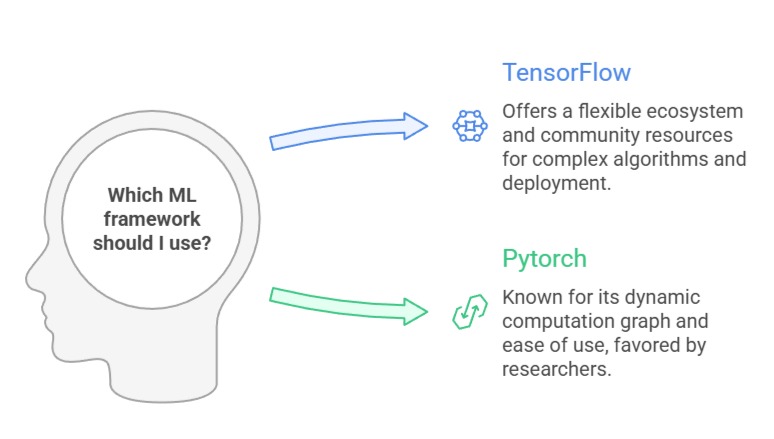
TensorFlow and PyTorch are leading deep learning frameworks that enable the development, training, and deployment of neural network models at scale.
They provide flexible APIs, automatic differentiation, and strong ecosystem support, making them widely adopted for research, prototyping, and production-grade AI systems.
TensorFlow
TensorFlow is an open-source deep learning framework designed for building, training, and deploying machine learning models at scale.
It provides powerful tools and flexible APIs that support both research experimentation and production-ready systems.
1. Graph-Based Execution for Scalable Model Development
TensorFlow operates on a computational graph structure that enables highly optimized execution across CPUs, GPUs, and distributed clusters.
This graph paradigm allows developers to visualize operations, monitor data flows, and fine-tune performance bottlenecks efficiently.
By separating graph construction from execution, TensorFlow can schedule operations intelligently and minimize redundant computations.
This design is especially useful in large-scale production environments where stability and predictable computation patterns matter.
It also supports automatic differentiation within the graph, making training processes smooth and efficient.
Such characteristics make TensorFlow an excellent choice for engineering robust enterprise-level deep learning pipelines.
Example: Using tf.function() converts Python operations into efficient graph code for high-speed deployment on cloud accelerators.
2. Keras APIs for Rapid Prototyping and Experimentation
TensorFlow integrates seamlessly with Keras, offering a concise and intuitive interface for designing neural networks with minimal overhead.
Developers can rapidly assemble layers, test different architectures, and iterate through training cycles without manually handling low-level engine details.
Keras supports functional, sequential, and subclassed models, giving the flexibility to handle both simple prototypes and sophisticated, custom designs.
Its modular structure encourages experimentation with diverse activation functions, custom loss components, and advanced callbacks.
This reduces development time while maintaining high flexibility and precision in research workflows.
Example: Implementing an image classifier with tf.keras.Sequential and training it using model.fit() provides a full workflow with only a few lines of code.
3. Deployment and Optimization Through TensorFlow Serving
TensorFlow offers dedicated tools for scalable deployment, including TensorFlow Serving, TensorFlow Lite, and TensorFlow.js.
These platforms ensure that trained models can run efficiently on servers, mobile devices, browsers, or embedded systems.
They support quantization, pruning, and weight clustering to reduce latency without compromising accuracy.
This deployment ecosystem enables seamless integration of deep learning models into real-world applications such as medical devices, mobile apps, and industrial IoT systems.
Example: Converting a model to TensorFlow Lite allows it to run smoothly on smartphones for tasks like real-time pose estimation.
PyTorch
PyTorch is an open-source deep learning framework widely used for research and production due to its flexibility and intuitive design.
It enables developers to build, train, and experiment with neural networks using a dynamic and Python-friendly workflow.
1. Dynamic Computation Graphs for Flexible Modeling
PyTorch employs a dynamic execution model, meaning the computational graph is built on the fly during runtime.
This flexibility enables custom architectures, conditional operations, and variable sequence lengths to be handled naturally.
Researchers often prefer PyTorch for its intuitive debugging, as models behave similarly to native Python programs.
The dynamic graph design also simplifies experimentation with novel algorithms, making it ideal for exploratory deep learning research.
Its transparent control flow helps developers understand gradients, forward passes, and tensor behavior in real time.
Example: Natural language models benefit from PyTorch’s dynamic graphs because sequence lengths frequently vary across different sentences.
2. Strong Ecosystem for High-Level Research Tools
PyTorch includes powerful libraries like PyTorch Lightning, TorchVision, TorchAudio, and TorchText, each tailored for specific data modalities.
These libraries reduce overhead by providing prebuilt transformations, curated datasets, and ready-to-use neural layers.
This ecosystem accelerates experimentation, encourages reproducibility, and streamlines training loops for complex models.
Researchers building advanced architectures—such as Transformers, GANs, or reinforcement learning agents—benefit from these structured utilities.
Example: TorchVision provides pre-trained backbones like ResNet and EfficientNet, allowing fast transfer learning with minimal coding.
3. Easy Integration With GPU Acceleration and Custom Operations
PyTorch simplifies the process of leveraging GPU hardware through intuitive operations such as .to(device) for tensor migration.
Developers can implement custom CUDA kernels or extend functionality using C++ for performance-heavy operations, making PyTorch suitable for computationally demanding research.
The framework also offers automatic mixed precision, gradient clipping, and efficient parallelization options.
Such features help maintain numerical stability while achieving high throughput during training.
Example: Training GANs with mixed precision in PyTorch significantly reduces GPU memory usage, enabling larger batch sizes.
Implementation Best Practices for Deep Learning Frameworks
Implementing deep learning frameworks effectively requires a combination of sound engineering practices and thoughtful experimentation strategies.
These best practices ensure efficient training, reliable results, and scalable deployment across diverse hardware and application domains.
1. Efficient Data Pipeline Construction
Designing a streamlined input pipeline is crucial to sustaining GPU utilization during training.
This involves using features like TensorFlow’s tf.data API or PyTorch’s DataLoader to enable parallel data loading, automated batching, and on-the-fly preprocessing.
A well-optimized pipeline prevents training slowdowns caused by CPU bottlenecks in data fetching.
Developers can also leverage caching strategies, smart shuffling, and prefetching to reduce disk read delays.
Incorporating augmentation within the pipeline ensures real-time variation without bloating memory usage. These practices collectively create a seamless flow from storage to model, boosting productivity and accuracy.
Example: Using DataLoader(num_workers=4, pin_memory=True) significantly accelerates input preparation in PyTorch.
2. Proper Model Initialization and Weight Management
Initialization determines how well gradients propagate during early training.
Using initializer utilities like Xavier or He initialization avoids exploding or vanishing gradients, especially in deep architectures.
Frameworks provide default initializers, but customizing them helps when experimenting with unconventional layers.
Weight regularization techniques such as weight decay and spectral normalization further stabilize optimization.
Managing initialization ensures consistent convergence across multiple training runs. It also aids reproducibility when combined with fixed random seeds.
Example: TensorFlow’s tf.keras.initializers.HeNormal() is effective for ReLU-based networks.
3. Version Control for Experiments
Tracking experiments systematically prevents confusion when managing hyperparameters, architectures, and training logs.
Tools like TensorBoard, Weights & Biases, MLflow, or even structured CSV logs help keep records of hundreds of experiment variations.
This becomes crucial when tuning deep models where minor parameter tweaks can drastically alter outcomes.
Maintaining experiment histories ensures reproducibility and makes comparisons more objective.
It also allows teams to collaborate by sharing metadata and training artifacts easily.
Example: Logging metrics with TensorBoard while saving checkpoints every five epochs for model traceability.
4. Leveraging Hardware Acceleration Properly
Deep models benefit heavily from GPUs, TPUs, or multi-core CPUs. Efficient framework usage requires device-specific optimizations such as mixed precision training, gradient checkpointing, and appropriate batch sizing.
PyTorch’s torch.cuda.amp and TensorFlow’s mixed_precision API reduce memory footprint and speed up computations.
Monitoring utilization helps identify bottlenecks and adjust workflows accordingly. Ensuring all tensors reside on the correct device avoids costly CPU–GPU transfer delays.
Example: Mixed precision training often yields 2–3× speed improvements on NVIDIA RTX GPUs.
5. Robust Checkpointing and Model Saving Strategies
Saving intermediate states safeguards against unexpected failures and allows training to resume seamlessly.
Both TensorFlow and PyTorch offer flexible checkpointing mechanisms that store weights, optimizers, and scheduler states.
Structuring checkpoints by epoch numbers or metric milestones prevents accidental overwrites.
Maintaining a rolling window of recent checkpoints provides recovery points while managing storage efficiently.
This practice becomes critical in long-running deep learning jobs that may span hours or days.
Example: PyTorch’s torch.save({'model': model.state_dict(),'opt': optimizer.state_dict()}).
6. Monitoring and Debugging Through Visualization Tools
Visualization accelerates debugging by exposing patterns in loss curves, gradients, activation maps, and predictions.
TensorFlow’s TensorBoard offers integrated dashboards for histograms, embeddings, and profile analysis.
PyTorch integrates with TensorBoard or third-party viewers to visualize metrics and intermediate computations.
Visual debugging helps detect overfitting, under-training, anomalous gradients, or bottlenecks early in development.
Interpretation becomes more intuitive, especially when dealing with large models like Transformers or CNNs.
Example: Inspecting activation distributions to detect dead ReLU layers.
7. Ensuring Reproducibility Across Runs
Reproducibility requires controlling randomness in dataset shuffling, weight initialization, and hardware-level operations.
TensorFlow and PyTorch both provide seed-setting utilities that standardize experimentation.
Storing environment details such as library versions, CUDA versions, and configuration files also prevents discrepancies between systems.
This discipline becomes essential when publishing results or collaborating across teams.
Reproducibility builds trust in the training process and ensures fair comparison across different model designs.
Example: Using torch.manual_seed(42) combined with deterministic backend settings.
8. Gradual and Controlled Learning Rate Scheduling
Adopting learning rate schedules promotes stable training and helps escape local minima.
Techniques like cosine annealing, step decay, warm-up phases, or cyclical schedules adjust learning dynamics intelligently.
Implementing schedules via tf.keras.callbacks.LearningRateScheduler or PyTorch’s built-in schedulers ensures automation and consistency.
Proper scheduling prevents overshooting during optimization while encouraging exploration early in training. This enhances generalization and accelerates convergence.
Example: Warm-up followed by cosine decay is widely used in Transformer training.

Class Sessions
Sales Campaign

We have a sales campaign on our promoted courses and products. You can purchase 1 products at a discounted price up to 15% discount.