Cloud data platforms have become central to modern machine learning and data science because they deliver elastic storage, on-demand computing, and fully managed analytical ecosystems.
Instead of maintaining physical servers, organizations can run large-scale data pipelines, deploy ML models, and analyze massive datasets using cloud-native tools that scale automatically with workload intensity.
These platforms also reduce operational complexity by offering integrated services for data ingestion, processing, governance, and security, allowing data teams to focus on insights rather than infrastructure.
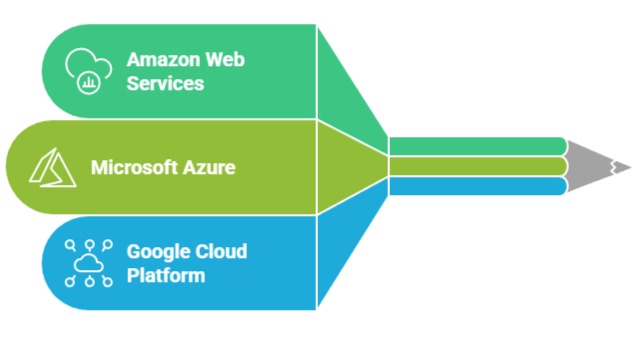
Three major platforms dominate the landscape—Amazon Web Services (AWS), Microsoft Azure, and Google Cloud Platform (GCP).
Each provides unique capabilities: AWS excels in enterprise-grade scalability and diverse services, Azure integrates deeply with Microsoft ecosystems, and GCP leads in ML-driven analytics and high-performance distributed systems.
Their ecosystems support end-to-end workflows such as ETL pipelines, real-time processing, data lake management, streaming analytics, and automated machine learning.
Amazon Web Services (AWS)
Amazon Web Services (AWS) offers a comprehensive cloud platform with scalable tools for storage, data processing, analytics, and machine learning.
Its robust infrastructure enables organizations to manage big data efficiently, supporting both real-time and batch workloads across industries.
1. AWS Overview & Capabilities
AWS delivers a rich suite of data tools—such as S3 for storage, Redshift for data warehousing, Glue for ETL, EMR for big data processing, and SageMaker for ML.
It supports both real-time and batch analytics using serverless and cluster-based options.
AWS’s global infrastructure ensures minimal latency and dependable performance across regions.
For instance, Netflix leverages AWS to process billions of events per day for recommendations and streaming optimization.
2. AWS for Big Data Processing
AWS enables scalable computation through EMR, which efficiently handles Spark, Hadoop, and Presto workloads.
EMR dynamically expands cluster size during heavy processing and contracts afterward, minimizing cost waste.
Businesses analyzing time-series financial transactions, fraud patterns, or clickstream data rely on EMR’s elasticity to maintain throughput.
3. AWS Data Lakes & Storage
Amazon S3 is a cornerstone of cloud data lakes, offering near-infinite storage with high durability.
It supports versioning, lifecycle policies, and integration with Athena for SQL-based querying.
Retail companies use S3-based data lakes to combine sales logs, customer interactions, and IoT signals for multi-dimensional analysis.
Importance of AWS (Amazon Web Services)
1. Global Scalability That Supports Large-Scale Data Science Workloads
AWS is important because it offers one of the largest global cloud footprints, providing multiple availability zones and regions to support distributed computing.
This global presence enables organizations to deploy applications closer to users, minimizing latency and improving system responsiveness.
For data science, globally distributed storage systems like S3 ensure reliable, redundant access to massive datasets.
Companies operating internationally rely on AWS to maintain consistent performance across continents.
The built-in fault tolerance also guarantees continuity during failures, making AWS essential for mission-critical analytics systems.
2. End-to-End Machine Learning Ecosystem Through Amazon SageMaker
AWS plays a vital role in simplifying the full ML lifecycle by offering SageMaker, which combines model training, hyperparameter tuning, data labeling, and deployment into a unified environment.
This reduces the need for managing scattered tools or building custom infrastructure.
SageMaker also supports distributed training and large-scale inference, enabling faster experimentation cycles. Its automated capabilities like
SageMaker Autopilot help teams accelerate development. Because of this, AWS becomes indispensable for enterprises trying to operationalize ML at scale.
3. Secure Infrastructure for Sensitive & Regulated Industries
AWS’s importance also lies in its comprehensive security architecture, which includes encryption, identity management, auditing, and compliance with strict standards such as HIPAA, PCI-DSS, and FedRAMP.
Organizations handling financial, healthcare, or government data rely on AWS for secure storage and processing.
AWS offers fine-grained control over access permissions using IAM, reducing the risk of data breaches.
Its network-level protections and DDoS mitigation further strengthen system resilience. This makes AWS a trusted foundation for sensitive AI workloads.
4. Flexibility to Support Any Data Format, Framework, or Technology Stack
AWS supports a vast array of frameworks such as TensorFlow, PyTorch, Spark, Hadoop, and Kubernetes, giving organizations freedom to build data systems tailored to their needs.
Whether it's structured databases, streaming data, log analytics, or unstructured file systems, AWS provides optimized services for each type.
This flexibility is essential in modern data science where pipelines often mix ETL, real-time analytics, and deep learning.
Teams can evolve their architecture without migrating platforms, making AWS a future-proof choice.
5. Rich Integrations for Real-Time Analytics and Streaming Workloads
AWS is important because it supports advanced real-time data pipelines using Kinesis, MSK, Lambda, and DynamoDB.
These tools make it possible to analyze events instantly, powering fraud detection, personalization engines, sensor monitoring, and live dashboards.
Many companies rely on AWS streaming services to convert raw event flows into actionable insights.
This integration ensures smooth data movement across ingestion, storage, and analytics layers, forming the backbone of modern AI-driven applications.
6. Cost-Effectiveness Through On-Demand, Reserved, and Spot Pricing
AWS’s pricing flexibility contributes significantly to its importance, allowing organizations to choose the most cost-efficient model for their workloads.
Spot instances can reduce training costs dramatically by utilizing unused cloud capacity.
Reserved instances help long-term projects control predictable costs.
This dynamic pricing structure enables startups, research labs, and large corporations to manage budgets effectively, a key factor when dealing with expensive ML operations.
7. Enterprise-Ready Tools Enabling DevOps and MLOps Automation
AWS integrates deeply with DevOps practices through tools like CodePipeline, CloudFormation, Step Functions, and EKS.
These support CI/CD automation, infrastructure-as-code, and pipeline orchestration. For ML teams, AWS offers MLOps features such as model drift detection, endpoint monitoring, and automated retraining.
This results in faster releases, consistent deployments, and reliable operations. As businesses scale AI products, this operational maturity becomes indispensable.
Advantages of AWS (Amazon Web Services)
1. Most Comprehensive Service Catalog Across Any Cloud Provider
AWS offers an unmatched breadth of services across compute, storage, analytics, data engineering, ML, IoT, and security.
This diversity allows teams to build highly customized architectures tailored to specific workflows without relying on external systems.
The wide range of managed services also reduces infrastructure overhead, letting teams focus on innovation instead of maintenance.
This advantage makes AWS suitable for enterprises with complex and evolving needs.
2. Best-in-Class Reliability Through Multi-AZ and Multi-Region Designs
AWS ensures high availability by offering multiple isolated availability zones in each region, guaranteeing system resilience during zone-level failures.
This architecture allows organizations to deploy redundant systems that automatically recover.
For applications requiring uninterrupted service—banking apps, e-commerce platforms, real-time analytics—AWS’s reliability becomes a major differentiating advantage.
Its infrastructure design is proven through decades of large-scale operations.
3. Highly Scalable Compute Options for Heavy AI Workloads
AWS provides a wide variety of compute choices including EC2, ECS, EKS, Lambda, and high-performance GPU/TPU-grade instances.
This makes it a strong advantage for training deep learning models, running distributed data processing, or deploying large-scale inference systems.
Teams can instantly scale up during heavy demand and scale down afterward, optimizing costs while maintaining performance. Such elasticity is difficult to achieve with on-premises infrastructure.
4. Excellent Data Lake Capabilities via Amazon S3
S3’s durability, scalability, and low cost make it one of AWS’s biggest advantages.
It acts as the foundation for data lakes, storing petabytes of data efficiently while supporting real-time analytics, ETL pipelines, and ML workflows.
With features like lifecycle policies, versioning, and cross-region replication, S3 simplifies long-term data management.
Its integration with services like Athena and Glue enhances analytical flexibility.
5. End-to-End AI and ML Tools That Accelerate Innovation
AWS SageMaker provides built-in tools for training, tuning, debugging, monitoring, and deploying models.
This centralized ecosystem reduces complexity and speeds up experimentation.
AWS also offers pre-trained APIs for NLP, vision, translation, and speech, reducing development time for AI capabilities.
Together, these tools help engineers build sophisticated AI systems with minimal setup.
6. Strong Security & Compliance Frameworks
AWS’s advanced security model encompassing IAM, VPC isolation, KMS encryption, and GuardDuty gives organizations confidence that their systems are protected from threats.
Compliance certifications simplify adoption for regulated sectors.
This advantage is critical for industries where security violations have severe financial or legal consequences.
7. Rich DevOps, Automation, and Infrastructure-as-Code Ecosystems
AWS supports DevOps pipelines through CloudFormation, CodeBuild, and Step Functions, enabling automated deployments and version-controlled infrastructure.
This reduces manual errors and accelerates iterative development. For ML projects, MLOps workflows become easier to maintain and scale.
The automation ecosystem strengthens operational reliability and reduces long-term maintenance efforts.
Limitations of AWS (Amazon Web Services)
1. Pricing Complexity and Potentially High Costs
Despite flexible pricing, AWS can become expensive when misconfigured due to its large catalog and consumption-based billing.
Teams must continuously monitor resources, optimize workloads, and set up budget alerts to avoid unexpected bills.
Cost management becomes challenging when multiple services interact, especially under dynamic workloads. This limitation affects both startups and enterprises.
2. Steep Learning Curve for New Users
AWS’s vast ecosystem can overwhelm beginners because services overlap or require advanced configuration.
Understanding IAM rules, VPC networking, security groups, and multi-service integrations demands time and experience.
Even skilled engineers may need extensive training to master complex architectures. This becomes a limitation for organizations without strong cloud expertise.
3. Vendor Lock-In Risk
Deep integration between AWS services increases dependence, making migration difficult once architectures are tightly coupled.
Systems built around proprietary tools like DynamoDB, Lambda, or SageMaker become less portable.
This limits flexibility when switching cloud providers in the future, creating long-term dependence.
4. Complexity in Governance & Permission Management
IAM offers powerful control but quickly becomes complicated in large teams.
Misconfigurations can introduce security weaknesses or access bottlenecks.
Managing hundreds of policies, roles, and permissions often requires specialized administrators. This limitation increases risk and operational overhead.
5. Overlapping Services Create Architectural Confusion
AWS frequently releases new tools that perform similar functions—Athena vs Redshift vs EMR, Lambda vs Fargate vs EC2, Glue vs Data Pipeline, etc.
This sometimes leads to confusion when deciding which service is best for a specific use case.
Suboptimal choices can increase cost or reduce performance.
6. Manual Tuning Required for Some Big Data & ML Tasks
While many services are managed, others require detailed configuration such as EMR tuning, cluster scaling, or VPC optimization.
Poorly optimized setups lead to slower performance or increased cost. This limitation affects teams running complex analytics workloads.
7. Regional Service Availability Differences
Some advanced AWS services are not available in all regions, forcing organizations to rely on workarounds or deploy workloads far from target users.
This impacts latency, compliance, and system design. The limitation especially affects companies with strict data localization rules.
Microsoft Azure
Microsoft Azure provides a versatile cloud platform for data storage, analytics, and machine learning, tightly integrated with the Microsoft ecosystem.
Its services support unified analytics, automated ML, and scalable enterprise solutions across regulated industries and hybrid environments.
1. Azure Overview & Capabilities
Azure integrates seamlessly with Microsoft tools like Active Directory, Power BI, and Dynamics, making it ideal for enterprises already using the Microsoft stack.
Its flagship data services include Azure Data Lake, Synapse Analytics, Databricks, and Machine Learning Studio.
Government, banking, and manufacturing industries choose Azure for its regulatory alignment and hybrid-friendly design.
2. Azure for Unified Analytics
Azure Synapse merges data warehousing, big data processing, and analytics into a unified environment.
Synapse pipelines orchestrate data flow from raw formats into analytics-ready structures.
For example, Rolls-Royce employs Azure Synapse to analyze flight telemetry data and optimize engine maintenance schedules.
3. Azure ML & Automation
Azure ML supports drag-and-drop modeling, automated ML, and MLOps with versioned datasets and experiment tracking.
The integration with GitHub and DevOps pipelines streamlines rapid deployment of predictive systems, such as hospital readmission models or insurance risk scoring.
Importance of Azure
1. Seamless Integration With Microsoft Enterprise Ecosystem
Azure is important because it naturally aligns with Microsoft tools like Windows Server, Active Directory, SQL Server, and Office 365, making it a preferred cloud for enterprises already using Microsoft products.
This tight integration simplifies authentication, workload migration, and hybrid cloud setups.
Organizations can extend their on-premise infrastructure into Azure with minimal modifications. The synergy reduces operational friction and accelerates cloud adoption.
2. Strong Hybrid Cloud Capabilities Through Azure Arc & Azure Stack
Azure stands out for its robust hybrid and multi-cloud architecture, enabling organizations to run workloads across on-premises environments, edge devices, and cloud platforms.
Tools like Azure Stack and Azure Arc allow consistent management of resources regardless of location.
This is crucial for industries with strict compliance or latency constraints.
Azure’s hybrid strategy helps modernize legacy systems without requiring full cloud migration.
3. Enterprise-Grade AI & Data Analytics Platform
Azure’s importance grows from its advanced data ecosystem—Azure Synapse, Azure Databricks, Cognitive Services, and Machine Learning Studio.
These tools make it easy to build large-scale AI workflows, unified pipelines, and embedded intelligence.
Azure Synapse blends data warehousing and Apache Spark analytics, allowing fast multi-model processing.
This provides end-to-end support for enterprises adopting data-driven decision systems.
4. Strong Governance and Identity Management With AAD
Azure Active Directory (AAD) is one of the most widely used identity solutions globally. Its seamless integration with Azure resources ensures centralized access control, policy enforcement, and secure authentication.
Enterprise teams benefit from SSO, conditional access, and multi-factor authentication.
These capabilities make Azure essential in organizations requiring structured governance models.
5. Advanced Support for Edge AI & IoT Workloads
Azure IoT Hub and Azure Edge compute services enable organizations to deploy intelligence close to devices, manufacturing systems, and sensors.
This reduces latency, enhances real-time decision-making, and supports automation in industrial settings.
Azure’s edge capabilities are significant for smart cities, connected vehicles, and manufacturing 4.0 applications.
6. High Adoption Among Regulated and Government Sectors
Azure’s compliance certifications and government cloud offerings make it an attractive choice for healthcare, finance, public sector, and defense organizations.
Microsoft provides specialized regulatory frameworks and region-isolated cloud footprints to meet strict data sovereignty requirements.
This importance is amplified in industries where auditability and legal compliance are mission-critical.
7. Extensive Developer Ecosystem and Tooling Support
Azure integrates deeply with GitHub, Visual Studio, Azure DevOps, and container services such as AKS.
This provides developers with unified pipelines, CI/CD automation, and monitoring tools.
The seamless tooling environment enhances productivity and accelerates application delivery.
Advantages of Azure
1. Best Hybrid Cloud and Multi-Cloud Support
Azure’s hybrid cloud leadership allows organizations to blend on-premise systems with cloud services without losing control or compatibility.
Azure Arc extends management to other clouds and physical hardware.
This flexibility significantly benefits enterprises unable to fully migrate due to compliance, data locality, or legacy constraints.
2. Integrated Development and DevOps Ecosystem
Azure is highly advantageous for application teams because it pairs perfectly with GitHub Actions, Azure DevOps, and Visual Studio.
This reduces the complexity of managing CI/CD pipelines, code repositories, and deployment environments.
Azure’s “developer-first” workflow helps accelerate product cycles.
3. Superior Windows & SQL Server Optimization
Azure offers unmatched performance, licensing benefits, and migration pathways for Windows workloads.
Azure SQL and managed SQL databases also support built-in tuning, scaling, and high availability.
This makes Azure highly advantageous for enterprises heavily dependent on Microsoft technologies.
4. Excellent Big Data & Analytics Tools (Synapse, Databricks)
Azure Synapse Analytics unifies SQL engines, Spark processing, and data integration services in one workspace.
Azure Databricks provides collaborative analytics workflows with GPU-enabled clusters.
Together, they give Azure a strong advantage in building modern data platforms.
5. Highly Secure and Compliant Infrastructure
Azure offers advanced security tools such as Defender for Cloud, Sentinel SIEM, and Key Vault.
These tools identify threats, manage secrets, and provide compliance dashboards.
Azure’s advantage lies in its security automation capabilities and broad regulatory adherence.
6. Large Marketplace and Integration Ecosystem
Azure Marketplace provides thousands of enterprise-ready apps from third-party vendors, making integrations smoother.
This is particularly advantageous for businesses building multi-layered solutions without custom coding.
7. Strong Edge and IoT Enablement
Azure’s IoT Suite and Azure Percept allow organizations to deploy AI on edge hardware.
Industries requiring low-latency decision-making—energy, supply chain, robotics—benefit from these capabilities.
Limitations of Azure
1. Complex Pricing and Licensing Structures
Azure’s pricing often becomes confusing due to region-based differences, hybrid licensing, and resource bundle dependencies.
Calculating accurate costs requires in-depth knowledge of both Azure services and Microsoft licensing.
Misjudged configurations lead to inflated expenses.
2. Occasional Performance Variability Across Regions
Azure can exhibit inconsistent performance across different regions or availability zones.
Some services are slower to roll out enhancements globally, causing disparities in capabilities.
These variations complicate architectural planning for globally distributed teams.
3. Steeper Learning Curve for Non-Microsoft Users
Organizations not already familiar with Microsoft tools may struggle with Azure’s architecture, identity system, and management interfaces.
This contrasts with more developer-focused cloud platforms like GCP. Teams may require significant onboarding time.
4. Limited Open-Source Culture Compared to GCP
Although Azure integrates with many open-source tools, it still leans heavily on proprietary Microsoft technologies.
This can limit flexibility for companies preferring open-source, community-driven ecosystems.
5. Complexity in Hybrid Configurations
While Azure excels in hybrid cloud, misconfigurations in VPNs, peering, or hybrid identity setups can cause operational overhead.
These setups often require specialized Azure architects.
6. Fewer Managed AI Models Compared to GCP
Azure provides strong cognitive APIs but still trails behind GCP in specialized vision, NLP, or document AI services.
This limits Azure’s utility for teams needing advanced pre-trained AI models.
7. Occasional UI/Portal Overload
Azure Portal can feel cluttered with nested menus and overlapping service categories, affecting usability.
Platform navigation becomes challenging, especially for operations teams managing large environments.
Google Cloud Platform (GCP)
Google Cloud Platform (GCP) provides a robust, scalable, and fully managed cloud environment for data analytics, machine learning, and large-scale distributed computing.
It empowers organizations to process, analyze, and derive insights from massive datasets efficiently using Google’s infrastructure.
1. GCP Overview & Capabilities
GCP is designed around high-performance analytics, machine learning, and distributed data systems.
Its core services include BigQuery, Vertex AI, Dataproc, and Dataflow.
Google’s infrastructure, which powers products like Search and YouTube, forms the foundation for GCP’s scalable and low-latency architecture.
Spotify uses BigQuery for event-level analytics across millions of daily interactions.
2. GCP for Serverless Analytics
BigQuery is a serverless data warehouse capable of scanning petabyte-scale datasets within seconds using columnar storage and vectorized execution.
Organizations rely on BigQuery for marketing analytics, anomaly detection, and real-time reporting dashboards.
With integrated ML (BQML), teams can train predictive models directly within SQL.
3. GCP ML Ecosystem
Vertex AI unifies model training, experimentation, drift monitoring, and deployment into one managed ecosystem.
Companies building recommendation engines or NLP systems leverage Vertex’s AutoML and explainability features to speed up experimentation and compliance.
Importance of GCP
1. Exceptional Strength in Data Analytics and Big Data Ecosystems
GCP is important due to its unmatched analytic platforms like BigQuery, Dataflow, and Pub/Sub.
BigQuery’s serverless architecture enables analyzing terabytes in seconds without managing infrastructure.
This is essential for modern data-driven companies requiring real-time insights. GCP’s big data ecosystem is considered one of the most advanced in the industry.
2. AI and ML Leadership With Cutting-Edge Research Integration
GCP’s importance also comes from its deep connection to Google Research and DeepMind.
It offers tools like Vertex AI, TensorFlow, AutoML, and pre-trained models that represent the state-of-the-art in machine intelligence.
These tools provide enterprises access to innovations used internally at Google—search, translation, YouTube, and more.
3. Superior Support for Containerized and Kubernetes Workloads
GCP created Kubernetes, giving it native optimization and best-in-class orchestration through GKE.
Many modern microservice architectures choose GCP for its container reliability, scaling algorithms, and automated node management.
This importance is amplified in organizations prioritizing cloud-native development.
4. Clean, Developer-Friendly Interface and Architecture
GCP stands out with its intuitive UI, minimalistic design, and consistent resource model.
Developers and data engineers appreciate GCP’s simplicity, making onboarding more efficient.
This usability reduces operational friction and enhances productivity.
5. High Performance Networking Infrastructure
Google owns one of the fastest global fiber networks, ensuring ultra-low latency for distributed applications.
GCP customers benefit from the same backbone used by products like YouTube and Gmail.
This makes GCP valuable for high-throughput streaming, real-time analytics, and distributed training.
6. Strong Focus on Sustainability and Green Computing
Google Cloud is carbon-neutral and operates on renewable energy.
Many global companies choose GCP to meet ESG or sustainability goals. This importance grows as industries prioritize environmentally responsible computing.
7. Integration With SaaS Products (Workspace, Maps, YouTube APIs)
GCP integrates seamlessly with Google Workspace, Maps API, Ads ecosystem, and search intelligence tools.
Companies building location services, recommendation engines, or advertising systems rely heavily on GCP’s native connections.
Advantages of GCP
1. Industry-Leading BigQuery Performance and Simplicity
BigQuery’s serverless SQL engine eliminates cluster management, automatic scaling, and caching complexities.
Analysts can query massive datasets instantly, making GCP highly advantageous for BI, marketing analytics, and product intelligence.
Its pay-per-query model lowers cost for variable workloads.
2. Best Kubernetes and Container Orchestration (GKE)
Google Kubernetes Engine offers superior autoscaling, node pooling, and cluster resilience features.
Engineering teams benefit from automated upgrades, monitoring, and resource optimization. This gives GCP a major advantage in cloud-native development.
3. Strong AI/ML Platform With Vertex AI
Vertex AI unifies model training, dataset management, labeling, pipelines, explainability, and deployment.
The advantage lies in the platform’s ability to streamline the ML lifecycle similar to Google’s internal workflows.
This reduces operational overhead and accelerates experimentation.
4. Competitive Pricing Structure
GCP provides sustained-use discounts, committed-use savings, and aggressive pricing for storage and compute. BigQuery’s cost transparency further reduces bill unpredictability. These pricing advantages appeal to startups and research teams.
5. High-Speed Networking & Global Backbone
GCP’s networking is considered the fastest in the industry, offering consistent performance even under heavy distributed workloads. Applications like multiplayer gaming, media streaming, and IoT benefit from this advantage.
6. Clean UI and Smooth Developer Workflow
GCP’s dashboard emphasizes clarity and hierarchy, reducing cognitive load. Developers appreciate how quickly they can deploy workloads without navigating complex menus.
7. Strong Security With Zero-Trust Architecture
GCP uses BeyondCorp principles, enforcing identity-based access across devices and networks.
Its security foundations are derived from Google’s internal infrastructure, offering enterprise-level protection.
Limitations of GCP
1. Smaller Global Footprint Compared to AWS and Azure
Although steadily expanding, GCP still offers fewer regions and availability zones.
Organizations requiring broad geographic redundancy may find this limiting.
Some government or regulated industries need region-specific certifications that GCP lacks in certain countries.
2. Lower Enterprise Adoption in Legacy Corporations
GCP is more popular among tech companies, startups, and AI-first organizations.
Traditional enterprises using legacy systems often prefer AWS or Azure. This results in fewer enterprise partnerships, support communities, or migration blueprints.
3. Less Mature Ecosystem for Hybrid Cloud
GCP’s hybrid cloud offerings (Anthos, GKE on-prem) are improving but still behind Azure’s and AWS’s more mature ecosystems.
This limits adoption in companies with complex on-premise dependencies.
4. Limited Managed Services for Some Enterprise Workloads
Although strong in AI and analytics, GCP offers fewer specialized solutions for areas like ERP migrations, enterprise identity systems, and traditional database engines.
This affects organizations with older IT architectures.
5. Smaller Marketplace Compared to Competitors
GCP’s marketplace has fewer third-party offerings, reducing availability of packaged solutions or enterprise-ready integrations.
This limitation affects large-scale digital transformation projects.
6. Less Aggressive Customer Support for New Cloud Users
GCP’s support ecosystem is improving, but many users report slower onboarding assistance compared to AWS or Azure.
Enterprises relying heavily on guided migration may find this a drawback.
7. Higher Skill Gap for Engineers Not Familiar With Google Ecosystem
Teams unfamiliar with tools like GKE, TensorFlow, or BigQuery may need additional training. GCP’s design philosophies differ from AWS/Azure, leading to a learning curve in real-world operations.

Class Sessions
Sales Campaign

We have a sales campaign on our promoted courses and products. You can purchase 1 products at a discounted price up to 15% discount.