Supervised and unsupervised learning form the two fundamental pillars of modern machine learning, and a strong understanding of their principles is essential as you advance into more sophisticated algorithms.
Supervised learning revolves around learning patterns from labeled datasets, where each input is associated with a known output.
This category includes algorithms for prediction, classification, ranking, and estimation—tasks that power applications such as fraud detection, medical diagnosis, sentiment analysis, and revenue forecasting.
As machine learning systems grow more complex, supervised models are increasingly enhanced using techniques like ensemble learning, regularization, and feature engineering to achieve high accuracy and robustness.
Unsupervised learning, in contrast, deals with unlabeled data and focuses on discovering hidden structures or relationships within datasets.
These techniques are crucial for exploratory analysis, dimensionality reduction, clustering, and anomaly detection.
With the exponential growth of unstructured data, unsupervised algorithms play a central role in organizing information, detecting hidden behavioral patterns, and revealing insights that support strategic decision-making.
Comprehensive Guide to Supervised and Unsupervised Machine Learning
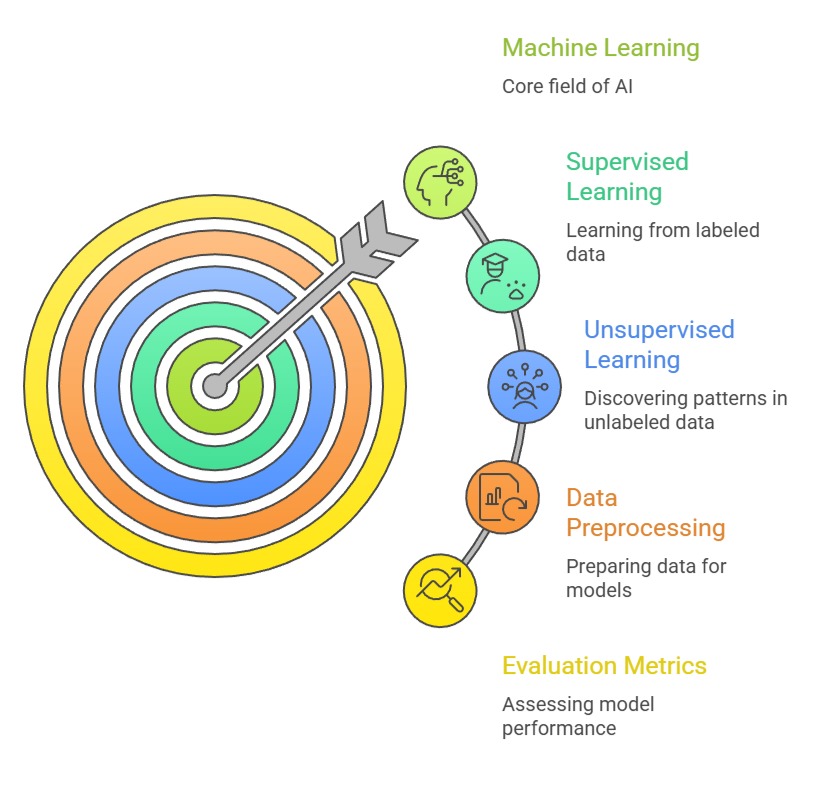
1. Understanding the core principles of supervised learning
Supervised learning relies on labeled datasets where the model learns a mapping between input features and known target values.
The training process uses loss functions and optimization techniques, enabling the algorithm to minimize prediction errors over time.
Techniques such as cross-validation help ensure that the model generalizes beyond the training set, while regularization controls complexity to avoid overfitting.
Supervised methods support a wide range of tasks, including classification, regression, and sequence prediction.
As datasets become larger and more diverse, model selection and hyperparameter tuning become vital.
These foundations prepare learners to adopt advanced variations like gradient-boosted trees and deep neural networks effectively within real-world pipelines.
2. Types of supervised learning algorithms and their applications
Popular algorithms include linear and logistic regression, decision trees, random forests, support vector machines, and neural networks.
Each method has strengths: linear models excel in interpretability, tree-based models capture nonlinear relationships, and neural networks scale to complex, high-dimensional data.
Practical applications span domains such as finance, healthcare, e-commerce, and transportation.
With rapid technological advances, supervised models now integrate techniques like feature selection, automated hyperparameter optimization, and data augmentation.
These capabilities ensure broader adaptability across diverse datasets. Understanding algorithm-specific behaviors helps practitioners choose efficient, explainable, and scalable solutions.
3. Core principles of unsupervised learning
Unsupervised learning focuses on uncovering patterns in data without predefined labels.
It is commonly used for clustering, grouping customers based on behavior, segmenting images, or identifying structural anomalies.
These algorithms rely on similarity metrics, distance calculations, or statistical relationships to detect meaningful patterns.
Since no ground truth is available, evaluation methods differ significantly from supervised learning, making silhouette scores, reconstruction loss, and cluster stability essential assessment tools.
Unsupervised techniques are especially powerful in exploratory data analysis, revealing hidden structures that shape downstream modeling choices.
As data volumes grow, unsupervised learning has become indispensable in data compression, anomaly detection, and automated insight discovery.
4. Major unsupervised algorithms and modern trends
Clustering methods such as K-Means, DBSCAN, and hierarchical clustering remain central due to their simplicity and effectiveness.
Dimensionality reduction techniques like PCA, t-SNE, and UMAP help visualize high-dimensional data and support noise reduction.
Modern unsupervised approaches include autoencoders, self-organizing maps, and contrastive learning, which leverage neural networks to capture deeper representations.
These techniques enable more advanced applications like recommendation engines, image compression, and generative modelling.
The rise of representation learning has significantly expanded the role of unsupervised techniques in natural language processing and computer vision.
As organizations collect more unstructured data, these algorithms continue to evolve for scalability and efficiency.
5. Importance of data preprocessing for both supervised and unsupervised models
Effective preprocessing directly influences algorithm performance, especially because both learning types rely heavily on feature quality.
Techniques such as normalization, handling missing values, encoding categorical variables, and noise reduction are essential to prevent skewed model outputs.
In supervised learning, preprocessing improves predictive accuracy, while in unsupervised learning, it strengthens cluster purity and structural consistency.
Poorly processed data can distort distance calculations, similarity measures, and decision boundaries.
As datasets become more complex and high-dimensional, automation tools for preprocessing—such as feature stores and pipeline frameworks—have become increasingly important.
A solid preprocessing workflow ensures reproducibility, stability, and cleaner learning patterns across both algorithm types.
6. Evaluation metrics and validation techniques across learning types
Evaluation in supervised learning uses quantitative metrics such as accuracy, F1 score, AUC, RMSE, and MAE, allowing clear performance comparison between models.
In contrast, unsupervised learning requires metrics such as silhouette score, Davies–Bouldin index, inertia, and reconstruction error since no labels exist.
Cross-validation and bootstrapping help prevent overfitting in supervised tasks, while cluster validation and stability tests guide unsupervised model reliability.
Understanding these metrics ensures that practitioners avoid misleading conclusions, especially when dealing with imbalanced or noisy datasets.
Modern ML platforms also support automated metric tracking and experiment logging, improving transparency. Proper evaluation enables better model selection, tuning, and deployment decisions.
7. Challenges and limitations in supervised and unsupervised algorithms
Supervised learning often requires large labeled datasets, which can be time-consuming and costly to produce, reducing scalability.
Overfitting, bias in training samples, and sensitivity to outliers are persistent challenges.
Unsupervised learning, on the other hand, may produce clusters or groupings that lack real-world interpretability, making validation difficult.
Algorithms like K-Means depend heavily on initialization and predefined cluster numbers, while density-based methods struggle with varying densities.
Both categories can be computationally expensive when dealing with massive datasets.
As models scale, resource constraints, hyperparameter sensitivity, and generalization become core issues requiring advanced optimization strategies.
8. Role of hybrid and semi-supervised learning bridging both paradigms
Hybrid approaches combine the strengths of supervised and unsupervised learning to overcome data scarcity and improve performance.
Semi-supervised learning leverages a small amount of labeled data alongside vast unlabeled datasets, significantly reducing annotation effort.
Techniques such as pseudo-labeling, graph-based learning, and consistency training have gained widespread use in NLP, computer vision, and speech processing.
These methods improve generalization by aligning representation spaces learned from unlabeled data with accurate labeled outputs.
Hybrid approaches enable smoother model adaptation in real-world environments where labeled data is scarce but raw data is abundant.
This evolving intersection is essential as organizations collect more unstructured information globally.

Class Sessions
Sales Campaign

We have a sales campaign on our promoted courses and products. You can purchase 1 products at a discounted price up to 15% discount.