Text Preprocessing and Feature Engineering form the foundational pipeline of Natural Language Processing, ensuring raw linguistic data is transformed into structured, machine-understandable formats.
Since real-world text often contains noise, inconsistencies, spelling errors, and extraneous symbols, preprocessing helps refine and standardize the input so that algorithms can interpret patterns more effectively.
This phase includes techniques like tokenization, text normalization, stopword elimination, stemming, lemmatization, and handling special characters or emojis depending on the domain.
Without clean and consistent text, even advanced models struggle to extract meaning or produce reliable predictions.
Feature Engineering further enhances model performance by converting processed text into meaningful numerical representations.
These features may range from simple frequency-based metrics to complex syntactic and semantic descriptors.
Effective feature engineering allows models to capture vocabulary richness, contextual clues, document structure, sentiment cues, and domain-specific terminology.
It helps differentiate subtle patterns, improves classification accuracy, and ensures downstream tasks such as topic modeling, sentiment analysis, recommendation systems, and text clustering operate with greater precision.
Together, preprocessing and feature engineering significantly improve computational efficiency, reduce dimensionality, and strengthen model interpretability.
Modern NLP systems, even those built on neural architectures, benefit from well-crafted preprocessing steps to reduce ambiguity and enhance representation quality.
As organizations rely more on textual data—emails, reviews, transcriptions, customer support logs, and legal documents—these techniques are critical for extracting actionable insights.
Ultimately, mastering preprocessing and feature engineering enables the development of robust, scalable NLP models capable of performing reliably across varied linguistic environments.
Key Concepts in Text Preprocessing and Feature Engineering
Text preprocessing and feature engineering are essential steps that convert raw, unstructured text into meaningful numerical representations.
These techniques clean, standardize, and enrich textual data so machine learning and deep learning models can learn patterns effectively.
1. Tokenization
Tokenization splits raw text into smaller units—words, subwords, or sentences—allowing models to analyze linguistic structure at granular levels.
It helps isolate meaningful components so algorithms can identify recurring patterns, transitions, and dependencies.
Advanced tokenizers, such as Byte Pair Encoding (BPE), break rare or unseen words into subword fragments, improving vocabulary coverage and reducing out-of-vocabulary issues.
Tokenization also assists in recognizing punctuation, emoticons, or domain-specific terms in social media and technical documents.
By converting a continuous text stream into manageable units, tokenization becomes the first gateway to reliable feature extraction.
Example: “Machine-learning models evolve.” → ["Machine", "-", "learning", "models", "evolve"]
2. Normalization
Normalization ensures text consistency by standardizing formatting, reducing variations, and eliminating irrelevant discrepancies.
This step includes converting text to lowercase, handling Unicode characters, expanding contractions, and removing redundant symbols.
For domains like healthcare, normalization must preserve critical terminology while removing noise.
It also supports tasks like speech transcripts where filler words or repeated characters need correction.
By harmonizing textual input, normalization reduces ambiguity and strengthens downstream feature learning.
Example: “I’M RUNNING!!!” → “i am running”
3. Stopword Removal
Stopword removal eliminates frequently occurring but semantically light words such as “the,” “is,” or “at.” This reduces computational load and helps models focus on the most informative content.
However, the stopword list must be domain-sensitive legal or medical texts may rely heavily on words that appear trivial in general language.
Removing noise from text improves clarity during vectorization and enhances performance for tasks like topic modeling or keyword extraction.
Stopword filtering helps capture core meaning rather than syntactic fillers.
Example: “The product is of great quality” → “product great quality”
4. Stemming and Lemmatization
Stemming trims words to their root forms by removing suffixes using rule-based algorithms, whereas lemmatization identifies the dictionary base form by considering grammatical context.
These methods consolidate multiple word variants into a unified representation, reducing vocabulary size and improving generalization.
Lemmatization is more precise but computationally heavier, making it suitable for tasks requiring linguistic accuracy.
Both approaches help models interpret related terms cohesively within classification or clustering tasks.
Example: “Running,” “runs,” “ran” → “run”
5. N-gram Feature Extraction
N-grams capture sequences of words to preserve contextual proximity and structural meaning beyond individual tokens.
They help models understand common patterns such as collocations, idioms, or phrase-level sentiment markers.
While unigrams reflect individual terms, bigrams and trigrams highlight relational meaning, aiding tasks like spam detection or intent classification.
Though n-grams increase feature dimensionality, they often provide richer insight into linguistic dependencies.
Example: “Natural language processing” → bigrams: (“natural language,” “language processing”)
6. TF-IDF Representation
TF-IDF transforms text into weighted scores that reflect both the frequency and uniqueness of terms across documents.
Words that appear frequently in a specific text but rarely in others receive higher scores, making them valuable discriminators.
This method improves document classification, keyword extraction, and content similarity analysis by capturing contextual importance.
It also reduces noise from overly common terms that contribute little meaning. TF-IDF remains a powerful tool in traditional NLP pipelines and hybrid neural workflows.
Example: Identifying “contract breach” as highly significant in legal case summaries.
Importance of Text Preprocessing and Feature Engineering in NLP
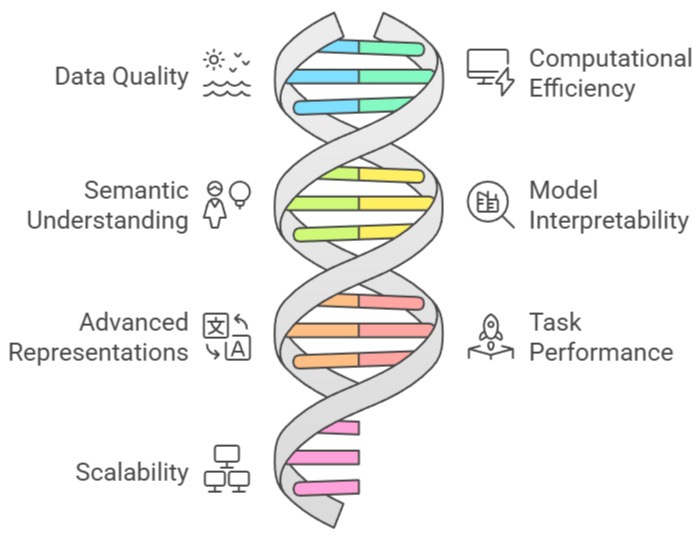
1. Enhances Data Quality and Reduces Noise
Clean and well-structured text is essential for any NLP system because raw linguistic data often contains errors, inconsistencies, and irrelevant characters that distort model learning.
Preprocessing removes typos, unneeded punctuation, repeated symbols, and formatting issues that could mislead algorithms.
When noise is reduced, models detect actual semantic patterns more accurately, resulting in stronger predictive performance.
This also minimizes false correlations that emerge from cluttered data. High-quality input ultimately leads to models that generalize better across unseen text.
Example: Removing emojis and HTML tags from customer reviews before sentiment analysis.
2. Improves Computational Efficiency and Reduces Dimensionality
Raw text creates enormous feature spaces, causing models to consume excessive memory and computation time.
Preprocessing techniques like stopword removal, normalization, and stemming compress the vocabulary into a more meaningful subset.
This reduction lowers the cost of training traditional models such as SVMs and Naïve Bayes while speeding up inference.
Efficient dimensionality also prevents overfitting, as models focus on significant linguistic signals rather than redundant tokens.
Example: Shrinking a 50,000 word vocabulary to 15,000 after preprocessing.
3. Strengthens Semantic Understanding and Context Extraction
Feature engineering helps highlight important linguistic structures such as phrase patterns, grammatical signals, and contextual relationships.
Representations like n-grams, TF-IDF, and lemmatized features reveal how meaning flows within sentences, improving classification and clustering outcomes.
These engineered features allow models—especially traditional machine learning algorithms—to capture nuances that plain tokens cannot represent.
Example: Using bigrams helps detect phrases like “credit card fraud” as a meaningful unit.
4. Enables Better Model Interpretability and Transparency
Preprocessing and engineered features make it easier for practitioners to understand why models behave the way they do.
Frequency-based features, cleaned tokens, and normalized text provide clear, human-readable structures that can be inspected directly.
This is especially important in sensitive domains such as healthcare, law, and finance, where explainability is a requirement.
Transparent features also help identify data leakage, mislabeled samples, or biased vocabulary distributions.
Example: TF-IDF weights reveal which words strongly influence a prediction.
5. Lays the Foundation for Advanced Language Representations
Even state-of-the-art neural architectures benefit from thoughtful preprocessing, as it reduces ambiguity and ensures consistent input.
Neural models struggle with messy formats, spelling variations, and irregular sentence structures.
Preprocessing brings uniformity, while feature engineering such as subword segmentation or character-level tokenization feeds richer signals into deep networks.
Well-prepared data enhances embedding quality, improves convergence, and stabilizes training.
Example: Subword tokenization helps Transformer models handle rare biomedical terms.
6. Boosts Performance Across NLP Tasks and Domains
Tasks like sentiment analysis, topic extraction, question answering, and spam filtering depend heavily on reliable textual representation.
Preprocessing and engineered features improve accuracy by highlighting the most relevant components of the text and removing distractions.
These techniques make models more adaptable to varied domains, whether dealing with social media, scientific literature, emails, or legal contracts.
Example: Lemmatization improves accuracy in intent classification systems.
7. Facilitates Scalability and Real-World Deployment
In production pipelines, NLP systems often need to process millions of messages daily. Efficient preprocessing ensures streamlined workflows that can handle continuous streams of text without performance drops.
Feature engineering creates compact, meaningful representations that allow real-time predictions at scale.
This reliability is essential for enterprise-level applications such as chatbots, monitoring tools, and recommendation engines.
Example: Scalable preprocessing pipelines deployed in customer support AI.

Class Sessions
Sales Campaign

We have a sales campaign on our promoted courses and products. You can purchase 1 products at a discounted price up to 15% discount.