AutoML tools and frameworks have become essential for simplifying the development, training, and deployment of machine learning models across diverse domains.
They reduce the need for manual experimentation by automating tasks such as feature engineering, algorithm selection, model optimization, and performance monitoring.
Among the widely adopted platforms, Google Cloud AutoML and H2O.ai stand out for their robustness, scalability, and ability to support enterprise-level ML workflows.
Google Cloud AutoML provides a fully managed ecosystem where users can train high-quality models without needing extensive coding or deep mathematical expertise.
It leverages Google’s advanced neural architectures and cloud resources to automate model creation, making it highly suitable for organizations aiming to deploy customized solutions quickly.
On the other hand, H2O.ai offers a more flexible, open-source-driven environment through its AutoML suite, enabling seamless integration with existing data pipelines and supporting a wide array of algorithms.
Its emphasis on transparency, interpretability, and distributed computing makes it a popular choice among data scientists looking to maintain control while still benefiting from automation.
Google Cloud AutoML
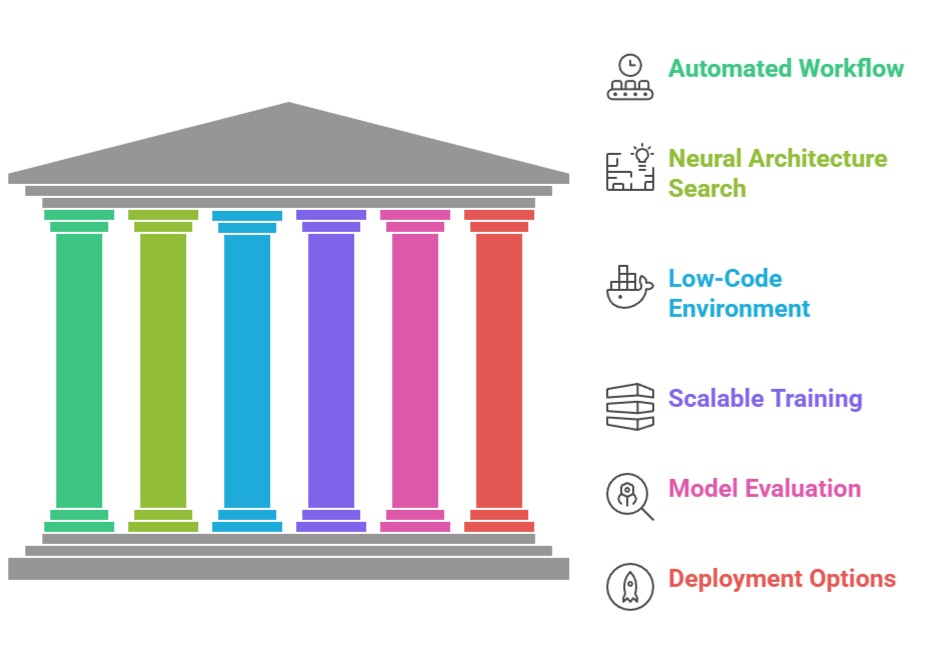 1. End-to-end automated workflow
Google Cloud AutoML provides a unified interface for dataset preparation, training, evaluation, and deployment.
The system streamlines tasks that would typically require significant coding effort, enabling faster iteration cycles.
This holistic framework is especially useful for vision, language, and structured data tasks where rapid prototyping is critical, such as product classification or document understanding.
2. Neural architecture search integration
The platform uses Google’s advanced neural architecture search (NAS) to identify optimal network structures for tasks like image recognition or text classification.
Instead of relying on predefined architectures, AutoML dynamically explores network shapes, improving accuracy beyond manual configuration.
For example, AutoML Vision creates custom CNNs tailored specifically to the dataset’s complexity.
3. User-friendly, low-code environment
With a clean UI and APIs, Google Cloud AutoML lets non-experts train sophisticated models without writing extensive code.
This accessibility supports business teams, product managers, and analysts who want machine learning capabilities without deep technical background.
It allows quick experimentation such as building a model that categorizes customer emails automatically.
4. Scalable training powered by Google Cloud
AutoML leverages distributed cloud infrastructure for model training, allowing users to handle large datasets efficiently.
This scalability ensures consistent performance even for enterprise workloads like sentiment analysis across millions of reviews.
Users only pay for compute used, making it cost-effective and flexible.
5. Integrated model evaluation and explainability
The platform includes built-in interpretability tools such as feature attributions, confusion matrices, and performance dashboards.
These insights help users understand model behavior and refine datasets accordingly.
For instance, AutoML Tables provides clear visibility into which inputs most influence predictions.
6. Seamless deployment options
Models can be deployed directly to Vertex AI endpoints for real-time or batch inference with minimal friction.
This reduces operational overhead and ensures models remain reliable in production environments, such as real-time fraud alerts or automated content moderation.
Example: A retail company uses AutoML Vision to classify product images into hundreds of categories, improving search accuracy and inventory management without manually designing CNN models.
Advantages
1. Highly Accessible for Non-Experts
Google Cloud AutoML allows users with minimal machine learning expertise to create strong models through its intuitive interface and low-code environment.
This accessibility reduces the dependency on highly specialized ML engineers, enabling broader teams such as marketing analysts or business strategists to leverage machine learning effectively.
The simplified workflow accelerates idea-to-solution timelines and encourages rapid experimentation across departments without requiring deep algorithmic knowledge.
2. Powerful Neural Architecture Search (NAS)
AutoML incorporates Google’s NAS technology, enabling dynamic model architecture exploration tailored to the dataset.
This significantly enhances performance for tasks like image classification, entity extraction, and structured data modeling.
Instead of forcing users to manually select or design architectures, NAS automates this process, often producing models surpassing those created through traditional trial-and-error.
This automated innovation makes it ideal for organizations looking for cutting-edge accuracy without manual architecture tuning.
3. Seamless Cloud Scalability
As a native part of Google Cloud, AutoML benefits from distributed training infrastructure capable of scaling to large datasets effortlessly.
Users can run high-compute training jobs without managing servers or hardware, reducing operational complexity.
This elasticity supports industries like e-commerce or social media that require massive, continuously growing datasets and real-time model updates.
Limitations
1. Limited Customization for Advanced Users
While great for ease of use, Google Cloud AutoML’s abstraction layers restrict low-level customization and detailed control over the training process.
Experienced ML practitioners may find it challenging to modify architectures, apply custom loss functions, or adjust nuanced optimization strategies.
This makes the platform less suitable for teams needing fine-tuned experimentation with diverse or highly specialized model structures.
2. High Cost for Extensive Training
AutoML services can become expensive when running multiple training cycles, especially for large image or text models.
Since training uses Google’s managed cloud infrastructure, the cost scales with compute hours, making long experimentation phases costly.
Organizations with constrained budgets or teams needing frequent retraining may face financial limitations compared to open-source or local alternatives.
H2O.ai (H2O AutoML)
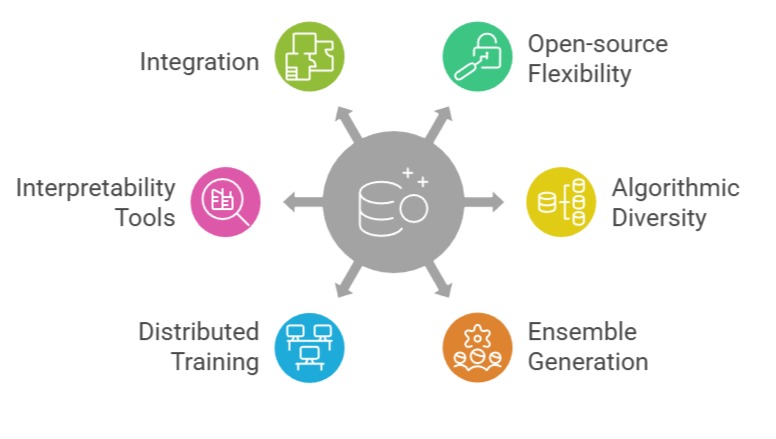
1. Open-source flexibility and transparency
H2O.ai provides an open-source AutoML engine that enables full visibility into model construction processes.
This transparency allows data scientists to inspect generated models, customize settings, and maintain control over the ML pipeline.
Organizations that prioritize auditability, like banking or insurance, benefit from this degree of openness.
2. Rich algorithmic diversity
The system explores a wide range of algorithms, including GBMs, XGBoost, GLMs, Random Forests, and stacked ensembles.
By testing several families of models, H2O AutoML broadens the search for superior solutions, especially for tabular datasets.
This versatility is valuable for applications like credit scoring or customer risk prediction.
3. Automatic ensemble generation
One of H2O’s strengths is its ability to build powerful stacked ensembles by combining predictions from multiple high-performing models.
This technique frequently leads to substantial boosts in accuracy without manual tuning.
For example, in a demand forecasting project, H2O ensembles often outperform standalone models.
4. Distributed and memory-efficient training
Built with scalability in mind, H2O AutoML supports distributed computing across clusters, enabling rapid experimentation with massive datasets.
Its optimized memory handling ensures smooth execution even when working with millions of records.
This capability is crucial for telecom churn analysis or sensor-based IoT predictions.
5. Interpretability tools through H2O Explainability
H2O integrates robust explainability features such as SHAP values, partial dependence plots, and decision paths.
These tools offer deep insights into how models behave, helping teams ensure fairness, compliance, and reliability.
It is especially helpful in sectors where transparency is mandatory.
6. Language and platform integration
H2O supports Python, R, Java, Spark, and Flow UI, making it highly adaptable to various workflows.
This interoperability ensures compatibility with existing infrastructure, reducing integration challenges for enterprise deployment pipelines.
Example: A healthcare provider uses H2O AutoML to build risk prediction models for patient readmissions, leveraging stacked ensembles to achieve higher precision while maintaining interpretability for medical teams.
Advantages
1. Strong Flexibility and Transparency
H2O AutoML offers full visibility into models, hyperparameters, and ensemble structures, giving teams granular control over the entire pipeline.
This transparency is essential for regulated industries where interpretability and auditability are required.
Data scientists can inspect models, override defaults, customize algorithms, or integrate them into existing workflows, making H2O a highly adaptable platform for technical teams.
2. Broad Algorithmic Range and Stacked Ensembles
The framework evaluates multiple algorithms—GLMs, GBMs, Random Forests, XGBoost, and deep learning networks—before combining top performers into robust ensembles.
This diversity increases the chances of achieving superior results, especially for tabular or structured datasets.
Stacked ensembles often outperform individual models, making H2O suitable for use cases like financial risk modeling or industrial forecasting.
3. Scalable, Distributed Computing Support
H2O’s architecture supports distributed training across clusters, allowing it to handle massive datasets efficiently.
This capability benefits organizations managing real-time analytics or high-frequency data streams.
The optimized memory management ensures smooth performance even under heavy workloads, making it a reliable option for enterprise-scale ML deployments.
Limitations
1. Requires Technical Expertise for Full Utility
Although H2O has user-friendly tools like the Flow UI, its full potential is realized only when used by data scientists with programming and statistical knowledge.
The learning curve may be steep for beginners who need to understand model structures, algorithms, and tuning options.
This reduces its accessibility for business users or teams without strong ML backgrounds.
2. Limited Support for Complex Deep Learning Tasks
While H2O supports basic deep learning models, it is not as advanced or optimized as specialized frameworks like TensorFlow or PyTorch for tasks such as image generation, NLP transformers, or reinforcement learning.
Users working on cutting-edge deep learning projects may find the capabilities insufficient or restrictive, particularly when custom architectures or GPU-optimized pipelines are required.

Class Sessions
Sales Campaign

We have a sales campaign on our promoted courses and products. You can purchase 1 products at a discounted price up to 15% discount.