Big Data technologies like Hadoop and Apache Spark form the backbone of modern large-scale data processing, enabling organizations to derive insights from massive, fast-moving, and highly diverse datasets.
As data volumes grow exponentially from IoT sensors, social media, enterprise transactions, and real-time digital streams traditional analytical tools fail to scale effectively.
Hadoop revolutionized distributed computing by introducing a way to store huge datasets across clusters of commodity hardware while providing resilient batch-processing capabilities through the MapReduce framework.
Spark evolved the ecosystem further by offering high-speed, in-memory distributed computation, enabling advanced analytics, interactive queries, and real-time processing pipelines.
Both technologies support industries dealing with complex datasets from e-commerce behavior logs to genomic sequences and predictive maintenance data.
Hadoop provides reliable long-term storage and fault-tolerant batch processing, while Spark enhances speed, versatility, and advanced analytical capabilities such as graph computation and machine learning.
Together they form a powerful ecosystem that enables scalable ETL workflows, stream analytics, and large-scale model training.
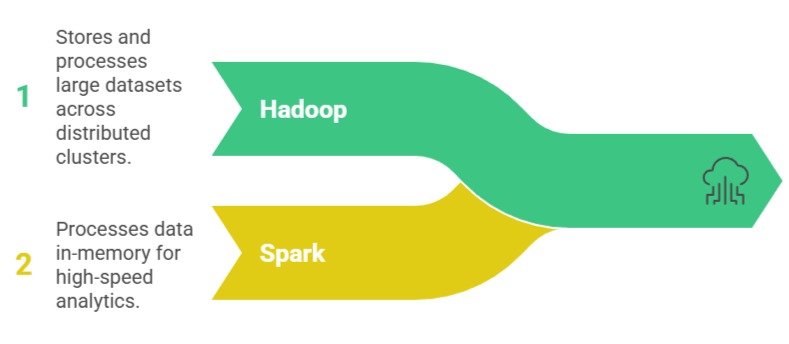
Hadoop
Hadoop is an open-source big data framework designed to store and process extremely large datasets across distributed clusters of commodity hardware.
It relies on the Hadoop Distributed File System (HDFS) for scalable storage and MapReduce for batch-oriented parallel processing.
Hadoop makes it possible to handle data volumes that exceed the limits of traditional databases by spreading workloads across thousands of nodes, ensuring reliability through replication and fault tolerance.
It is primarily used for massive, long-running, batch-driven analytics such as log processing, clickstream analysis, and historical data crunching.
1. Distributed Storage with HDFS
HDFS (Hadoop Distributed File System) splits large datasets into smaller blocks and spreads them across multiple servers.
This approach ensures durability because each block is replicated across nodes, preventing data loss in case of hardware failure.
HDFS supports petabyte-scale storage, making it ideal for archival data, log collection, and massive ETL workflows.
It allows parallel read operations, accelerating batch jobs that process multi-terabyte datasets.
Companies like LinkedIn use HDFS for long-term data retention and large-scale analytical workflows.
2. Batch Processing with MapReduce
MapReduce enables parallel data transformations by splitting jobs into mapping (filtering) and reducing (aggregation) phases.
It is optimized for tasks such as log parsing, clickstream summarization, and index building.
Although slower compared to Spark, MapReduce guarantees reliability and fault tolerance.
It automatically handles node failures, restarts tasks, and ensures consistent output. Industries like insurance and banking use MapReduce for compliance reporting and heavy historical data processing.
3. Scalability and Cost Efficiency
Hadoop is designed to scale linearly by simply adding more commodity hardware nodes.
This makes it extremely cost-effective for enterprises dealing with multi-petabyte datasets. Instead of investing in high-end servers, organizations can use clusters of affordable machines.
This model is crucial for companies such as Twitter, which handle billions of daily interactions requiring distributed storage.
Importance of Hadoop
1. Foundation for Large-Scale Distributed Storage
Hadoop’s HDFS provides the backbone for storing massive datasets across clusters of inexpensive hardware.
It breaks files into distributed blocks and replicates them across nodes to eliminate single points of failure.
This design is crucial for enterprises that accumulate terabytes of logs, transactions, or sensor readings daily.
By supporting distributed workloads, HDFS enables organizations to handle exponential data growth without relying on expensive proprietary storage systems.
2. Essential for Batch Processing of Historical Data
Hadoop’s MapReduce is optimized for processing huge static datasets where immediate results are not required.
This makes it vital for financial auditing, risk modeling, compliance reporting, and archival data analytics.
It handles multi-hour or multi-day jobs reliably without crashing, even during node failures.
This robustness makes Hadoop an irreplaceable choice for sectors that rely heavily on historical patterns and long-term data analysis.
3. Cost-Effective Architecture for Data Lakes
Hadoop underpins many enterprise data lake infrastructures because it scales horizontally with low-cost commodity servers.
Traditional relational databases fail beyond a certain size, while Hadoop expands nearly limitlessly.
Organizations like banks, retailers, and healthcare systems use Hadoop-based data lakes to store structured, semi-structured, and raw data without worrying about schema constraints.
Its affordability makes it ideal for long-term retention.
Advantages of Hadoop
1. Massive Scalability Using Commodity Hardware
Hadoop clusters can scale from a few nodes to thousands simply by adding machines.
This horizontal expansion makes it ideal for growing businesses that need more storage or processing without redesigning their architecture.
Unlike traditional solutions that require premium hardware, Hadoop works effectively with inexpensive servers.
This keeps costs manageable as data volumes climb into petabytes.
2. Strong Fault Tolerance and High Durability
HDFS creates multiple replicas of each block so data persists even when hardware components fail.
The NameNode tracks these replicas and automatically rebalances the cluster to maintain resilience.
This built-in reliability ensures analytical tasks continue running despite node crashes.
Industries dealing with compliance, risk, and regulated data benefit significantly from this reliability.
3. Handles Unstructured and Semi-Structured Data Efficiently
Unlike relational databases requiring rigid schemas, Hadoop accepts logs, images, JSON files, clickstream data, and more in their raw form.
This flexibility allows data scientists to store everything first and decide structure later during analysis.
Hadoop is particularly valuable for ETL pipelines, data ingestion frameworks, and exploratory analytics where data formats vary widely.
Limitations of Hadoop
1. Slow Execution Due to Disk-Heavy Processing
MapReduce relies on frequent disk reads and writes, making it significantly slower than memory-based engines like Spark.
Iterative algorithms such as clustering or neural network training become impractically slow.
As a result, Hadoop is unsuitable for tasks demanding rapid insights or real-time responsiveness, limiting its relevance in modern, fast-paced analytical environments.
2. High Operational Complexity
Managing Hadoop’s ecosystem NameNode, Secondary NameNode, DataNodes, YARN, and HDFS replication policies requires skilled administrators.
Misconfigurations can lead to bottlenecks, cluster imbalance, or data loss.
The learning curve is steep for new teams, making operational overhead substantial.
Organizations often need dedicated engineering teams to maintain healthy Hadoop clusters.
3. Poor Fit for Real-Time Applications
Hadoop is fundamentally a batch-processing framework and cannot handle streaming data or low-latency tasks.
Businesses requiring instant fraud detection, recommendation engines, or dynamic pricing models cannot rely solely on Hadoop.
Its design does not support real-time state updates or event-driven analytics, limiting its usage in modern AI-driven workflows.
Spark
Apache Spark is a unified big data processing engine built for high-speed computation using in-memory operations.
Unlike Hadoop’s MapReduce, Spark offers a resilient distributed dataset (RDD) model, enabling lightning-fast iterative and real-time analytics.
It supports multiple workloads including batch processing, machine learning (MLlib), graph computation (GraphX), SQL (Spark SQL), and streaming under a single ecosystem.
Spark is widely used when applications need low-latency processing, iterative machine learning algorithms, and interactive data exploration.
1. In-Memory Distributed Computing
Spark processes data in RAM whenever possible, drastically reducing execution time compared to disk-dependent MapReduce.
This architecture allows operations like iterative ML algorithms, graph traversal, and interactive analytics to run significantly faster.
For example, Spark MLlib is used by Airbnb for dynamic pricing models requiring repeated computations over large datasets.
2. Real-Time & Streaming Analytics with Spark Streaming
Spark enables near–real-time analytics by processing continuous data streams from sources like Kafka or IoT sensors.
It supports micro-batching and structured streaming, making it suitable for fraud detection, traffic pattern monitoring, and anomaly detection.
Companies like Uber leverage Spark streaming to update ETA predictions dynamically.
3. Unified Analytical Ecosystem
Spark integrates SQL queries (Spark SQL), graph processing (GraphX), machine learning (MLlib), and streaming in a single framework.
This simplifies data pipelines and avoids switching between multiple systems.
For instance, telecom companies use Spark to combine call-record analytics, customer churn modeling, and fraud detection within one ecosystem.
Importance of Apache Spark
1. High-Speed Processing for Modern Analytics Workloads
Spark’s in-memory computation makes it dramatically faster than disk-based frameworks.
This speed is vital for iterative algorithms in ML, exploratory data analysis, and rapid prototyping.
Data scientists running algorithms like gradient boosting or feature selection rely on Spark’s ability to reprocess data quickly.
It empowers organizations to develop insights and deploy models faster.
2. Unified Platform for SQL, Machine Learning, and Streaming
Spark integrates analytics components under one ecosystem—Spark SQL, MLlib, GraphX, and Structured Streaming.
This eliminates the need to maintain separate systems for different workloads.
Teams can run ETL queries, train ML models, and process real-time streams using the same engine.
This unification improves productivity and simplifies deployment in production environments.
3. Critical for Real-Time and Low-Latency Applications
With Structured Streaming, Spark can process continuous data inputs from IoT devices, financial transactions, and user interactions.
This capability enables use cases like anomaly detection, dynamic recommendations, cybersecurity monitoring, and predictive maintenance.
Modern enterprises depend on fast data insights, making Spark essential for operational decision-making.
Advantages of Apache Spark
1. Lightning-Fast In-Memory Computation
Spark minimizes disk access by keeping data in RAM between operations.
This architecture accelerates iterative tasks, making it much faster than Hadoop MapReduce.
Complex ML workflows, graph algorithms, and multi-stage transformations benefit tremendously.
This speed enables businesses to experiment rapidly and reduce model development cycles.
2. Versatile APIs for Multiple Programming Languages
Spark supports Python (PySpark), Scala, Java, and R, allowing diverse teams to collaborate seamlessly.
This flexibility makes Spark accessible to data engineers, analysts, machine learning practitioners, and software developers.
Its familiar abstractions like DataFrames simplify complex distributed computing, enabling efficient development across varied skillsets.
3. Compatible with Hadoop Ecosystem and Cloud Platforms
Spark can run on YARN, Kubernetes, Mesos, or standalone clusters. It can read data from HDFS, S3, Cassandra, and multiple storage backends.
This interoperability ensures Spark fits naturally into existing enterprise infrastructures.
Companies migrating to cloud-native architectures heavily rely on Spark for distributed ETL and scalable ML pipelines.
Limitations of Apache Spark
1. High Memory Consumption and Resource Costs
Spark’s performance relies heavily on RAM, and memory-intensive jobs may exhaust cluster resources quickly.
This can lead to expensive hardware requirements or cloud compute costs.
Without proper memory tuning, Spark jobs may crash due to out-of-memory errors. This makes Spark less economical for extremely large workloads that do not require speed.
2. Challenging Performance Optimization
Achieving peak efficiency requires expertise in partitioning, caching, serialization, and cluster configuration.
Poor tuning can create bottlenecks or lead to slow execution despite Spark’s design advantages.
Teams must understand shuffle operations, executor management, and resource allocation to maintain reliability.
This complexity may hinder adoption in less experienced environments.
3. Not Suitable for Long-Term Data Storage
Spark is a compute engine and does not include its own native storage layer.
It depends on external systems such as HDFS, S3, Hive, or cloud storage solutions.
This limits its role in long-term archival workloads. Organizations need additional infrastructure to store and manage the data Spark processes.

Class Sessions
Sales Campaign

We have a sales campaign on our promoted courses and products. You can purchase 1 products at a discounted price up to 15% discount.