The democratization of machine learning aims to empower individuals without deep technical training to apply intelligent systems in their everyday work.
Modern AutoML platforms, no-code ML builders, and intuitive dashboards have enabled business users, analysts, project managers, educators, healthcare staff, and even small entrepreneurs to create data-driven solutions independently.
This shift marks a transformative step in the evolution of machine learning, where the power previously restricted to specialized data scientists is now accessible to a much broader audience.
Democratized ML focuses on removing traditional barriers—such as programming skills, mathematical knowledge, and familiarity with complex algorithms—by providing automated pipelines, guided interfaces, and smart defaults.
As a result, users can rapidly prototype, evaluate, and deploy models for real-world tasks without diving into the internal mechanics of feature extraction or hyperparameter optimization.
Whether predicting sales, analyzing customer reviews, or automating repetitive decisions, non-specialists can now leverage ML to value creation without requiring advanced technical literacy.
Real-World Applications of Democratized Machine Learning
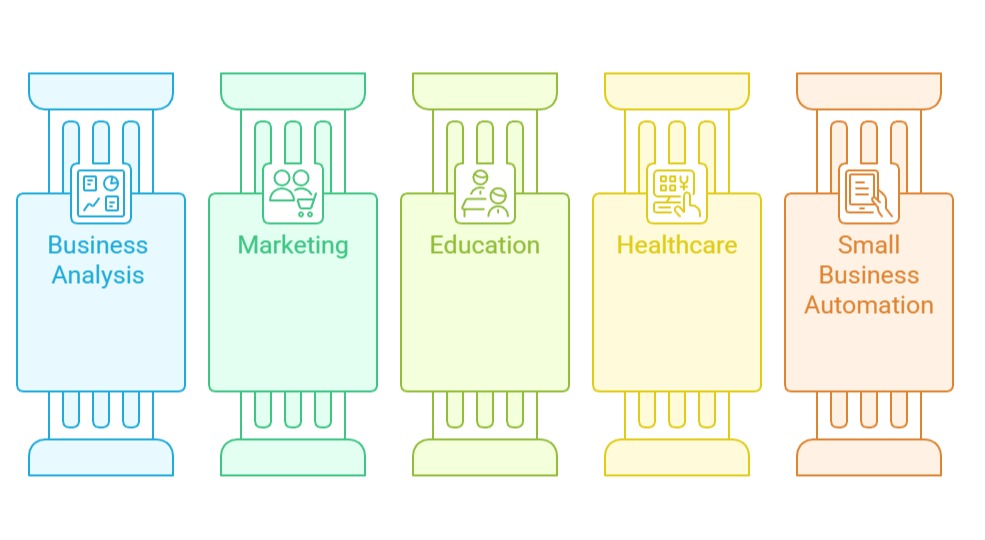 1. Business Analysts Using ML for Forecasting
Business analysts often need quick insights for planning, and democratized ML equips them with automated forecasting tools embedded in cloud platforms or BI dashboards.
These systems guide users through data uploading, choosing objectives, and generating predictive charts without requiring algorithmic knowledge.
Analysts can instantly assess patterns, seasonality, and anomalies through AutoML-generated reports.
The workflow eliminates manual scripting while maintaining accuracy for short and long-term projections.
For instance, an analyst can forecast monthly sales for different product lines using a drag-and-drop ML interface.
The tool automatically selects appropriate time-series models and evaluates performance, enabling faster decision-making for campaigns or inventory adjustments.
2. Marketing Teams Leveraging ML for Customer Segmentation
Marketing departments benefit significantly from democratized ML by using automated clustering tools that segment audiences based on behavior, demographics, or engagement patterns.
These platforms provide guided workflows where the user simply defines the goal—for example, identifying promising customer groups—and the system handles algorithm selection and tuning.
The resulting clusters help marketers personalize promotions, improve retention strategies, and design targeted campaigns.
AutoML dashboards offer easy visualizations that explain the key differentiators between segments, making insights actionable.
A marketing team could, for instance, use ML to classify website visitors into “high intent,” “occasional buyers,” and “information seekers,” enabling more tailored outreach without involving data scientists.
3. Educators Applying ML for Student Performance Prediction
Teachers and academic administrators can utilize democratized ML to anticipate student outcomes, identify learning gaps, and design interventions.
AutoML-powered education platforms allow them to upload attendance, assessment scores, and past performance records to generate predictive insights.
These models reveal at-risk students or topics requiring reinforcement, offering recommendations without requiring the educator to understand model complexity.
The accessible interface ensures the process remains intuitive, with clear explanations of influential features.
For example, an instructor can predict which students may struggle in upcoming exams and provide personalized study support based on ML-driven insights.
4. Healthcare Staff Using ML for Preliminary Risk Assessment
Healthcare workers, including nurses and administrative staff, can leverage democratized ML to generate early risk assessments for conditions like readmissions or missed appointments.
User-friendly portals allow them to input routine patient information and instantly receive risk scores validated by AutoML pipelines.
The platform abstracts all technical decisions, focusing instead on actionable insights and clear explanations.
These predictions help prioritize resources, streamline workflows, and improve patient engagement.
For instance, hospital staff may use ML tools to identify patients likely to miss follow-up visits so reminders or alternative scheduling can be arranged.
5. Small Businesses Automating Decisions with ML-Powered Tools
Small business owners often lack dedicated data teams, making democratized ML especially valuable.
Tools embedded in e-commerce platforms, POS systems, and cloud dashboards allow them to predict demand, flag unusual transactions, or optimize pricing automatically.
The ML engine processes their sales logs, customer interactions, or inventory records and generates recommendations aligned with business goals.
Without writing code, owners can deploy predictive models that boost operational efficiency.
An example is a local retailer using AutoML to forecast peak selling hours, enabling better staffing and stock planning.
Real-World Case Studies for Democratizing ML
Real-world case studies in democratizing ML demonstrate how no-code and AutoML platforms enable non-technical users to solve complex problems using machine learning.
These examples highlight how accessible ML tools drive practical impact across business, education, healthcare, and public services without requiring data science expertise.
1. Retail Store Managers Using AutoML for Inventory Optimization
A mid-sized retail chain deployed a no-code AutoML platform to help store managers—who had no prior ML experience predict product demand at the branch level.
Managers uploaded daily sales logs and inventory records through a simple interface and generated forecasts automatically.
The AutoML engine selected best-fit models and produced intuitive graphs showing peak periods, slow movers, and seasonal fluctuations.
As a result, branches significantly reduced overstocking and prevented frequent stockouts without involving data scientists.
Within months, the chain observed smoother supply cycles, improved shelf availability, and reduced waste from unsold goods.
This case highlights how non-specialists can drive measurable business improvements purely through guided ML workflows.
2. Human Resources Teams Applying AutoML for Employee Retention Insights
An HR department at a large services company used democratized ML to examine why employee turnover was rising.
Without writing code, HR analysts uploaded the past three years of attendance patterns, performance scores, and engagement data into an AutoML dashboard.
The tool automatically generated models explaining which variables were most predictive of resignations.
Insights revealed that workload imbalance and low manager interaction were major contributors.
These findings were presented visually, making it easier for HR to design corrective policies like mentorship programs and workload redistribution.
With zero technical expertise required, the HR team successfully used ML to enhance employee satisfaction and reduce attrition.
3. Educators Using AutoML to Identify Students at Risk of Dropping Out
A public-school district implemented an AutoML solution to help teachers and administrators understand dropout risks earlier in the school year.
Educators uploaded basic information such as attendance, assignment completion, participation scores, and previous grades—into a simple interface.
The system automatically built prediction models and displayed at-risk students along with the factors contributing most to risk levels.
Teachers used these insights to tailor support plans, conduct parent meetings, and adjust learning strategies.
Within the first academic year, dropout rates reduced significantly, demonstrating how ML can support outcomes even when the users are not technically trained.
This case showcases ML as a practical tool for improving academic continuity.
4. Healthcare Clinics Using ML for Early Appointment-No-Show Prediction
A chain of outpatient clinics used a user-friendly AutoML system to forecast which patients were likely to miss scheduled appointments.
Nurses and administrative staff—none with ML backgrounds—entered simple variables such as previous no-shows, appointment type, reminder history, and travel distance.
The platform automatically generated a risk model and provided clear explanations for each prediction.
Staff used this information to send targeted reminders, offer telehealth alternatives, or reschedule intelligently.
As a result, missed appointments dropped noticeably, reducing revenue leaks and improving patient access.
This case illustrates how non-specialists in healthcare can benefit from intelligent automation without needing technical expertise.
5. Small E-Commerce Entrepreneurs Using ML for Pricing and Promotion Decisions
A small online seller integrated AutoML tools embedded in their e-commerce platform to optimize pricing and promotional decisions.
The owner uploaded product sales data, customer clicks, and competitor prices into the no-code ML system.
The platform automatically tested multiple models and recommended optimal pricing ranges for maximizing conversions while maintaining margin targets.
The seller also received insights into which products respond well to discounts and which perform better with bundle offers.
This resulted in a significant sales lift during peak seasons and helped the small business compete effectively with larger brands.
The entrepreneur achieved this without hiring a data scientist, proving how AutoML levels the playing field for smaller players.
6. Municipal Governments Using AutoML for Civic Issue Prioritization
A city municipality adopted a no-code ML solution to prioritize civic issues such as potholes, streetlight outages, and sanitation complaints.
Administrative staff uploaded service request logs and geolocation data, and the AutoML engine generated predictions on which complaints required urgent intervention.
The model also highlighted hotspots that needed long-term planning. As a result, city officials allocated resources more efficiently and improved response times.
This case underscores how public-sector staff with no ML expertise can use automated intelligence to improve urban management and citizen satisfaction.