Quantum computing represents a radical shift from traditional computational paradigms by leveraging the principles of superposition, entanglement, and quantum interference to perform calculations at unprecedented scales.
Instead of processing information through binary bits, quantum systems use qubits, which can exist in multiple states simultaneously.
This parallelism allows quantum algorithms to explore vast solution spaces far faster than classical approaches, making them especially powerful for data science tasks involving optimization, pattern discovery, and probabilistic modeling.
With classical models facing limitations in high-dimensional environments, quantum computing introduces mechanisms that can accelerate learning, reduce computation time, and handle complex mathematical transformations more efficiently.
In the context of data science, quantum computing supports breakthroughs in machine learning, clustering, linear algebra operations, cryptographic security, and Bayesian inference.
Quantum-enhanced models like Quantum Support Vector Machines (QSVM) and Quantum Neural Networks (QNNs) demonstrate advantages in handling large feature spaces and non-linear mappings.
Meanwhile, algorithms such as Grover’s search and Shor’s factorization highlight the potential for dramatic speed-ups in searching and decomposition tasks.
As quantum hardware evolves, hybrid strategies combining classical and quantum processors are becoming viable for real-world problems in finance, healthcare, logistics, and scientific discovery.
Key Quantum Algorithms
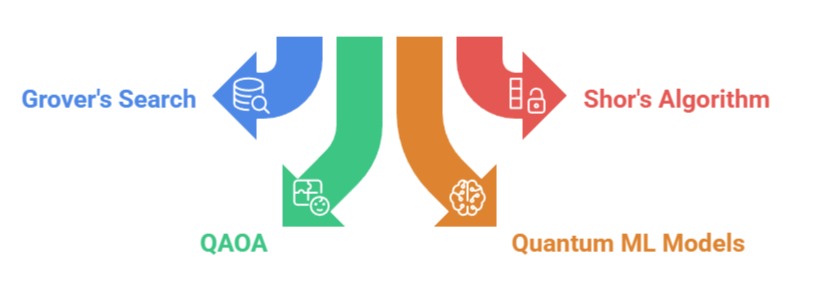
1 Grover’s Search Algorithm
Grover’s algorithm provides a quadratic speedup for searching unsorted databases, making it valuable for data retrieval and anomaly detection.
Unlike classical search, which requires O(N) operations, Grover reduces this to O(√N) through amplitude amplification.
Its iterative structure enhances the probability of locating the correct solution without scanning all entries explicitly.
In data science, this acceleration supports faster feature selection, optimization over large datasets, and rapid outlier identification.
Example: Identifying fraudulent transactions in a massive financial dataset where only a small subset exhibits abnormal patterns.
2 Shor’s Algorithm for Factorization
Shor’s algorithm achieves exponential speedup in integer factorization, a foundational operation behind encryption and number-theoretic tasks.
Although primarily known for its cryptographic implications, Shor’s method significantly impacts data security, secure storage, and privacy-preserving analytics.
Its reliance on quantum Fourier transforms introduces efficient ways to solve periodicity-related problems.
Example: Rapidly analyzing encrypted healthcare logs for anomalies while maintaining strict privacy boundaries.
3 Quantum Approximate Optimization Algorithm (QAOA)
QAOA is pivotal for solving combinatorial optimization problems common in logistics, scheduling, and resource allocation.
It blends quantum circuits with classical optimization loops, making it suitable for near-term quantum hardware.
QAOA approximates optimal solutions by exploiting quantum interference, enabling quicker convergence in complex search landscapes.
Example: Determining the most efficient delivery routes for a global logistics company under shifting demand constraints.
4 Quantum Machine Learning Models (QSVM, QNN, QKMeans)
Quantum ML models exploit high-dimensional Hilbert spaces to perform transformations and classification tasks more efficiently.
QSVMs excel at separating non-linear data with fewer computational steps, while QNNs model intricate patterns with quantum-layered architectures.
Quantum K-Means accelerates cluster assignments using distance estimation via superposition.
Example: Grouping genetic expression profiles for personalized medicine with substantially reduced computation time.
Challenges and Limitations of Quantum Computing
Quantum computing promises unprecedented computational power, but practical implementation faces significant hurdles.
Challenges such as hardware instability, error rates, and scalability limit its current real-world applicability.
1. Hardware Instability & Decoherence
Quantum bits lose their state extremely quickly due to noise, temperature fluctuations, and external disturbances.
This leads to high error rates and short coherence times, limiting the complexity of tasks that can be executed reliably.
2. Limited Qubit Count
Current quantum computers (“NISQ” devices) only offer tens to a few hundred qubits, far below what's needed for large-scale ML or cryptographic workloads.
This restricts the size of problems that can be modeled or optimized.
3. Error Correction Overhead
Quantum error correction requires thousands of physical qubits to form one logical qubit, making fully error-corrected systems difficult to build.
This massively inflates computational cost and complexity.
4. Algorithm Availability
Only a small set of algorithms (e.g., QAOA, VQE, Grover’s search) provide real quantum advantage.
Many ML tasks still lack quantum-native alternatives.
5. High Cost & Infrastructure Requirements
Quantum systems need near-absolute-zero temperatures and highly specialized maintenance.
This makes them expensive and inaccessible for most organizations.
6. Skill Gap
Quantum programming requires knowledge in physics, mathematics, and quantum circuits.
The scarcity of skilled developers slows industry adoption.
7. Integration Limitations with Classical ML
Quantum devices are not standalone; they must be paired with classical computers.
Data loading, preprocessing, and post-processing often dominate runtime, reducing real-world advantage.
Real-World Case Studies
Real-world case studies demonstrate how quantum computing is being explored across industries to tackle complex, computationally intensive problems.
From drug discovery to traffic optimization and financial modeling, these applications highlight both potential benefits and current technological limitations.
1. Pfizer & IBM – Drug Molecule Simulation
Pfizer partnered with IBM to use quantum algorithms (VQE & Hamiltonian simulation) for modeling molecular interactions.
This could accelerate drug discovery by reducing classical simulation time for complex molecules.
2. Volkswagen – Traffic Flow Optimization
Volkswagen applied quantum annealing to optimize real-time taxi routing in Beijing.
Their system demonstrated improved route assignments but highlighted the need for more stable quantum hardware.
3. Goldman Sachs – Portfolio Optimization
Using quantum algorithms (QAOA) for risk-management optimization problems showed promising results.
Though prototypes remained hybrid, they demonstrated improved solution search for large combinatorial challenges.
4. Mercedes-Benz & Google Quantum AI – Battery Chemistry
Quantum simulations helped analyze lithium-sulfur battery materials.
Findings supported long-term research into higher-capacity EV batteries.
5. NASA – Mission Scheduling & Optimization
NASA explored quantum methods to optimize space mission planning, task scheduling, and satellite path optimization.
Early results show potential speed-ups in NP-hard scheduling tasks.