Feature engineering and large-scale feature extraction are fundamental in advanced data science workflows, enabling models to interpret complex datasets efficiently and accurately.
As modern enterprises collect data from high-speed streams, distributed servers, IoT devices, and multi-modal platforms, the challenge is no longer just transforming features but doing so reliably, consistently, and at massive scale.
Techniques such as distributed vectorization, automated feature construction, scalable aggregations, and optimized dimensionality reduction help handle datasets that grow beyond the limits of single-machine processing.
In high-volume environments like finance, e-commerce, telecommunications, and healthcare, features must be generated in real time and consumed by predictive systems without delays.
Therefore, scalable feature engineering integrates tools like Apache Spark, Ray, Feast feature store, and cloud-based processing engines that orchestrate pipelines across clusters.
These systems ensure consistency, versioning, freshness, and reproducibility for features used across teams and models.
By handling heavy workloads and multiple data modalities text, images, logs, and sensor streams scalable feature engineering supports both operational ML and batch-modeling workflows.
Ultimately, the goal is to create robust features that retain context, minimize noise, and improve model performance even when datasets expand exponentially.
Feature Engineering and Extraction at Scale
Feature engineering and extraction at scale focuses on building, transforming, and managing features efficiently when working with massive, high-velocity datasets.
It ensures that complex feature pipelines remain fast, reliable, and consistent across distributed systems while supporting high-quality model performance.
1. Distributed Feature Transformation and Aggregation
Large-scale environments demand transformation routines that can operate in parallel across clusters, allowing complex operations such as windowed aggregations, temporal grouping, and categorical expansion to run efficiently.
Frameworks like Apache Spark enable operations such as pivoting, bucketing, or computing rolling averages on billions of records within minutes rather than hours.
For example, a telecom company analyzing customer usage patterns can calculate hourly session statistics across millions of devices using distributed workers.
These parallelized workflows prevent bottlenecks and maintain consistency by performing operations simultaneously on partitions of data.
This approach ensures timely model training and inference even when feature transformations are computationally intensive.
2. Automated Feature Construction and High-Dimensional Extraction
Automation tools generate interaction terms, polynomial features, frequency encodings, and composite attributes at scale without manual intervention.
These automated processes are vital when datasets involve hundreds or thousands of attributes, making manual exploration impractical.
Tools like H2O, FeatureTools, or DataRobot automatically scan relationships within tables and create meaningful derived features.
For instance, an e-commerce platform can automatically generate ratio-based features such as “discount percentage vs. purchase likelihood” across millions of orders.
This process surfaces hidden patterns that significantly enhance model accuracy. Automation ensures that useful transformations appear even in extremely high-dimensional spaces.
3. Scalable Vectorization and Embedding Techniques
When working with text, images, and sequential logs, scalable embedding frameworks allow large datasets to be converted into dense numerical formats suitable for machine learning pipelines.
Distributed Word2Vec, FastText, and transformer-based embedding generators can process terabytes of documents or records without memory constraints by splitting data across compute nodes.
For example, a global news aggregator produces daily word embeddings for hundreds of thousands of articles using distributed training.
These embeddings capture semantic meaning while maintaining training stability and speed.
Scalable vectorization ensures that enriched representations remain consistent across entire corpora and can be reused by multiple downstream applications.
4. Dimensionality Reduction and Feature Selection at Scale
Massive datasets often include redundant, noisy, or weakly correlated features that harm model performance.
Scalable feature selection algorithms—such as distributed mutual information analysis, variance filtering, or large-scale PCA/autoencoders—reduce dimensionality while preserving essential structure.
Tools like MLlib or RAPIDS allow these operations to run across GPUs or clusters, enabling rapid compression of high-volume datasets.
For example, a financial institution analyzing market signals may reduce thousands of time-series indicators into a manageable set of principal components that still represent global market dynamics.
Scaling these methods prevents memory overload and enhances model efficiency without sacrificing accuracy.
Challenges and Limitations of Feature Engineering at Scale
Challenges and limitations of feature engineering at scale arise from the sheer volume, velocity, and diversity of modern data environments.
These issues highlight why scalable feature pipelines must balance performance, reliability, cost, and model effectiveness simultaneously.
1. Computational Overheads and Resource Constraints
Processing trillions of records or high-dimensional data requires enormous compute, memory, and storage capacity, often exceeding the limits of traditional infrastructure.
Distributed operations can cause cluster contention, slow execution, or job failures when workloads peak unexpectedly.
Complex feature transformations especially embeddings, window functions, and graph-based features consume extensive CPU/GPU cycles.
Moreover, network latency between nodes slows down shuffling and data transfers.
These resource burdens can drive up operational costs and require sophisticated workload planning. Organizations must therefore balance scalability with cost efficiency to prevent infrastructure overload.
2. Data Quality Inconsistency Across Multiple Sources
At scale, datasets often originate from disparate platforms transactional systems, logs, APIs, IoT devices, and batch uploads resulting in inconsistent formatting, missing values, and conflicting timestamps.
When feature extraction spans multiple pipelines, even minor quality issues can cascade into massive downstream distortions.
For example, a misaligned timestamp in one data stream can corrupt time-windowed aggregations for millions of rows.
Ensuring unified schemas, synchronized clocks, and reliable metadata becomes increasingly difficult as systems grow.
These quality inconsistencies reduce feature reliability and may cause biased or unstable model behavior.
3. Operational Complexity and Pipeline Maintenance
As features proliferate, pipelines become harder to maintain, version, and monitor.
Dependencies between upstream data sources and downstream models create fragile connections where one change can break the entire chain.
Feature drift caused by evolving user behavior or updated data sources adds another challenge, demanding continuous recalibration.
Teams must manage dependency graphs, DAG failures, reprocessing delays, and compatibility issues across production systems.
Without strong governance, feature stores and pipelines become cluttered, redundant, and unreliable, reducing the reproducibility of machine learning results.
4. Scaling Feature Stores and Ensuring Consistency
Feature stores promise centralized management, but scaling them across high-traffic applications introduces multiple bottlenecks.
Ensuring that feature values remain fresh, consistent, and synchronized across streaming and batch environments can be extremely difficult.
For example, model inference may use stale or outdated features if online/offline stores are not aligned.
Latency-sensitive applications like fraud detection require near-instant feature retrieval, putting pressure on caching and storage engines.
These challenges make it difficult to guarantee correctness and real-time availability at massive scale.
5. Model Degradation from Over-Engineered or Noisy Features
When automated tools generate thousands of candidate features, many are redundant or irrelevant, increasing model complexity without meaningful value.
Excessive feature creation leads to overfitting, slower training, and degraded interpretability.
At scale, even small inaccuracies in feature logic multiply across billions of records, amplifying noise and weakening signal extraction.
Additionally, high-dimensional data intensifies the “curse of dimensionality,” making it harder for models to generalize.
Monitoring feature usefulness becomes a continual challenge as datasets evolve.
Best Practices for Feature Engineering and Extraction at Scale
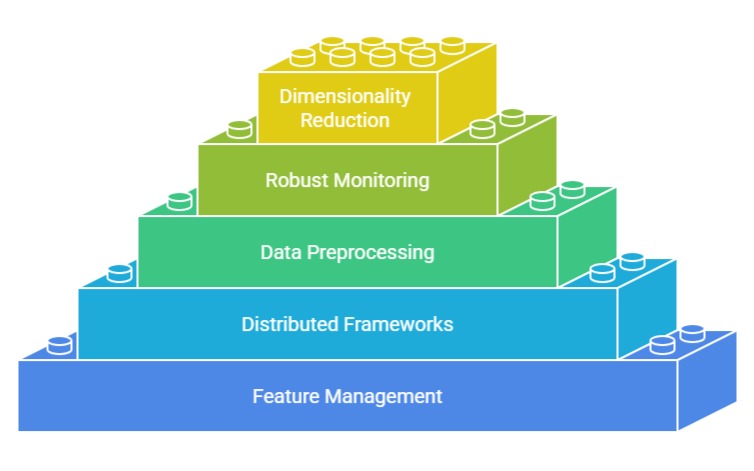
1. Establish Clear Feature Ownership, Versioning, and Governance
Create a structured feature management framework that assigns ownership for each feature group, maintains version histories, and enforces naming conventions.
A well-governed feature repository prevents duplication, ensures traceability, and simplifies debugging when unexpected data shifts occur.
Centralized documentation enables cross-team collaboration and eliminates guesswork.
By maintaining strict standards for feature definitions, organizations can ensure that models use consistent and validated inputs, reducing drift and improving reproducibility.
This approach strengthens long-term reliability and communication between ML, data engineering, and analytics teams.
2. Use Distributed Frameworks Optimized for Large-Scale Workloads
Select systems like Apache Spark, Ray, RAPIDS, or Flink to execute heavy transformations across cluster nodes.
These tools automatically partition workloads, avoid memory bottlenecks, and parallelize expensive operations like joins and aggregations.
Integrating these frameworks into ML pipelines ensures stable performance even with petabyte-level data.
For example, Spark’s DataFrame API simplifies scalable feature transformations while managing resource allocation behind the scenes.
Leveraging distributed compute ensures predictable execution times and prevents single-node saturation.
3. Standardize Data Preprocessing with Reusable Pipelines
Building reusable, modular transformations makes large-scale preprocessing easier to manage, test, and deploy.
Using workflow orchestration tools like Airflow, Prefect, or Kubeflow ensures that pipelines operate reliably with structured DAG execution.
Reusable preprocessing blocks—such as normalization, encoding, or temporal aggregation—can be applied across models and datasets with minimal duplication.
This consistency improves efficiency and reduces the probability of logic discrepancies. It also enhances reproducibility in both experimental and production environments.
4. Implement Robust Monitoring for Drift, Freshness, and Data Integrity
Real-time monitoring of feature distribution, null rates, and value ranges helps detect data drift and anomalies before they impact modeling outcomes.
Automated alerts allow teams to respond quickly when transformations break or input data patterns shift.
Tracking freshness ensures that online and offline feature stores remain synchronized, preventing inference mismatches.
Monitoring also enables continuous quality assessment of upstream sources, protecting models from subtle data integrity issues that otherwise go unnoticed.
This proactive approach safeguards long-term model performance.
5. Prioritize Dimensionality Reduction and Feature Selection Early
To control computational load and prevent overfitting, apply scalable feature selection such as mutual information filtering, PCA, or embedded methods before feeding data into models.
Reducing the feature space early optimizes training time, decreases storage requirements, and improves model generalization.
When handling millions of features, removing redundancy significantly enhances interpretability and stability.
Choosing essential features also reduces the cost of maintaining massive pipelines, ensuring that only useful transformations are computed in production.