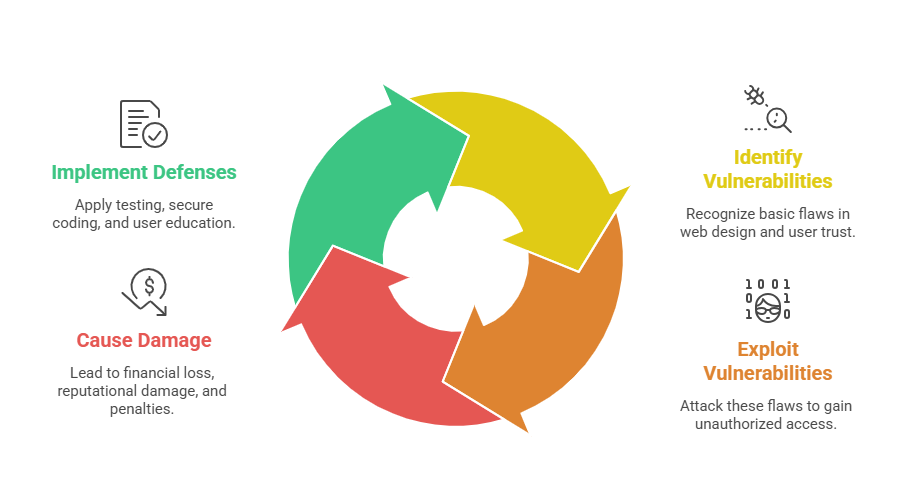
Web vulnerabilities are weaknesses in web applications that attackers exploit to compromise security, steal data, or disrupt operations. Among the most common and impactful vulnerabilities are SQL Injection (SQLi), Cross-Site Scripting (XSS), and Cross-Site Request Forgery (CSRF). These vulnerabilities exploit flaws in how web applications handle input, maintain sessions, and authorize actions.
SQL Injection (SQLi)
SQL Injection occurs when untrusted user input is inserted directly into SQL queries without proper validation or sanitization. This allows attackers to manipulate database queries to perform unauthorized actions.
Impact: Attackers can extract sensitive data (e.g., usernames, passwords, credit card details), modify or delete records, and sometimes gain administrative access to the database or underlying server.
Example Scenario: A login form fails to sanitize inputs, allowing the attacker to input SQL commands that bypass authentication and log in as an administrator.
Mitigation: Use parameterized queries or prepared statements, validate and sanitize inputs, implement least privilege on database accounts, and perform regular vulnerability scans.
Cross-Site Scripting (XSS)
XSS vulnerabilities arise when an attacker injects malicious scripts (usually JavaScript) into web pages viewed by other users. The injected scripts run in the victim’s browser, potentially stealing session cookies or performing unauthorized actions.
Types of XSS:
1. Stored XSS: Malicious script is permanently stored on the target server (e.g., in a forum post or comment).
2. Reflected XSS: Malicious script is reflected off a web server, delivered through a crafted link or form input.
3. DOM-based XSS: Script execution caused by modifying the DOM environment in the victim’s browser.
Impact: Theft of credentials, session hijacking, defacement, or malware distribution.
Mitigation: Validate and encode user input, use Content Security Policy (CSP), sanitize HTML and JavaScript, and employ security frameworks.
Cross-Site Request Forgery (CSRF)
CSRF tricks a logged-in user’s browser into submitting unwanted requests (e.g., changing a password or making transactions) to a web application without their consent. This happens because the browser automatically sends credentials, like cookies, with requests.
Attack Vector: An attacker crafts a malicious link or form that performs state-changing operations and entices the victim to execute it.
Impact: Unauthorized actions on behalf of genuine users, data alteration, or privilege abuse.
Mitigation: Use anti-CSRF tokens, verify HTTP referer headers, employ SameSite cookie attributes, and require re-authentication for sensitive actions.
Why These Vulnerabilities Matter

Class Sessions
Sales Campaign

We have a sales campaign on our promoted courses and products. You can purchase 1 products at a discounted price up to 15% discount.