Hyperparameter tuning is a crucial phase in building high-performing deep learning systems because it determines how effectively a model learns patterns, converges, and generalizes.
Unlike trainable model parameters such as weights and biases, hyperparameters are external settings learning rate, batch size, number of layers, dropout rate, optimizer choice, and regularization intensity—that must be deliberately selected before training begins.
The performance of a neural network can vary dramatically depending on how these values are configured.
As deep learning models grow in size and complexity, manual trial-and-error quickly becomes inefficient and error-prone.
This challenge has led to systematic tuning strategies such as grid search, random search, and Bayesian optimization.
These approaches not only accelerate experimentation but also uncover hyperparameter combinations that deliver higher accuracy, reduced loss, and stronger generalization across unseen data.
Modern tuning workflows also incorporate practices like early stopping, learning rate schedules, warm restarts, and validation-driven decision-making.
With the rapid evolution of AI infrastructure and automated tools, hyperparameter tuning has become more structured, data-driven, and optimized for real-world applications.
Grid Search
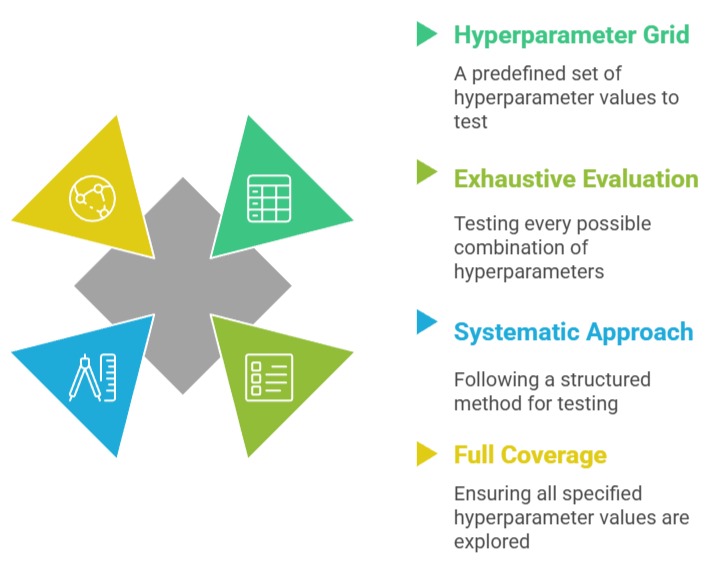
Grid search exhaustively evaluates all possible combinations of hyperparameters specified in a predefined grid.
It is systematic and ensures full coverage of the search space within chosen values.
Advantages
1. Exhaustive Exploration of Defined Hyperparameter Space
Grid search systematically investigates every combination of hyperparameter values specified in the grid.
Because it evaluates all predefined settings, it guarantees that nothing within that restricted space is overlooked, which is useful when the optimal region is known approximately.
This exhaustive approach reduces uncertainty, making the process transparent and dependable.
It allows researchers to clearly compare performances across all tested configurations because the sampling strategy is consistent and evenly distributed.
This structured method is highly beneficial in controlled experiments where interpretability and reproducibility hold priority.
2. Easy to Configure and Implement
One of the most appealing features of grid search is its simplicity, as it requires only the definition of parameter ranges and step sizes.
There is no need for probabilistic models, specialized libraries, or sampling theory; the tuning routine can be executed even by beginners.
Most machine learning frameworks integrate grid search modules directly, making the setup nearly effortless.
Because everything is predetermined, debugging also becomes straightforward each result corresponds to an explicitly defined configuration.
This clarity is valuable for academic settings or training environments where learners benefit from observing the impact of each hyperparameter combination.
Disadvantages
1. High Computational Cost and Slow Scalability
A major drawback of grid search is its exponential growth in computational requirements as the number of hyperparameters increases.
Even adding one additional hyperparameter dimension can cause a dramatic jump in the number of combinations to test, making it computationally infeasible for deep networks.
This problem becomes more severe when the model has long training times or when high-resolution parameter sweeps are required.
The method often evaluates numerous unproductive combinations, wasting valuable GPU or TPU resources.
As a result, grid search becomes impractical in production environments that demand efficiency and cost-effectiveness.
2. Poor Coverage of Continuous Hyperparameter Ranges
Although grid search is exhaustive, it samples only the points explicitly defined in the grid, which leads to rigid and coarse exploration.
Critical hyperparameter values between grid points may never be tested, even though they could significantly improve performance.
This limitation is especially problematic for continuous variables like learning rates or momentum, where performance often depends on subtle adjustments.
Because the resolution of the grid must be manually preselected, users may either oversample unnecessarily or undersample important regions.
In turn, this inflexibility often results in wasted computation or incomplete insights.
Random Search
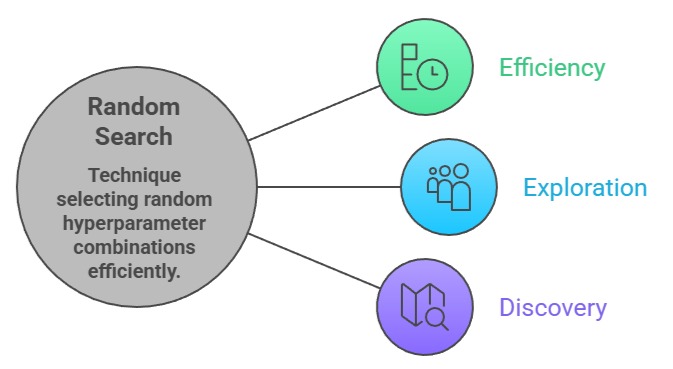
Random search selects random combinations of hyperparameters from user-defined ranges, enabling broader exploration without evaluating the entire space.
Advantages
1. Highly Efficient in High-Dimensional Spaces
Random search bypasses the rigidity of grid search by selecting random combinations across the entire parameter range, enabling faster discovery of promising values.
In high-dimensional spaces where only a few parameters heavily influence performance, random sampling offers dramatically better efficiency. Instead of evaluating every unimportant combination, it spreads the search more widely and captures diverse configurations.
This flexibility makes it ideal for models with many interacting hyperparameters, such as large CNNs or transformer architectures. By reducing redundant evaluations, it allows experimentation to focus on areas with greater potential.
In practice, random search often uncovers strong configurations in far fewer trials compared to grid search. This makes it highly practical for large-scale research and production workloads.
2. Better Handling of Continuous and Broad Parameter Ranges
Random search naturally samples continuous hyperparameters across wide intervals, making it significantly more flexible than fixed-grid approaches.
This characteristic enables the tuning process to identify fine-grained optimal values that may lie between arbitrarily chosen grid points.
The method supports both uniform and non-uniform probability distributions, giving researchers more control over sampling behavior and exploration dynamics.
Its randomness increases the likelihood of encountering unexpectedly high-performing configurations that structured methods might miss.
This stochastic nature often yields quicker convergence on useful regions of the search space.
Disadvantages
1. Non-Deterministic Outcomes and Lower Reproducibility
Random search’s inherent unpredictability makes it difficult to replicate exact results across runs unless seeds are explicitly controlled.
This stochasticity can pose challenges in environments where reproducibility is a critical requirement, such as regulated domains, academic publishing, or model auditing.
Because each experiment may produce different outcomes, tracing the reasoning behind improvement becomes less straightforward.
Variability in sampling may also lead to inconsistent results when evaluating small datasets.
Moreover, debugging becomes more complicated because issues might stem from sampling randomness rather than modeling errors.
2. Possibility of Missing Critical Parameter Regions
Despite its wide sampling behavior, random search may entirely overlook narrow but important regions of the hyperparameter space.
If optimal values lie within a very small range, randomness does not guarantee their discovery unless the number of trials is sufficiently large.
This limitation may lead to premature conclusions or inaccurate assessments of model capability. As a result, performance may vary significantly depending on how many trials were executed.
In practice, poorly chosen sampling distributions can skew the search toward irrelevant regions.
Bayesian Optimization
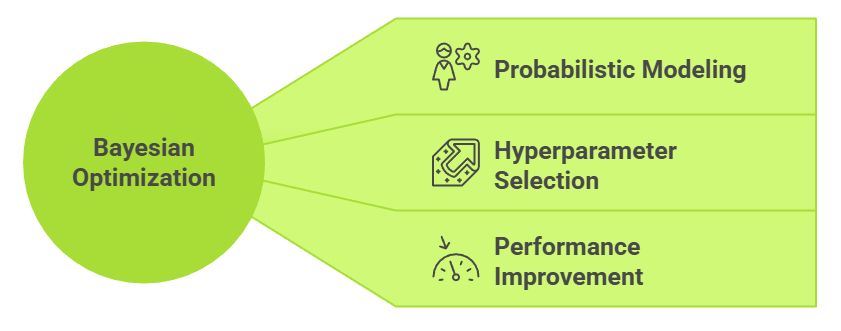
Bayesian optimization models the relationship between hyperparameters and performance using probabilistic functions.
It chooses the next set of hyperparameters based on what is most likely to improve outcomes.
Advantages
1. Highly Sample-Efficient Search Process
Bayesian optimization intelligently models the relationship between hyperparameters and performance, enabling it to focus evaluations on the most promising configurations.
Instead of sampling blindly, it updates its internal surrogate model after each trial, progressively refining its understanding of the search landscape.
This results in significantly fewer computations compared to brute-force approaches, making it ideal for expensive deep learning workloads.
The method is particularly beneficial when training large models where each trial may require hours or days.
By reducing redundant experiments, it enables efficient use of limited hardware resources.
The iterative improvement in prediction accuracy helps the optimization converge more quickly toward high-performing hyperparameter sets.
2. Intelligent Balance Between Exploration and Exploitation
Through acquisition functions such as Expected Improvement or Upper Confidence Bound, Bayesian optimization strategically chooses hyperparameters that balance exploring new areas and refining known promising regions.
This dual approach leads to smoother and more targeted progression toward optimal solutions.
It also adapts well to complex, non-linear search spaces where hyperparameter interactions are difficult to predict manually.
The probabilistic modeling component helps identify intricate relationships between hyperparameters, revealing insights that other methods may overlook.
In scenarios where diminishing returns become evident, acquisition functions help shift the search focus efficiently.
This makes the tuning process both adaptive and analytically grounded.
Disadvantages
1. Increased Implementation Complexity
Bayesian optimization requires a deeper understanding of statistical modeling, Gaussian processes, and acquisition functions, making it more challenging to configure.
Compared to grid and random search, the setup is not straightforward and often requires specialized libraries such as Optuna, Hyperopt, BoTorch, or Spearmint.
Debugging becomes more complicated because tuning performance depends on both the model being optimized and the surrogate model used by the Bayesian procedure.
Even small configuration mistakes can lead to inefficient searches or poor convergence.
Additionally, the overhead of constructing and updating probabilistic models increases computational time during early iterations.
2. Scalability Limitations for Very High-Dimensional Spaces
Although Bayesian optimization excels in moderate-dimensional search spaces, it becomes less effective as dimensions increase significantly.
The surrogate model struggles to maintain accuracy when too many hyperparameters interact, leading to unreliable predictions.
As dimensionality grows, the computational overhead of updating the Gaussian process or tree-based surrogate increases dramatically.
These issues result in slower performance and diminishing returns as the search space expands.
Furthermore, Bayesian optimization becomes harder to parallelize effectively because each iteration depends on the outcomes of previous trials.