Deep learning is a subfield of artificial intelligence that focuses on training multi-layered neural networks to learn complex patterns from data.
Unlike traditional machine learning, which often requires handcrafted features, deep learning models automatically extract meaningful representations—making them especially effective for high-dimensional, unstructured data such as images, audio, text, and sensor streams.
By leveraging massive datasets, advanced architectures, and GPU/TPU computing, deep learning has become the backbone of modern AI systems powering applications like language translation, autonomous driving, medical imaging, robotics, and generative AI.
Its significance lies in its scalability, adaptability, and ability to outperform classical algorithms in tasks that demand nuanced pattern recognition.
Over the past decade, deep learning has evolved rapidly with innovations such as convolutional neural networks (CNNs), recurrent neural networks (RNNs), transformers, and diffusion models.
These breakthroughs have enabled AI models to achieve human-level or even superhuman performance in several domains.
As industries continue to adopt AI-driven workflows, deep learning stands at the core, shaping how machines perceive, reason, and generate.
Importance of Deep Learning
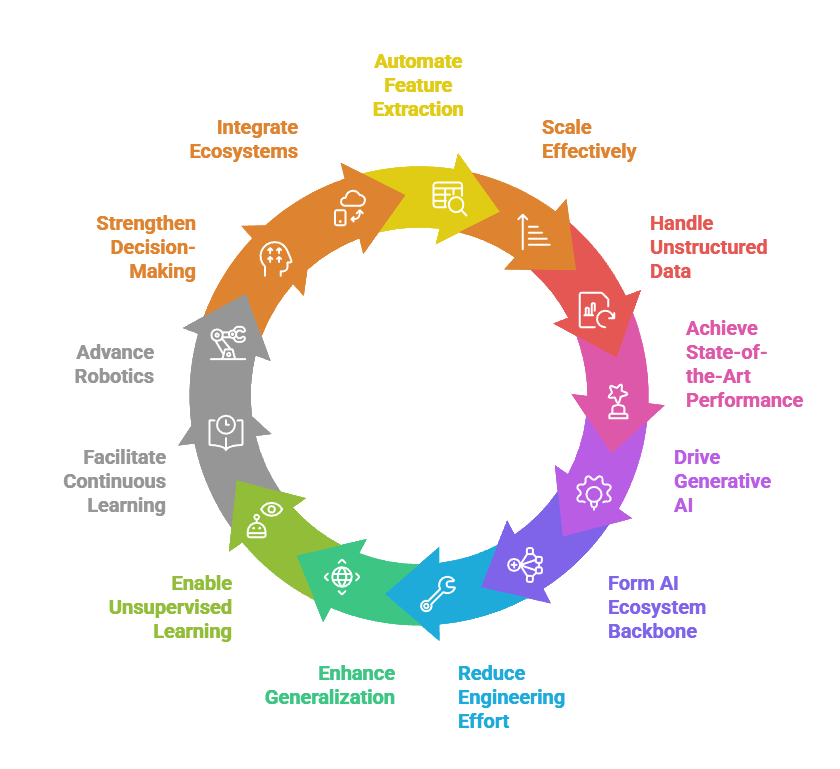
1, Deep learning automates feature extraction
Deep learning models reduce the need for manually engineered features by learning hierarchical representations directly from raw data.
Early layers capture basic patterns like edges or frequencies, while deeper layers learn increasingly abstract concepts, enabling models to understand complex relationships.
This automatic learning process significantly accelerates model development and improves accuracy, especially in areas like computer vision and speech recognition where traditional feature engineering is difficult.
2. Scales effectively with large datasets and high computational power
Unlike classical algorithms that plateau with more data, deep learning continues to improve as datasets grow larger.
Modern hardware such as GPUs, TPUs, and distributed training frameworks allow models to handle millions or billions of parameters.
This scalability has enabled breakthroughs in generative AI, foundation models, and large language models, fundamentally transforming the performance ceiling of artificial intelligence systems.
3. Capable of handling unstructured and multimodal data
Deep learning excels at processing diverse data formats—including images, audio, video, time series, and text—without strict preprocessing rules.
Models such as CNNs, LSTMs, and transformers can interpret and combine multimodal inputs, enabling applications like vision-language models, autonomous navigation, and voice-based assistants.
This flexibility makes deep learning indispensable for building complex AI systems that rely on real-world data streams.
4. Enables state-of-the-art performance across industries
From healthcare diagnostics to cybersecurity threat detection, deep learning powers solutions that surpass traditional machine learning approaches.
Its ability to capture subtle patterns and anomalies helps organizations improve accuracy, reduce errors, and automate tasks previously dependent on expert judgment.
The result is a new wave of intelligent applications capable of real-time decision-making.
5. Continues to evolve with new architectures and training techniques
Recent advancements—such as transformers, self-supervised learning, graph neural networks, and diffusion models—have expanded deep learning’s capabilities.
These innovations reduce data dependency, improve generalization, and enhance model robustness.
As research progresses, we are witnessing a shift from narrow, task-specific models to versatile foundation models adaptable across domains.
6. Drives the development of generative AI and intelligent automation
Generative models like GANs, VAEs, and diffusion architectures enable machines to create realistic images, videos, designs, and even code.
Combined with reinforcement learning and large-scale training, deep learning systems can plan, reason, and automate complex tasks with minimal human intervention.
This evolution marks a significant leap toward more autonomous and creative AI systems.
7. Forms the backbone of modern AI ecosystems
Deep learning integrates with cloud platforms, edge computing, and emerging tools like MLOps pipelines to support scalable AI deployment. Its compatibility with real-time systems allows seamless integration into industries such as finance, retail, supply chain, manufacturing, and entertainment.
As organizations adopt AI-first strategies, deep learning remains the central technology driving innovation.
8. Supports end-to-end learning and reduces task-specific engineering
Deep learning models can learn an entire task pipeline—from input data to final predictions—without needing separate modules for feature extraction, transformation, and classification.
This end-to-end workflow simplifies development, reduces reliance on domain-specific heuristics, and ensures the system optimizes holistically rather than in fragmented stages.
As a result, deep learning solutions often achieve higher accuracy and minimize error propagation found in traditional multi-step pipelines.
This design principle is crucial for complex tasks such as speech-to-text transcription, real-time translation, and autonomous driving.
9. Enhances model generalization through advanced regularization techniques
Modern deep learning uses powerful regularization methods like dropout, batch normalization, data augmentation, weight decay, and early stopping to improve model robustness and reduce overfitting.
These methods allow networks to generalize better across unseen data, even with large parameter counts.
Techniques like Mixup, CutMix, and stochastic depth further strengthen performance, especially in computer vision tasks.
These advances make deep learning models more stable in real-world deployment scenarios, where input variability and noise are common.
10. Enables self-supervised and unsupervised learning at scale
With the rise of self-supervised learning (SSL), deep learning models can learn high-quality representations from unlabeled data—reducing dependence on expensive and time-consuming annotation processes.
Approaches like contrastive learning, masked autoencoders, and generative pretraining allow models to uncover patterns autonomously.
This capability has led to breakthroughs in foundation models for NLP and vision, where pretraining on massive datasets significantly boosts downstream task performance.
As industries continuously generate vast amounts of unlabeled data, SSL has become a cornerstone of modern AI development.
11. Facilitates continuous learning and adaptability in dynamic environments
Deep learning systems can be updated through transfer learning, fine-tuning, and incremental learning, allowing them to adapt quickly to changing data trends.
Instead of training from scratch, models can build on previously learned knowledge to reduce training time and computational costs.
This adaptability is essential in fields like cybersecurity, finance, and healthcare, where data evolves rapidly.
Continuous learning ensures that deep learning systems remain relevant, accurate, and capable of responding effectively to new scenarios.
12. Fuels advancements in robotics and human–machine interaction
Deep learning plays a critical role in enabling robots to perceive environments, understand human intent, and execute precise actions.
Vision-based models help robots detect objects, while reinforcement learning enables them to learn complex manipulation and navigation strategies.
Additionally, language and gesture recognition models make human–robot interaction more natural and intuitive.
These capabilities are vital for autonomous drones, warehouse robotics, smart manufacturing, and assistive technologies designed to support human tasks.
13. Strengthens decision-making through predictive and prescriptive analytics
Deep learning models can identify subtle trends, predict future outcomes, and recommend optimal actions across various sectors.
In finance, they analyze market patterns; in healthcare, they support diagnostic systems; and in retail, they optimize pricing and customer segmentation.
Because deep learning captures nonlinear relationships more effectively than classical models, it delivers more accurate predictions.
This predictive strength forms the foundation for intelligent automation and data-driven decision-making at scale.
14. Integrates seamlessly with cloud, edge, and IoT ecosystems
Deep learning’s compatibility with distributed computing, microservices, and hardware accelerators allows deployment across diverse infrastructures—from cloud servers to edge devices.
Techniques like model quantization, pruning, and knowledge distillation make deployment feasible even on resource-constrained devices such as smartphones, wearables, and IoT sensors.
This flexibility is essential for real-time applications like facial recognition, smart surveillance, autonomous vehicles, and industrial IoT analytics. The ability to run deep learning models everywhere amplifies AI adoption across sectors.