Deep learning models have revolutionized artificial intelligence, demonstrating remarkable performance across areas such as computer vision, natural language processing, speech recognition, and generative modeling.
Despite these achievements, neural networks are often considered black-box models, making it difficult to understand how they arrive at specific predictions.
This lack of transparency presents significant challenges for trust, safety, and accountability, especially in high-stakes applications such as healthcare, finance, autonomous vehicles, and legal decision-making.
Explainability and interpretability are the fields of research dedicated to addressing these challenges by making model decisions understandable and actionable for humans.
Interpretability focuses on the extent to which humans can comprehend the relationship between inputs and outputs in a model.
It provides insight into how features are used by the model and how they contribute to predictions.
Explainability, on the other hand, emphasizes providing clear justifications for a model’s decisions, either at a global level (understanding overall model behavior) or a local level (understanding a specific prediction).
Techniques for achieving these goals include feature attribution, saliency maps, attention visualization, surrogate models, and model-agnostic approaches like LIME and SHAP.
Implementing explainability and interpretability has numerous benefits, such as improving model trust, facilitating bias detection, enhancing collaboration with domain experts, and enabling regulatory compliance.
These methods also allow researchers to identify and correct errors, optimize architectures, and gain novel insights from data patterns captured by the model.
Benefits of Explainable and Interpretable Models
Explainable and interpretable models help users understand how and why AI systems make decisions.
These capabilities improve trust, transparency, and responsible adoption of machine learning across real-world applications.
1. Building Trust and Accountability
Explainable models allow stakeholders to understand and verify why a particular prediction was made.
In critical domains like healthcare, this could involve highlighting regions of a medical image responsible for a diagnosis, thereby increasing clinician confidence in AI-assisted decisions.
Transparency fosters accountability and ensures that AI systems are not blindly relied upon, reducing potential risks associated with opaque automated decision-making.
2. Facilitating Model Debugging and Improvement
Interpretability provides insights into how models use input features, revealing unintended dependencies or biases.
For instance, attention maps may show that a model trained on visual data focuses on background artifacts rather than relevant objects.
Detecting such issues allows developers to refine datasets, adjust model architectures, and improve overall performance, leading to more robust and reliable systems.
3. Regulatory Compliance and Ethical Alignment
In regulated industries like finance, insurance, or healthcare, explainable AI ensures compliance with laws and ethical standards.
Providing interpretable explanations of predictions allows organizations to justify decisions, avoid discriminatory outcomes, and maintain transparency for audits.
Explainability thus becomes a critical requirement for responsible AI deployment in these sensitive sectors.
4. Enhancing Human-AI Collaboration
Interpretable models support effective collaboration between AI systems and domain experts.
By understanding how decisions are made, humans can validate outputs, provide feedback, or intervene when necessary.
In research, healthcare, or engineering applications, this collaboration improves decision quality, enables human oversight, and facilitates more informed choices based on AI-generated insights.
5. Detecting Biases and Ensuring Fairness
Interpretability techniques reveal hidden biases in training data or learned representations.
By understanding feature importance and model behavior, practitioners can identify unfair patterns that may affect certain demographic groups or categories.
Correcting these biases ensures equitable outcomes and prevents models from perpetuating historical inequalities or systemic errors.
6. Knowledge Discovery from Data
Beyond validation, interpretable models can uncover new insights about complex datasets.
For Example, attention-based models in NLP can highlight key phrases influencing sentiment, while visual models can reveal relationships between features in scientific images.
These discoveries enhance understanding, generate hypotheses, and contribute to domain knowledge beyond mere prediction accuracy.
7. Flexible Application Across Models
Many interpretability techniques, such as LIME and SHAP, are model-agnostic and can be applied to diverse architectures including CNNs, RNNs, Transformers, and hybrid models.
This flexibility allows consistent evaluation and comparison of multiple models while maintaining interpretability standards across different tasks and domains, supporting broader adoption of explainable AI practices.
Challenges in Explainability and Interpretability
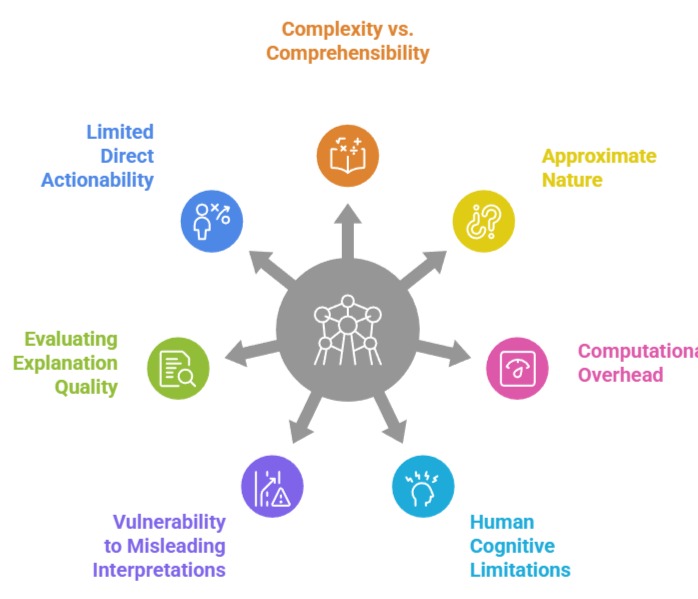
1. Complexity vs. Comprehensibility Trade-Off
Highly accurate deep learning models often rely on intricate feature interactions that are difficult to summarize in simple explanations.
Simplifying these interactions for human understanding may omit critical details, leading to incomplete or misleading interpretations of model behavior.
2. Approximate Nature of Explanations
Many techniques provide approximate rather than exact interpretations. For example, surrogate models used in LIME approximate the decision boundary locally, which may not reflect global model reasoning.
Such approximations can mislead stakeholders about the model’s true behavior.
3. Computational Overhead
Generating explanations can be resource-intensive, especially for large-scale models or high-dimensional data.
Saliency maps, SHAP values, or gradient-based methods require multiple forward and backward passes, increasing latency and computational cost, which may hinder real-time applications.
4. Human Cognitive Limitations
Even when explanations are provided, users may struggle to understand them fully.
Feature importance scores, attention visualizations, or gradient maps often require domain knowledge to interpret correctly, limiting accessibility for non-experts and reducing practical impact.
5. Vulnerability to Misleading Interpretations
Models can sometimes produce explanations that appear reasonable but are not causally linked to the prediction.
This risk is heightened if models exploit spurious correlations or adversarial patterns, potentially undermining trust and safety in sensitive applications.
6. Evaluating Explanation Quality
There is no standardized metric for judging the quality of explanations. What counts as a “good” explanation varies depending on the domain, task, or audience.
Evaluating interpretability remains subjective and context-dependent, complicating benchmarking and assessment.
7. Limited Direct Actionability
Even when a model’s reasoning is understood, it may not provide immediate guidance for correction or improvement.
Knowing which features influenced a decision does not automatically resolve model biases, errors, or dataset shortcomings without additional intervention.
Real-World Case Studies of Explainability and Interpretability in Deep Learning
Explainability and interpretability are increasingly being applied in real-world deep learning systems to ensure transparency, safety, and trust.
These case studies illustrate how explainable AI techniques support better decision-making across high-impact domains.
1. Medical Imaging and Diagnostics
Deep learning models are increasingly used for disease detection from medical images such as X-rays, MRIs, and CT scans.
A key challenge is ensuring that AI predictions can be trusted by clinicians. Explainable AI techniques, such as Grad-CAM or saliency maps, are applied to highlight which regions of the image influenced the model’s diagnosis.
For Example, in detecting pneumonia or tumors from chest X-rays, attention maps allow radiologists to verify that the model focuses on medically relevant regions rather than irrelevant background features.
This increases confidence, enables collaborative decision-making, and reduces the risk of misdiagnosis caused by hidden biases in the training data.
2. Autonomous Vehicles
Self-driving cars rely on deep learning for object detection, lane keeping, and pedestrian recognition. Explainability techniques are critical for debugging and safety assurance.
For instance, interpretable attention maps in CNNs or LIDAR-based models help engineers understand which features (like pedestrian positions or traffic signals) influenced the vehicle’s decisions.
By visualizing model reasoning, manufacturers can detect failure modes, identify spurious correlations (e.g., reliance on shadows or road markings), and refine sensor inputs and training datasets.
This is essential for regulatory compliance and ensuring public safety in real-world deployment.
3. Financial Credit Scoring
Banks and financial institutions use deep learning models to evaluate creditworthiness and predict loan defaults.
Explainable AI is vital to justify approval or denial decisions to both regulators and clients.
Techniques like SHAP (Shapley Additive Explanations) highlight which factors—such as income, credit history, or debt-to-income ratio—most influenced the model’s prediction.
This not only ensures transparency but also identifies potential biases in lending, such as discrimination based on gender, age, or location.
Explainability ensures compliance with regulations like GDPR and builds trust with customers.
4. Natural Language Processing (NLP)
Large transformer-based models, such as BERT or GPT, are widely used in sentiment analysis, document classification, and question-answering systems.
Explainable AI methods, like attention visualization or feature attribution, are used to understand which words or phrases drive model predictions.
For instance, in sentiment analysis, interpretability can reveal whether the model focuses on meaningful adjectives, nouns, or contextual cues.
This helps developers detect model biases (e.g., misclassifying text due to demographic terms) and refine training datasets for fairness and reliability.
5. Criminal Justice and Risk Assessment
AI models are increasingly applied to predict recidivism or assess criminal risk. In such high-stakes applications, explainability is essential for fairness and accountability.
Interpretable models and feature importance analysis help judges and policymakers understand which factors, like prior offenses, age, or socioeconomic status, contributed to risk predictions.
Explainable outputs help prevent opaque decision-making, reduce discrimination, and enable regulatory oversight.
6. Drug Discovery and Genomics
In drug discovery, deep learning models predict molecular activity or protein interactions.
Explainability methods identify which molecular structures, chemical bonds, or genetic markers influence predictions.
For Example, attention mechanisms in models analyzing chemical compounds can highlight functional groups responsible for biological activity.
This accelerates scientific insight, guides experimental validation, and reduces costly trial-and-error in lab experiments.