Graph Neural Networks (GNNs) have revolutionized the way relational and structured data is processed across diverse domains.
Traditional machine learning models are often limited to tabular or Euclidean data, but many real-world systems are inherently graph-structured, where entities interact in complex ways.
GNNs leverage message passing and neighborhood aggregation to learn powerful embeddings that encode both node features and graph topology.
This capability has opened up transformative applications in social networks, chemistry, and recommendation systems.
In social networks, users, posts, and interactions can be represented as nodes and edges, allowing GNNs to model community structures, influence propagation, and friend or content recommendations.
In chemistry and molecular biology, atoms and chemical bonds form molecular graphs; GNNs can predict molecular properties, biological activity, and drug-target interactions, dramatically reducing experimental costs and time.
In recommendation systems, users and items are represented as nodes, with interactions forming edges. GNNs capture both direct and multi-hop interactions, improving prediction accuracy for content and product recommendations.
Social Networks
GNNs are extensively used in social networks to model relationships between users and content.
Users are represented as nodes, while friendships, follows, or interactions form edges.
By aggregating information from neighboring nodes, GNNs can identify community structures, detect influential users, and predict user behavior.
For example, platforms like Facebook and Twitter use GNNs for friend or content recommendation, helping users discover relevant connections or posts.
These models also assist in detecting malicious accounts, spam, or abnormal activities by analyzing multi-hop interactions in the graph.
Through node embeddings, GNNs capture both the structure and activity patterns, providing actionable insights for marketing, engagement strategies, and network moderation.
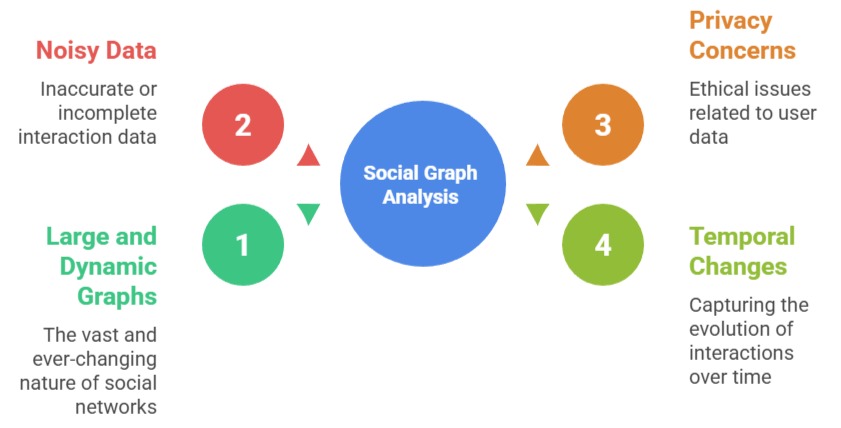
Challenges
Chemistry and Molecular Biology
Molecules are naturally represented as graphs, with atoms as nodes and chemical bonds as edges.
GNNs can predict molecular properties, bioactivity, or binding affinity, making them invaluable in drug discovery and material science.
For instance, models like Message Passing Neural Networks (MPNNs) are used to identify promising drug candidates by learning representations of chemical structures.
By integrating node features such as atom type and bond information, GNNs capture intricate chemical interactions, enabling predictions of solubility, toxicity, or protein-ligand interactions.
This approach drastically reduces the need for expensive laboratory experiments and accelerates the research pipeline for pharmaceuticals and advanced materials.
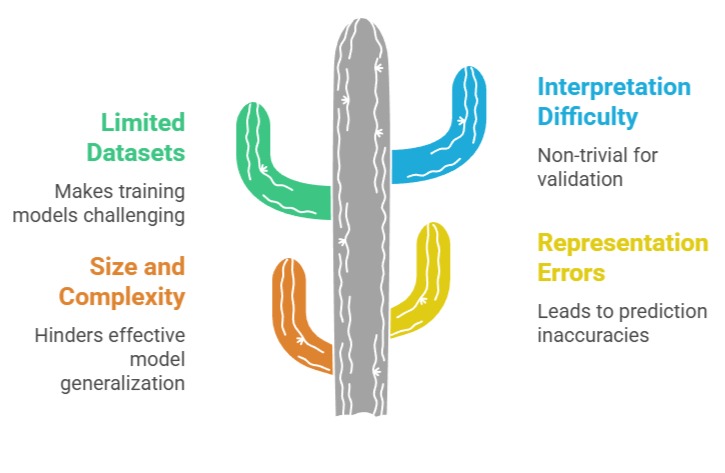
Challenges
Recommendation Systems
GNNs model users and items as nodes, with interactions forming edges, enabling the capture of direct and multi-hop relationships.
For example, in e-commerce or streaming platforms like Amazon or Netflix, GNNs learn embeddings for users and products by aggregating neighborhood information.
This allows for personalized recommendations based on not only direct interactions but also the behavior of similar users or items.
GNNs can uncover latent preferences and correlations that traditional collaborative filtering misses, improving the relevance of recommendations and overall user satisfaction.
Multi-layered GNNs capture complex patterns, enabling more sophisticated recommendation strategies.
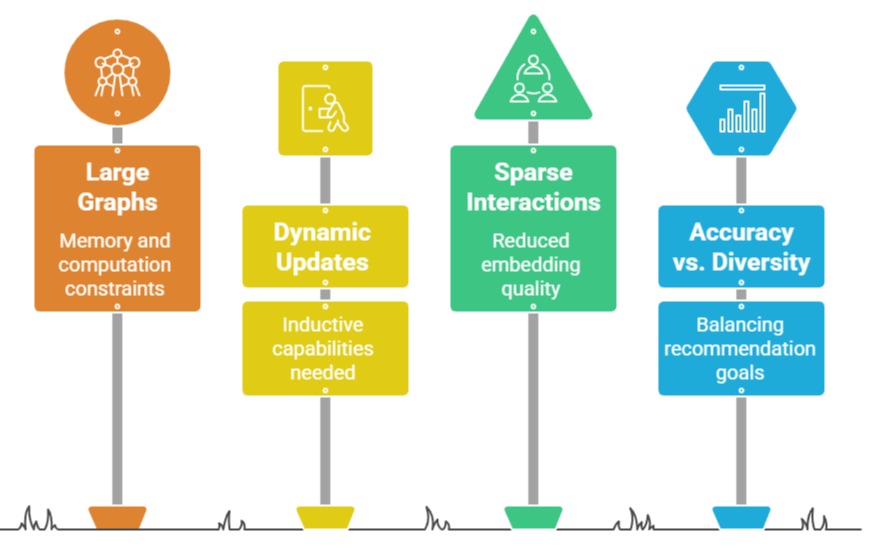
Challenges
Real-Life Case Studies of GNN Applications
Graph Neural Networks (GNNs) are widely used in real-world systems that involve complex relationships and interconnected data.
These case studies illustrate how GNNs drive smarter recommendations, scientific discovery, and social network analysis across industries.
1. Social Networks
Facebook Friend Recommendation
Facebook uses GNN-based models to enhance its friend suggestion system. Users are represented as nodes, and their interactions, friendships, and shared content form edges.
By learning embeddings that capture both local neighborhoods and multi-hop relationships, GNNs can recommend friends who share common connections or interests.
This approach goes beyond traditional heuristics like mutual friends and allows the system to detect latent patterns of user engagement.
It also helps in spam and fake account detection by identifying anomalous connectivity patterns that deviate from typical user behavior.
Twitter Community Detection
Twitter leverages GNNs to identify communities and trending topics. Tweets, users, and hashtags are represented as nodes, with edges showing interactions such as mentions, retweets, and replies.
GNNs can detect clusters of users discussing similar topics, enabling targeted recommendations and trend analysis.
By aggregating neighborhood information, the platform can prioritize content that is most relevant to each user while also understanding the dynamics of influence propagation within communities.
2. Chemistry and Molecular Biology
Drug Discovery with DeepChem
Pharmaceutical companies use GNNs to predict molecular properties for new drug candidates.
Platforms like DeepChem implement message-passing GNNs that represent molecules as graphs, with atoms as nodes and bonds as edges.
GNNs can predict properties like solubility, toxicity, and binding affinity to target proteins, reducing the need for expensive wet-lab experiments.
For example, GNNs were used to identify molecules with potential activity against specific cancer targets, enabling faster candidate screening and prioritization in drug pipelines.
Protein
Protein Interaction Prediction: Bioinformatics applications use GNNs to model interactions between proteins.
Nodes represent proteins, and edges indicate observed interactions. GNN embeddings help predict new interactions that are biologically plausible but not experimentally validated.
This approach accelerates research into protein functions, pathways, and drug-target identification, providing insights that guide experimental verification and therapeutic development.
3. Recommendation Systems
Amazon Product Recommendations
Amazon uses GNN-based recommendation engines where users and products are nodes, and purchases, clicks, or reviews form edges.
GraphSAGE and GAT models aggregate neighborhood information, capturing not only direct user-product interactions but also multi-hop relationships, such as users with similar purchase histories.
This improves personalized recommendations, increasing the likelihood of engagement and purchase. GNNs allow the system to handle millions of products and dynamically adapt to new user behaviors efficiently.
Netflix Content Recommendations
Netflix leverages GNNs to model users, movies, and series as a heterogeneous graph.
Edges represent viewing history, ratings, and genre preferences. GNNs aggregate information from similar users and content to generate embeddings that predict what a user is likely to watch next.
This improves recommendation accuracy, user satisfaction, and retention by uncovering latent correlations that traditional collaborative filtering approaches may miss.