Attention mechanisms and Transformer architectures represent a paradigm shift in deep learning for sequence modeling, enabling models to focus selectively on the most relevant parts of input sequences.
Traditional recurrent models, including RNNs, LSTMs, and GRUs, often struggle with long-term dependencies and parallelization constraints.
Attention mechanisms address these issues by assigning weights to different elements of the input, allowing the network to prioritize important information while ignoring less relevant content.
This selective processing improves performance in natural language processing, machine translation, and speech recognition tasks, where the relationships between distant sequence elements are critical.
The Transformer architecture, introduced by Vaswani et al. in 2017, builds entirely upon attention mechanisms, eliminating recurrence and convolutions.
It relies on self-attention to model dependencies between all input tokens simultaneously, allowing highly parallelized computations and faster training on large datasets.
Attention Mechanisms
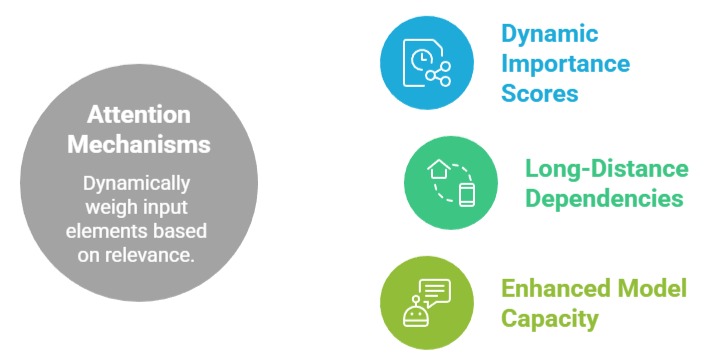
Attention mechanisms allow models to weigh different parts of input sequences according to their relevance to a given task.
Unlike fixed-length representations, attention dynamically computes importance scores for each input element, enhancing the model's capacity to capture dependencies over long distances.
In sequence-to-sequence tasks like machine translation, attention allows the decoder to focus on the most relevant encoder outputs at each step, significantly improving translation quality.
By highlighting important features and suppressing irrelevant ones, attention improves interpretability, making it easier to understand which parts of the input influenced predictions.
Advantages
1. Enhanced Long-Term Dependency Modeling
Attention mechanisms overcome the limitations of traditional RNNs by directly connecting distant input elements, allowing models to capture relationships across long sequences.
This is particularly crucial in tasks like document summarization, language modeling, and question answering, where the meaning of one token may depend on several others far apart.
By computing context-aware weights, attention enables models to maintain global information without the bottleneck of sequential recurrence, improving accuracy and coherence.
2. Improved Interpretability
The attention scores provide insight into which parts of the input the model considered most significant when producing outputs.
This transparency allows practitioners to debug models, analyze reasoning paths, and understand potential biases.
For instance, in machine translation, attention maps reveal which source words influenced each target word, helping researchers evaluate alignment quality and decision rationale.
3. Flexibility Across Modalities
Attention mechanisms are not limited to textual data—they have been successfully applied in vision, audio, and multimodal tasks. In image captioning, for example, spatial attention focuses on relevant image regions while generating words.
In speech recognition, temporal attention emphasizes important audio frames.
This adaptability makes attention a universal tool for a variety of sequence-to-sequence problems.
4. Supports Parallel Computation
Unlike recurrent structures, attention allows simultaneous computation over all input elements, significantly accelerating training and inference.
This parallelism enables scaling to massive datasets and long sequences, which is essential for modern large-scale models.
Faster computation reduces training costs and facilitates rapid experimentation with complex architectures.
5. Robustness to Variable Input Lengths
Attention mechanisms handle sequences of varying lengths without modification, as importance weights are computed dynamically.
This is beneficial in real-world applications where inputs may be short or very long, such as in conversation modeling, document summarization, or audio streams.
Dynamic weighting ensures that models remain effective regardless of input size.
6. Enables Fine-Grained Feature Selection
By assigning different weights to each input component, attention effectively performs feature selection within the model.
This allows the system to focus on critical elements while ignoring irrelevant noise, enhancing performance and generalization.
Such fine-grained control improves the model’s ability to learn subtle patterns in complex datasets.
7. Foundation for Transformer Architectures
Attention is the central concept behind Transformers, forming the basis of multi-head attention, self-attention, and cross-attention mechanisms.
These architectures rely entirely on attention to capture global dependencies, making the development of large-scale, highly parallelizable models possible.
Its foundational role ensures that attention mechanisms remain critical in modern deep learning research.
Disadvantages
1. Computational Complexity
Calculating attention weights between all input elements scales quadratically with sequence length, leading to high memory and computation costs.
Long sequences can quickly exhaust GPU resources, requiring optimizations such as sparse or linear attention approximations. This limits deployment in resource-constrained environments.
2. Requires Large Datasets for Optimal Performance
Attention models often need extensive training data to learn meaningful weight patterns. Insufficient data can lead to overfitting or unstable attention distributions, reducing performance on real-world tasks.
Large-scale datasets are typically essential for high-quality applications in NLP, vision, and multimodal learning.
3. Potential for Overemphasis on Irrelevant Inputs
Although attention highlights important elements, poorly trained models may assign high weights to irrelevant tokens, causing misleading outputs.
This can degrade performance and introduce biases, particularly when the training data is noisy or unbalanced.
4. Limited Handling of Local Patterns in Isolation
Attention excels at capturing global dependencies but may underperform when subtle local structures dominate task performance.
For Example, in character-level language modeling, local context is critical, and naive attention may overlook fine-grained sequential details.
5. Interpretability Can Be Misleading
While attention scores are often treated as explanations, they do not always correspond perfectly to model reasoning.
Overreliance on attention maps for interpretability can be deceptive if not analyzed carefully alongside other model behaviors.
6. Higher Memory Footprint
Self-attention requires storing intermediate representations for all pairs of input elements, increasing memory usage compared to RNNs or CNNs.
For very long sequences, this can exceed practical hardware limits, necessitating careful engineering or sequence truncation.
7. Susceptible to Adversarial Manipulations
Attention weights can be manipulated by adversarial inputs, causing the model to focus incorrectly and make erroneous predictions.
This vulnerability is important to consider in security-sensitive applications such as automated content filtering or medical diagnosis.
Examples
1. Machine Translation: Focuses on relevant words in source sentences to generate accurate translations.
2. Text Summarization: Highlights key sentences or phrases to produce concise summaries.
3. Image Captioning: Spatial attention identifies important regions of images for descriptive text generation.
4. Speech Recognition: Temporal attention prioritizes critical audio frames for transcription.
5. Question Answering: Attention selects the most relevant portions of context paragraphs to answer queries.
Transformer Architecture
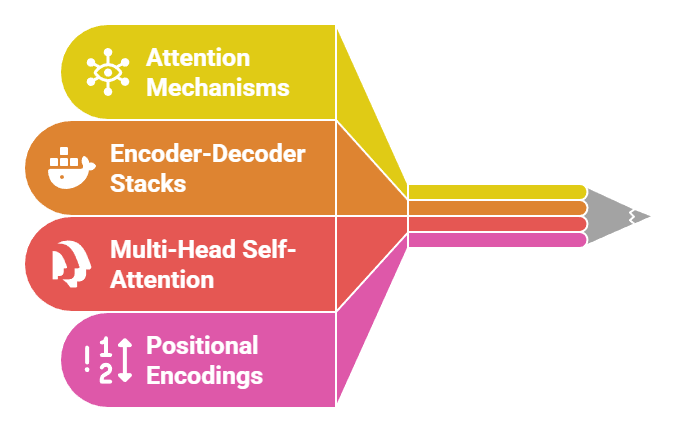
The Transformer architecture replaces recurrence and convolutions entirely with attention mechanisms, allowing direct modeling of global dependencies.
It consists of encoder and decoder stacks, each containing multi-head self-attention and feed-forward layers, with residual connections and layer normalization.
Positional encodings preserve sequence order, while multi-head attention enables the model to learn relationships from multiple representation subspaces simultaneously.
Transformers facilitate highly parallelizable training, enabling large-scale pretraining and transfer learning, which powers modern NLP giants like BERT, GPT, and T5.
Their modularity allows adaptation to vision, audio, and multimodal tasks, making Transformers central to contemporary deep learning.
Advantages
1. High Parallelization for Efficient Training
Transformers eliminate sequential recurrence, allowing simultaneous computation across all input tokens.
This drastically speeds up training compared to RNN-based models, enabling the use of massive datasets and large-scale architectures, which is essential for state-of-the-art NLP and multimodal tasks.
2. Superior Long-Range Dependency Modeling
By using self-attention, Transformers directly connect every input token with every other token, capturing relationships across long distances without suffering from vanishing gradients.
This is critical for tasks like document-level translation, summarization, or dialogue systems where context spans hundreds of tokens.
3. Flexibility Across Modalities
Transformers are adaptable to text, speech, images, and multimodal inputs.
Vision Transformers (ViT) apply self-attention to image patches, demonstrating that the architecture generalizes beyond sequences to spatial data, enabling unified model designs across domains.
4. Foundation for Pretrained Large Models
Transformers enable large-scale pretraining (e.g., BERT, GPT) followed by fine-tuning on specific tasks.
This paradigm maximizes performance while reducing task-specific training requirements, democratizing high-accuracy models for diverse applications.
5. Robust to Variable-Length Inputs
Transformers handle sequences of differing lengths efficiently, as attention weights are computed dynamically. This makes them suitable for varied real-world inputs without architectural changes.
6. Captures Complex Interactions
Multi-head attention allows the model to focus on different representation subspaces simultaneously, capturing nuanced patterns and dependencies.
This leads to improved contextual understanding in text, images, or audio sequences.
7. Supports Scalable Architectures
Transformers are highly modular and can scale to billions of parameters while maintaining efficient training through parallelization.
This enables extremely powerful models that dominate modern AI benchmarks.
Disadvantages
1. Quadratic Complexity
Self-attention scales quadratically with sequence length, making long sequences memory-intensive. Strategies like sparse or linear attention are needed to reduce costs.
2. High Hardware Demands
Large Transformers require powerful GPUs or TPUs for training and inference, increasing deployment cost and energy consumption.
3. Data-Hungry
Transformers perform best on massive datasets; small datasets often lead to overfitting or poor generalization.
4. Sensitive to Positional Encoding Choices
Since Transformers lack recurrence, positional encodings are crucial. Improper encoding can degrade sequence understanding.
5. Less Intuitive Interpretability
Despite attention visualization, Transformer reasoning remains complex, limiting explainability compared to simpler models.
6. Difficulty in Real-Time Applications
Large Transformers are slower for inference in low-latency applications due to memory and computation requirements.
7. Training Instability
Very deep Transformer models can suffer from convergence issues without careful optimization, normalization, and learning rate scheduling.
Examples
1. Natural Language Processing: BERT, GPT, T5 for translation, summarization, QA.
2. Speech Recognition: Attention-based Transformers for end-to-end transcription.
3. Vision: Vision Transformers for image classification and object detection.
4. Multimodal AI: CLIP and DALL·E combining text and image understanding.
5. Time-Series Forecasting: Transformers predicting financial, weather, or sensor data sequences.