Deep learning has become a transformative technology across industries, enabling intelligent decision-making, automation, and predictive capabilities that were previously unattainable.
While theory and experiments provide foundational understanding, real-world applications illustrate the practical impact, challenges, and strategies required to deploy models effectively.
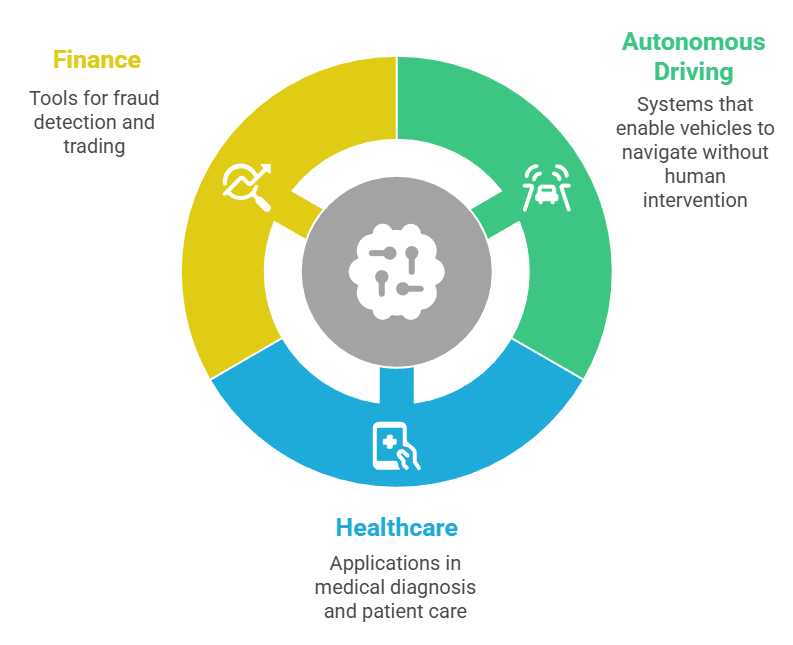
Examining case studies in autonomous driving, healthcare, and finance highlights how deep learning is applied in mission-critical environments and the considerations needed for production deployment.
In autonomous driving, deep learning models analyze camera, LiDAR, and radar inputs to detect objects, predict motion, and navigate complex environments.
These models must operate with high accuracy and extremely low latency to ensure safety and reliability, demanding optimized deployment pipelines and rigorous error analysis.
In healthcare, deep learning assists in disease diagnosis, medical imaging, and patient monitoring.
Models such as those detecting tumors or predicting disease progression require high precision and interpretability, as incorrect predictions can have severe consequences.
Data privacy and compliance are also critical, necessitating careful handling of sensitive patient data.
In finance, deep learning powers fraud detection, credit scoring, algorithmic trading, and risk assessment.
These applications involve imbalanced datasets, real-time predictions, and strict regulatory requirements, demanding robust evaluation metrics, error analysis, and deployment strategies that maintain reliability and explainability.
Real World Applications
1. Autonomous Driving
Autonomous driving systems rely on deep learning models to detect pedestrians, vehicles, traffic signs, and road boundaries using inputs from cameras, LiDAR, and radar sensors.
Object detection and segmentation models must operate in real-time with minimal latency, as delays can compromise safety. Models are optimized through quantization, pruning, and deployment on edge devices inside vehicles.
Error analysis is critical to identify failure scenarios, such as occlusions, poor lighting, or adverse weather conditions. These insights guide improvements in model architectures, data augmentation, and sensor fusion, ensuring robust performance in diverse driving conditions.
2. Healthcare
In healthcare, deep learning is used for applications such as tumor detection, radiology analysis, and predictive patient monitoring.
Models must achieve high sensitivity and specificity to avoid false negatives or positives, as these can directly impact patient outcomes.
Deployment requires compliance with data privacy regulations like HIPAA or GDPR, as well as interpretability to allow clinicians to trust predictions.
Error analysis often identifies challenging cases, such as rare disease patterns or poor-quality imaging, prompting targeted augmentation, retraining, or model refinement.
Real-world deployment also necessitates scalable infrastructure and monitoring systems to handle continuous patient data streams reliably.
3. Finance
In finance, deep learning models support fraud detection, credit scoring, algorithmic trading, and risk management.
Data is often highly imbalanced, with fraudulent transactions being rare, requiring careful evaluation using metrics like ROC-AUC, precision-recall, and F1-score.
Models must process high-frequency transactional data in real-time, making deployment on optimized servers or edge devices essential.
Error analysis helps identify patterns that lead to false alarms or missed detections, guiding feature engineering, threshold adjustment, and model updates. Additionally, models must be explainable and auditable to meet regulatory compliance and ensure stakeholder trust.