Graphs are fundamental data structures used to represent relationships and interactions between entities, making them essential in domains ranging from social networks and molecular chemistry to recommendation systems and transportation networks.
A graph consists of nodes (vertices) representing entities and edges representing relationships or interactions between these nodes.
Graphs can be directed or undirected, weighted or unweighted, and may contain attributes for both nodes and edges, providing rich structural information that traditional tabular data cannot capture.
Understanding graph theory is critical to designing machine learning models that can leverage these complex relational structures.
Graph Neural Networks (GNNs) are a class of deep learning models specifically designed to operate on graph-structured data.
Unlike traditional neural networks that assume Euclidean input spaces, GNNs can directly process non-Euclidean structures by learning node embeddings that encode both local and global graph information.
GNNs achieve this through message-passing mechanisms, where each node aggregates information from its neighbors to iteratively update its representation.
This allows models to capture connectivity patterns, community structures, and relational dependencies.
Key Points and Advantages
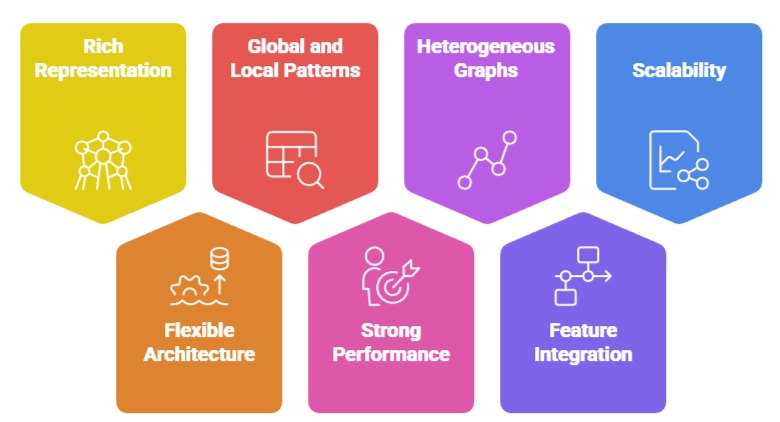
1. Rich Representation of Relational Data
Graphs provide a natural framework for representing complex relationships between entities.
GNNs leverage this structure to learn node and edge embeddings that capture both local and global connectivity.
This enables predictive models to understand relational patterns that traditional feature-based methods cannot, improving accuracy in applications like social network analysis, molecular property prediction, and knowledge graph reasoning.
2. Flexible Architecture for Diverse Graph Types
GNNs can handle directed, undirected, weighted, and heterogeneous graphs, making them versatile across multiple domains.
The message-passing and aggregation functions can be adapted to capture domain-specific interactions, such as chemical bonds in molecules, follower relationships in social networks, or traffic flows in transportation graphs.
This flexibility allows GNNs to generalize across a wide range of graph-structured problems.
3. Capturing Global and Local Graph Patterns
Through iterative aggregation, GNNs incorporate both local neighborhood information and higher-order connectivity patterns.
This allows nodes to develop representations that reflect not only their immediate neighbors but also more distant parts of the graph, supporting tasks such as community detection, link prediction, and anomaly detection.
4. Strong Performance on Relational Prediction Tasks
GNNs have shown state-of-the-art results in tasks like node classification, link prediction, and graph classification.
For Example, in recommender systems, GNNs can model user-item interactions as a bipartite graph, capturing complex preferences and improving recommendation accuracy over traditional collaborative filtering methods.
5. Adaptability to Heterogeneous and Multi-Relational Graphs
Many real-world networks contain multiple types of nodes and edges.
GNNs can be extended to heterogeneous graphs by using specialized aggregation functions or attention mechanisms to differentiate between node and edge types.
This capability makes them suitable for applications in knowledge graphs, biomedical networks, and multi-relational social networks.
6. Ability to Integrate Node and Edge Features
GNNs can incorporate both node-level attributes and edge-level information during message passing.
This allows for richer representations that capture not only structural patterns but also intrinsic properties of nodes and relationships, enhancing predictive performance in applications such as molecular property prediction or traffic modeling.
7. Scalability with Graph Sampling Techniques
Modern GNN frameworks implement graph sampling strategies (e.g., GraphSAGE, Cluster-GCN) to handle large-scale graphs.
These approaches allow the model to efficiently process millions of nodes and edges while maintaining high accuracy, making GNNs practical for real-world industrial applications.
Real-World Case Studies of Graph Neural Networks
Graph Neural Networks (GNNs) are increasingly adopted across industries to model complex relational data and interconnected systems.
These real-world case studies demonstrate how GNNs enable more accurate predictions, better recommendations, and deeper insights from graph-structured data.
1. Social Network Analysis
GNNs are extensively used in social networks to model relationships between users and their interactions.
Platforms like Facebook, LinkedIn, and Twitter use GNN-based models for friend recommendations, community detection, and influence prediction.
By representing users as nodes and interactions (friendships, likes, shares) as edges, GNNs learn embeddings that capture social structures and patterns.
For instance, LinkedIn uses graph embeddings to suggest professional connections based on multi-hop relationships, improving user engagement and network growth.
These models also help detect fake accounts or malicious activities by analyzing anomalous patterns in the graph structure.
2. Recommendation Systems
E-commerce platforms like Amazon and Alibaba leverage GNNs for product and content recommendations.
User-item interactions are modeled as bipartite graphs, where nodes represent users and products, and edges indicate purchases or clicks.
GNNs aggregate information from neighboring nodes to learn rich embeddings, enabling personalized recommendations.
For example, in Amazon, a user’s embedding incorporates information from previously interacted products and similar users, improving recommendation accuracy beyond traditional collaborative filtering.
This method captures complex relationships and multi-hop dependencies that are essential for predicting user preferences in large catalogs.
3. Drug Discovery and Molecular Property Prediction
In biomedical applications, molecules can be represented as graphs with atoms as nodes and chemical bonds as edges. GNNs, such as Message Passing Neural Networks (MPNNs), are used to predict molecular properties, binding affinities, and potential drug candidates.
For instance, DeepChem and MoleculeNet utilize GNNs to predict toxicity, solubility, and bioactivity of molecules, accelerating the drug discovery process.
By learning embeddings that capture chemical structures, GNNs help researchers identify promising compounds without expensive lab experiments, significantly reducing cost and time in pharmaceutical R&D.
4. Traffic and Transportation Networks
GNNs are applied to traffic flow prediction, route optimization, and congestion detection.
Cities like Beijing and New York use graph-based models where intersections are nodes and roads are edges.
GNNs aggregate information from neighboring intersections to predict traffic patterns, detect anomalies, and optimize traffic signal timings.
This enables more efficient urban mobility management and reduces congestion, accidents, and emissions.
Additionally, public transit systems use GNNs to recommend optimal routes for commuters in real-time by analyzing dynamic traffic graphs.
5. Knowledge Graph Completion
Companies like Google and Microsoft use GNNs to enhance knowledge graphs, which represent entities (people, places, concepts) as nodes and relationships as edges.
GNNs help with link prediction and entity classification, allowing systems like Google Search or Bing to infer missing relationships between entities and improve search relevance.
For instance, a GNN can predict new connections in a biomedical knowledge graph, suggesting potential interactions between proteins or diseases that were previously unknown.
6. Fraud Detection in Financial Systems
Financial institutions apply GNNs to detect fraudulent transactions, money laundering, and account takeovers.
Transaction networks are represented as graphs where nodes are accounts and edges are transactions.
GNNs can capture complex patterns of interactions and multi-hop relationships, enabling the identification of suspicious activities that traditional rule-based systems might miss.
For Example, PayPal and Ant Financial use GNN-based approaches to improve fraud detection accuracy, reducing financial losses and improving regulatory compliance.

Class Sessions
Sales Campaign

We have a sales campaign on our promoted courses and products. You can purchase 1 products at a discounted price up to 15% discount.