USD ($)
$
United States Dollar
Euro Member Countries
India Rupee
د.إ
United Arab Emirates dirham
ر.س
Saudi Arabia Riyal

Regression Algorithms: Linear Regression, Ridge/Lasso, Decision Trees

Lesson 16/44 | Study Time: 20 Min

Regression algorithms are fundamental tools in machine learning used to predict continuous outcomes based on input variables. They establish relationships between dependent and independent variables, enabling forecasting, trend analysis, and decision-making across diverse domains.

Introduction to Regression

Regression analysis focuses on modeling the relationship between a continuous dependent variable and one or more independent variables (features). The goal is to learn a function that maps inputs to predicted continuous values while minimizing prediction errors. Different regression algorithms vary in complexity, interpretability, and suitability for handling multicollinearity, overfitting, or non-linear relationships.

Linear Regression

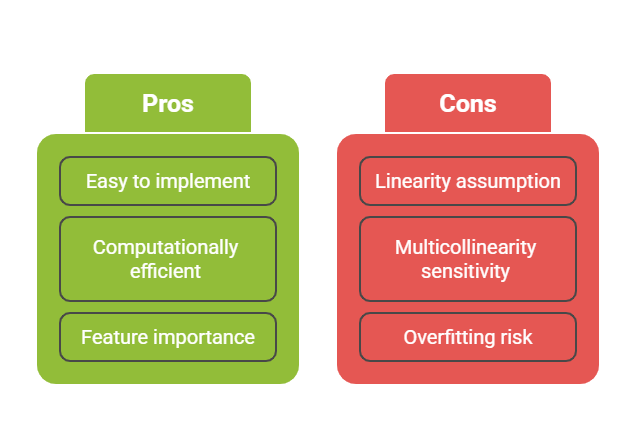
Linear Regression is the simplest and most widely used regression technique. It assumes a linear relationship between the independent variables and the dependent variable.


How it Works:


1. The algorithm fits a linear equation    , 

2. Coefficients β are estimated using methods like Ordinary Least Squares (OLS) to minimize the sum of squared residuals.

Ridge and Lasso Regression (Regularized Regression)

Regularization techniques address overfitting and multicollinearity by adding penalty terms to the linear regression's cost function, shrinking coefficient magnitudes.


Ridge Regression (L2 Regularization):


1. Adds a penalty equal to the sum of the squared coefficients multiplied by a regularization parameter λ.

2. Shrinks coefficients towards zero but never exactly zero.

3. Effectively reduces model complexity while retaining all features.

4. Suitable when all predictors contribute to the outcome.


Mathematically, the objective is:


Lasso Regression (L1 Regularization):


1. Adds a penalty proportional to the absolute values of the coefficients.

2. Can shrink some coefficients exactly to zero, performing feature selection.

3. Produces simpler, more interpretable models by excluding irrelevant features.

4. Useful when only a subset of predictors is relevant.


Objective function:


Decision Tree Regression

Decision Tree Regression models predict continuous outputs by recursively partitioning the feature space into regions and fitting simple models within each region.


How it Works:


1. Split data based on feature thresholds that minimize prediction error (e.g., mean squared error).

2. Create a tree structure where leaf nodes represent predicted values.


Practical Use Cases


1. Linear Regression: Predicting sales based on advertising spend.

2. Ridge Regression: Housing price estimation with many correlated features.

3. Lasso Regression: Genetic data analysis where only a few genes impact the outcome.

4. Decision Trees: Customer segmentation and credit risk analysis.

Chase Miller

Chase Miller

Product Designer
Profile

Class Sessions

1- What is Artificial Intelligence? Types of AI: Narrow, General, Generative 2- Machine Learning vs Deep Learning vs Data Science: Fundamental Differences 3- Key Concepts in Machine Learning: Models, Training, Inference, Overfitting, Generalization 4- Real-World AI Applications Across Industries 5- AI Workflow: Data Collection → Model Building → Deployment Process 6- Types of Data: Structured, Unstructured, Semi-Structured 7- Basics of Data Collection and Storage Methods 8- Ensuring Data Quality, Understanding Data Bias, and Ethical Considerations 9- Exploratory Data Analysis (EDA) Fundamentals for Insight Extraction 10- Data Splitting Strategies: Train, Validation, and Test Sets 11- Handling Missing Values and Outlier Detection/Treatment 12- Encoding Categorical Variables and Scaling Numerical Features 13- Feature Engineering: Selection vs Extraction 14- Dimensionality Reduction Techniques: PCA and t-SNE 15- Basics of Data Augmentation for Tabular, Image, and Text Data 16- Regression Algorithms: Linear Regression, Ridge/Lasso, Decision Trees 17- Classification Algorithms: Logistic Regression, KNN, Random Forest, SVM 18- Model Evaluation Metrics: Accuracy, Precision, Recall, AUC, RMSE 19- Cross-Validation Techniques and Hyperparameter Tuning Methods 20- Clustering Algorithms: K-Means, Hierarchical Clustering, DBSCAN 21- Association Rules and Market Basket Analysis for Pattern Mining 22- Anomaly Detection Fundamentals 23- Applications in Customer Segmentation and Fraud Detection 24- Neural Networks Fundamentals: Architecture and Key Components 25- Activation Functions and Backpropagation Algorithm 26- Overview of Deep Learning Architectures 27- Basics of Computer Vision: CNN Concepts 28- Fundamentals of Natural Language Processing: RNN and LSTM Concepts 29- Transformers Architecture 30- Attention Mechanism: Concept and Importance 31- Large Language Models (LLMs): Functionality and Impact 32- Generative AI Overview: Diffusion Models and Generative Transformers 33- Hyperparameter Tuning Methods: Grid Search, Random Search, Bayesian Approaches 34- Regularization Techniques: Purpose and Usage 35- Handling Imbalanced Datasets Effectively 36- Model Monitoring for Drift Detection and Maintenance 37- Fairness and Mitigation of Bias in AI Models 38- Interpretable Machine Learning Techniques: SHAP and LIME 39- Transparent and Ethical Model Development Workflows 40- Global Ethical Guidelines and AI Governance Trends 41- Introduction to Model Serving and API Development 42- Basics of MLOps: Versioning, Pipelines, and Monitoring 43- Deployment Workflows: Local Machines, Cloud Platforms, Edge Devices 44- Documentation Standards and Reporting for ML Projects