USD ($)
$
United States Dollar
Euro Member Countries
India Rupee
د.إ
United Arab Emirates dirham
ر.س
Saudi Arabia Riyal

Introduction to Model Serving and API Development

Lesson 41/44 | Study Time: 20 Min

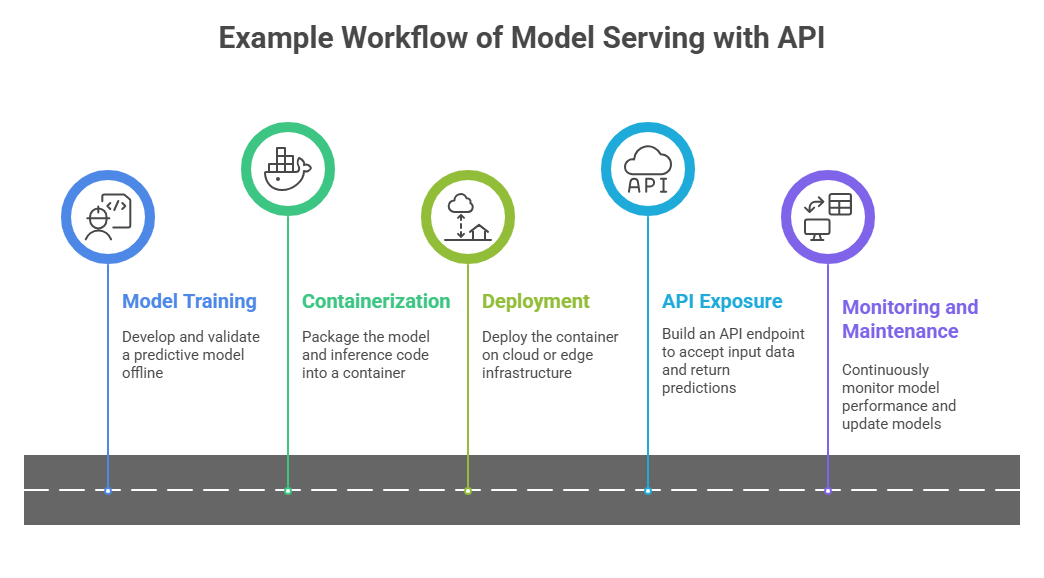
In the lifecycle of machine learning projects, transitioning from model development to production deployment is pivotal. Model serving and API development are integral parts of this deployment phase, enabling trained models to be accessible and usable by other systems or end-users in real time. 

What is Model Serving?

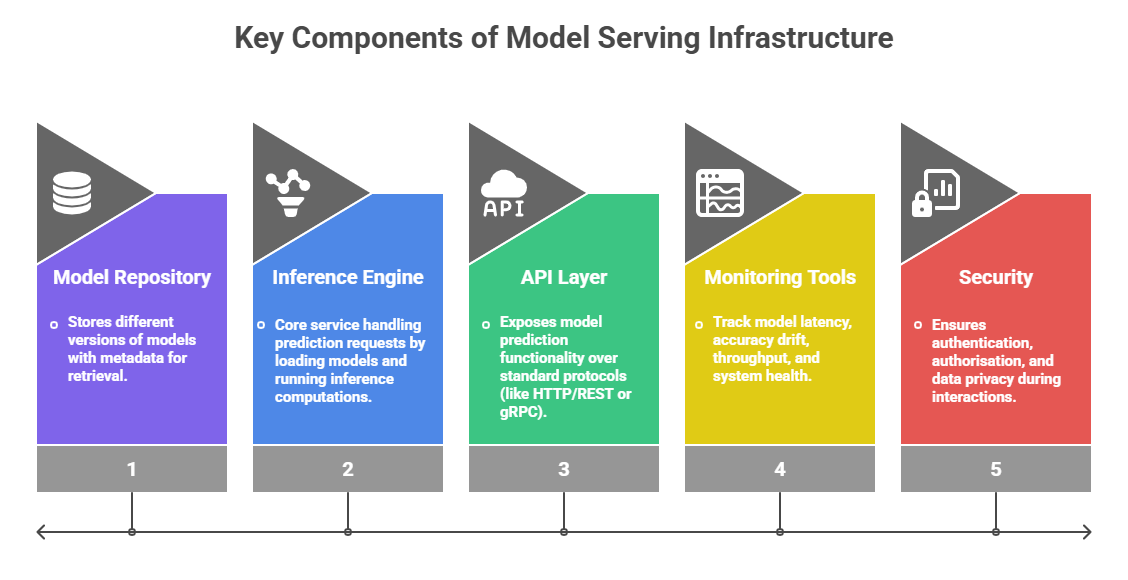
Model serving refers to the process of making a trained machine learning model available in a production environment to perform inference on new data inputs. It acts as a bridge between the model's offline training phase and real-time decision-making or automation applications.

Goal: Efficiently deliver model predictions with low latency and high reliability.

Context: Part of a larger MLOps pipeline encompassing continuous integration, monitoring, and maintenance.

Model serving may involve scaling, load balancing, version control, and integration with upstream and downstream systems.

API Development for Machine Learning Models

An API (Application Programming Interface) provides a standardised way for external applications to interact with the model serving system. This makes the machine learning model reusable, scalable, and maintainable.


1. RESTful APIs: Popular approach using HTTP methods, allowing clients to send prediction requests and receive responses.

2. gRPC: High-performance alternative suited for microservices and internal communication.

3. Input/Output Specification: Clear schema definitions for requests and responses ensure consistent and error-free communication.

4. Serialisation Formats: JSON, Protocol Buffers, or Avro are commonly used for data exchange.

Best Practices for Model Serving and APIs

Effective model serving depends on a set of core operational principles that support stability and smooth delivery. The following outlines essential practices to optimise API-driven model usage.


1. Versioning: Maintain multiple model versions to rollback or test new models safely.

2. Scalability: Use container orchestration (e.g., Kubernetes) and auto-scaling to handle variable loads.

3. Latency Optimisation: Employ batching, caching, or model quantisation to reduce prediction time.

4. Robust Error Handling: Ensure graceful degradation and meaningful error messages.

5. Logging and Auditing: Keep detailed logs for monitoring and diagnosing issues.

6. Security Measures: Use TLS, API gateways, and authentication mechanisms to protect endpoints.

Chase Miller

Chase Miller

Product Designer
Profile

Class Sessions

1- What is Artificial Intelligence? Types of AI: Narrow, General, Generative 2- Machine Learning vs Deep Learning vs Data Science: Fundamental Differences 3- Key Concepts in Machine Learning: Models, Training, Inference, Overfitting, Generalization 4- Real-World AI Applications Across Industries 5- AI Workflow: Data Collection → Model Building → Deployment Process 6- Types of Data: Structured, Unstructured, Semi-Structured 7- Basics of Data Collection and Storage Methods 8- Ensuring Data Quality, Understanding Data Bias, and Ethical Considerations 9- Exploratory Data Analysis (EDA) Fundamentals for Insight Extraction 10- Data Splitting Strategies: Train, Validation, and Test Sets 11- Handling Missing Values and Outlier Detection/Treatment 12- Encoding Categorical Variables and Scaling Numerical Features 13- Feature Engineering: Selection vs Extraction 14- Dimensionality Reduction Techniques: PCA and t-SNE 15- Basics of Data Augmentation for Tabular, Image, and Text Data 16- Regression Algorithms: Linear Regression, Ridge/Lasso, Decision Trees 17- Classification Algorithms: Logistic Regression, KNN, Random Forest, SVM 18- Model Evaluation Metrics: Accuracy, Precision, Recall, AUC, RMSE 19- Cross-Validation Techniques and Hyperparameter Tuning Methods 20- Clustering Algorithms: K-Means, Hierarchical Clustering, DBSCAN 21- Association Rules and Market Basket Analysis for Pattern Mining 22- Anomaly Detection Fundamentals 23- Applications in Customer Segmentation and Fraud Detection 24- Neural Networks Fundamentals: Architecture and Key Components 25- Activation Functions and Backpropagation Algorithm 26- Overview of Deep Learning Architectures 27- Basics of Computer Vision: CNN Concepts 28- Fundamentals of Natural Language Processing: RNN and LSTM Concepts 29- Transformers Architecture 30- Attention Mechanism: Concept and Importance 31- Large Language Models (LLMs): Functionality and Impact 32- Generative AI Overview: Diffusion Models and Generative Transformers 33- Hyperparameter Tuning Methods: Grid Search, Random Search, Bayesian Approaches 34- Regularization Techniques: Purpose and Usage 35- Handling Imbalanced Datasets Effectively 36- Model Monitoring for Drift Detection and Maintenance 37- Fairness and Mitigation of Bias in AI Models 38- Interpretable Machine Learning Techniques: SHAP and LIME 39- Transparent and Ethical Model Development Workflows 40- Global Ethical Guidelines and AI Governance Trends 41- Introduction to Model Serving and API Development 42- Basics of MLOps: Versioning, Pipelines, and Monitoring 43- Deployment Workflows: Local Machines, Cloud Platforms, Edge Devices 44- Documentation Standards and Reporting for ML Projects

Sales Campaign

Sales Campaign

We have a sales campaign on our promoted courses and products. You can purchase 1 products at a discounted price up to 15% discount.