USD ($)
$
United States Dollar
Euro Member Countries
India Rupee
د.إ
United Arab Emirates dirham
ر.س
Saudi Arabia Riyal

Dimensionality Reduction Techniques: PCA and t-SNE

Lesson 14/44 | Study Time: 20 Min

Dimensionality reduction is an essential technique in machine learning and data analysis used to simplify high-dimensional datasets while preserving meaningful information. This process improves model performance, reduces computational complexity, and aids in visualization.

Two popular techniques for dimensionality reduction are Principal Component Analysis (PCA) and t-Distributed Stochastic Neighbor Embedding (t-SNE). Though both serve to reduce data dimensions, they have different mechanisms, strengths, and use cases.

Dimensionality Reduction

High-dimensional data can be challenging to analyze due to the "curse of dimensionality," which leads to overfitting and prolonged computation times. Dimensionality reduction helps by transforming the data into a lower-dimensional space that retains important characteristics. This is useful for both preprocessing before model training and for visualizing complex datasets.

Principal Component Analysis (PCA)

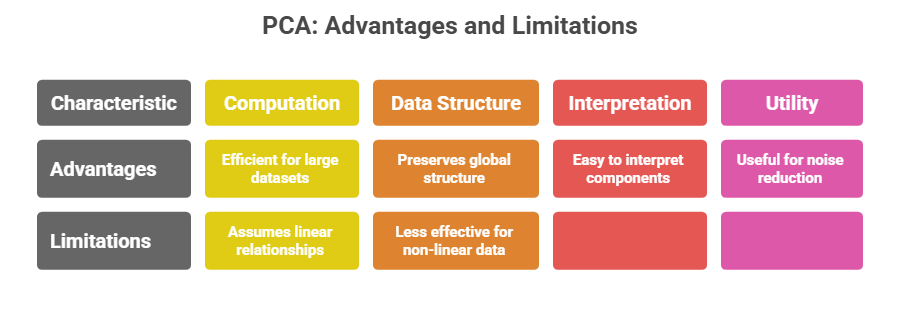
PCA is a linear dimensionality reduction technique that identifies the directions (principal components) along which the data varies the most. It projects the original data onto a smaller set of orthogonal axes that capture the maximum variance.


How PCA Works:


1. Computes the covariance matrix of the data.

2. Extracts eigenvalues and eigenvectors representing directions of maximum variance.

3. Order these principal components by the amount of variance explained.

4. Projects data onto the top principal components, reducing the feature space while preserving global structure.

t-Distributed Stochastic Neighbor Embedding (t-SNE)

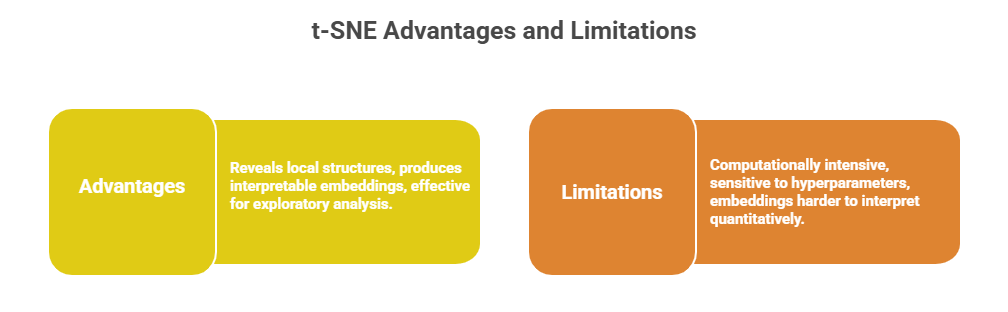
t-SNE is a non-linear dimensionality reduction technique designed primarily for visualizing high-dimensional data in two or three dimensions. It focuses on preserving local relationships and similarities by converting distances into probabilities that capture pairwise similarities.


How t-SNE Works:


1. Converts distances between high-dimensional points into conditional probabilities reflecting similarity.

2. Maps these probabilities to a low-dimensional space using a Student’s t-distribution to model similarities.

3. Optimizes the embedding by minimizing the Kullback–Leibler divergence between high- and low-dimensional probability distributions using gradient descent.

4. Emphasizes preserving distances between nearby points, clustering similar data points together.

Hybrid Approach

Often in practice, PCA is used first to reduce very high-dimensional data to fewer dimensions (e.g., 50), followed by t-SNE for further reduction to 2 or 3 dimensions to improve visualization speed and quality.

Chase Miller

Chase Miller

Product Designer
Profile

Class Sessions

1- What is Artificial Intelligence? Types of AI: Narrow, General, Generative 2- Machine Learning vs Deep Learning vs Data Science: Fundamental Differences 3- Key Concepts in Machine Learning: Models, Training, Inference, Overfitting, Generalization 4- Real-World AI Applications Across Industries 5- AI Workflow: Data Collection → Model Building → Deployment Process 6- Types of Data: Structured, Unstructured, Semi-Structured 7- Basics of Data Collection and Storage Methods 8- Ensuring Data Quality, Understanding Data Bias, and Ethical Considerations 9- Exploratory Data Analysis (EDA) Fundamentals for Insight Extraction 10- Data Splitting Strategies: Train, Validation, and Test Sets 11- Handling Missing Values and Outlier Detection/Treatment 12- Encoding Categorical Variables and Scaling Numerical Features 13- Feature Engineering: Selection vs Extraction 14- Dimensionality Reduction Techniques: PCA and t-SNE 15- Basics of Data Augmentation for Tabular, Image, and Text Data 16- Regression Algorithms: Linear Regression, Ridge/Lasso, Decision Trees 17- Classification Algorithms: Logistic Regression, KNN, Random Forest, SVM 18- Model Evaluation Metrics: Accuracy, Precision, Recall, AUC, RMSE 19- Cross-Validation Techniques and Hyperparameter Tuning Methods 20- Clustering Algorithms: K-Means, Hierarchical Clustering, DBSCAN 21- Association Rules and Market Basket Analysis for Pattern Mining 22- Anomaly Detection Fundamentals 23- Applications in Customer Segmentation and Fraud Detection 24- Neural Networks Fundamentals: Architecture and Key Components 25- Activation Functions and Backpropagation Algorithm 26- Overview of Deep Learning Architectures 27- Basics of Computer Vision: CNN Concepts 28- Fundamentals of Natural Language Processing: RNN and LSTM Concepts 29- Transformers Architecture 30- Attention Mechanism: Concept and Importance 31- Large Language Models (LLMs): Functionality and Impact 32- Generative AI Overview: Diffusion Models and Generative Transformers 33- Hyperparameter Tuning Methods: Grid Search, Random Search, Bayesian Approaches 34- Regularization Techniques: Purpose and Usage 35- Handling Imbalanced Datasets Effectively 36- Model Monitoring for Drift Detection and Maintenance 37- Fairness and Mitigation of Bias in AI Models 38- Interpretable Machine Learning Techniques: SHAP and LIME 39- Transparent and Ethical Model Development Workflows 40- Global Ethical Guidelines and AI Governance Trends 41- Introduction to Model Serving and API Development 42- Basics of MLOps: Versioning, Pipelines, and Monitoring 43- Deployment Workflows: Local Machines, Cloud Platforms, Edge Devices 44- Documentation Standards and Reporting for ML Projects

Sales Campaign

Sales Campaign

We have a sales campaign on our promoted courses and products. You can purchase 1 products at a discounted price up to 15% discount.