USD ($)
$
United States Dollar
Euro Member Countries
India Rupee
د.إ
United Arab Emirates dirham
ر.س
Saudi Arabia Riyal

Encoding Categorical Variables and Scaling Numerical Features

Lesson 12/44 | Study Time: 20 Min

In machine learning, data preprocessing is essential for preparing raw data into a form that algorithms can effectively use. Two critical preprocessing steps are encoding categorical variables and scaling numerical features. Encoding converts categorical data into numerical values since most machine learning algorithms require numeric input. Scaling standardizes the range of numerical features to improve convergence and model performance. 

Encoding Categorical Variables

Categorical variables represent data points that fall into discrete categories, such as gender, color, or product type. Because machine learning models are mathematically designed to process numbers, categorical data must be converted into numeric representations — a process called encoding.

Common Encoding Techniques


1. Label Encoding


Assigns each category a unique integer label (e.g., ‘Red’ → 1, ‘Blue’ → 2).

Suitable when categories have an ordinal (ordered) relationship.

Simple and memory-efficient.


Potential drawback: may imply a false ordinal relationship for nominal categories.

2. One-Hot Encoding


Converts each category into a binary vector where each column represents one category.

Avoids implicit order by creating separate columns with 0s and 1s.

Widely used with nominal data.

Can lead to high dimensionality with many categories.


3. Ordinal Encoding: Similar to label encoding but explicitly used when the categorical variable has a meaningful order (e.g., ‘Low’, ‘Medium’, ‘High’).

4. Target Encoding


Replaces categories with the mean of the target variable for that category.

Useful for high-cardinality features.

Risks of overfitting; smoothing or cross-validation techniques are recommended.


5. Binary Encoding


Converts categories to binary numbers and splits them into multiple columns.

Memory-efficient for high-cardinality data.

More complex, but reduces dimensionality compared to one-hot encoding.

Scaling Numerical Features

Numerical features often come with widely different ranges and units, which can bias machine learning models. Scaling transforms features to a standard scale, improving model training speed and accuracy.


Common Scaling Techniques


1. Min-Max Scaling (Normalization)


Transforms data to fit within a fixed range, usually.​  

Formula:    

Preserves relative distances but is sensitive to outliers.


2. Standardization (Z-score Scaling)


Centers data around the mean with unit variance.

Formula:   

Works well with algorithms assuming a Gaussian distribution.


3. Robust Scaling


Uses median and interquartile range, making it robust to outliers.

Suitable for datasets with many anomalies.

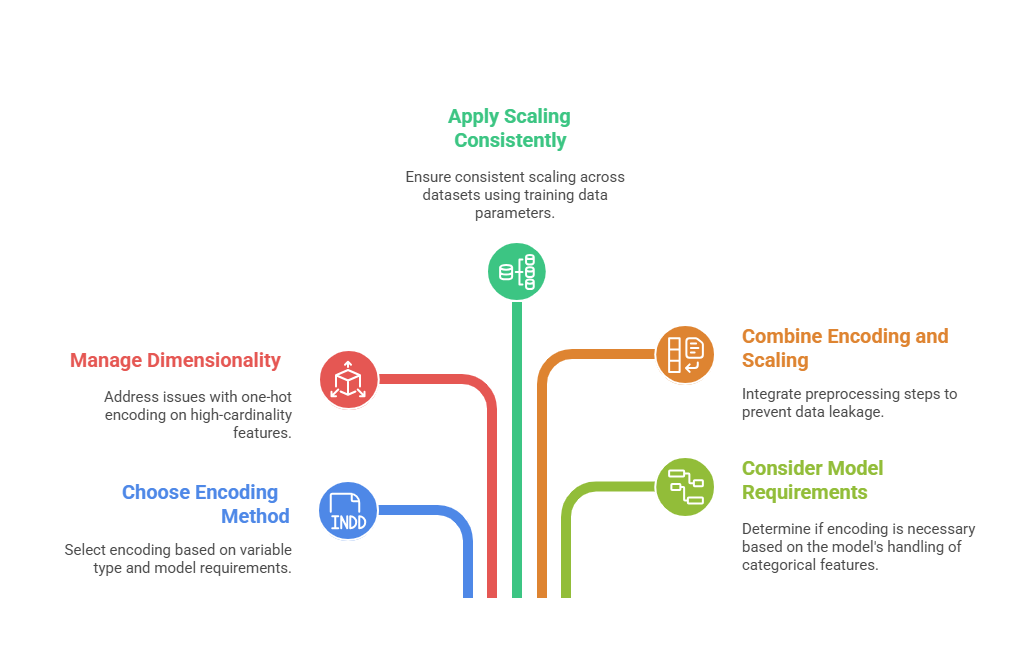
Best Practices and Considerations

Effective data preparation involves balancing model requirements, feature properties, and pipeline consistency. Outlined here are best practices that support robust and well-structured preprocessing workflows.

Chase Miller

Chase Miller

Product Designer
Profile

Class Sessions

1- What is Artificial Intelligence? Types of AI: Narrow, General, Generative 2- Machine Learning vs Deep Learning vs Data Science: Fundamental Differences 3- Key Concepts in Machine Learning: Models, Training, Inference, Overfitting, Generalization 4- Real-World AI Applications Across Industries 5- AI Workflow: Data Collection → Model Building → Deployment Process 6- Types of Data: Structured, Unstructured, Semi-Structured 7- Basics of Data Collection and Storage Methods 8- Ensuring Data Quality, Understanding Data Bias, and Ethical Considerations 9- Exploratory Data Analysis (EDA) Fundamentals for Insight Extraction 10- Data Splitting Strategies: Train, Validation, and Test Sets 11- Handling Missing Values and Outlier Detection/Treatment 12- Encoding Categorical Variables and Scaling Numerical Features 13- Feature Engineering: Selection vs Extraction 14- Dimensionality Reduction Techniques: PCA and t-SNE 15- Basics of Data Augmentation for Tabular, Image, and Text Data 16- Regression Algorithms: Linear Regression, Ridge/Lasso, Decision Trees 17- Classification Algorithms: Logistic Regression, KNN, Random Forest, SVM 18- Model Evaluation Metrics: Accuracy, Precision, Recall, AUC, RMSE 19- Cross-Validation Techniques and Hyperparameter Tuning Methods 20- Clustering Algorithms: K-Means, Hierarchical Clustering, DBSCAN 21- Association Rules and Market Basket Analysis for Pattern Mining 22- Anomaly Detection Fundamentals 23- Applications in Customer Segmentation and Fraud Detection 24- Neural Networks Fundamentals: Architecture and Key Components 25- Activation Functions and Backpropagation Algorithm 26- Overview of Deep Learning Architectures 27- Basics of Computer Vision: CNN Concepts 28- Fundamentals of Natural Language Processing: RNN and LSTM Concepts 29- Transformers Architecture 30- Attention Mechanism: Concept and Importance 31- Large Language Models (LLMs): Functionality and Impact 32- Generative AI Overview: Diffusion Models and Generative Transformers 33- Hyperparameter Tuning Methods: Grid Search, Random Search, Bayesian Approaches 34- Regularization Techniques: Purpose and Usage 35- Handling Imbalanced Datasets Effectively 36- Model Monitoring for Drift Detection and Maintenance 37- Fairness and Mitigation of Bias in AI Models 38- Interpretable Machine Learning Techniques: SHAP and LIME 39- Transparent and Ethical Model Development Workflows 40- Global Ethical Guidelines and AI Governance Trends 41- Introduction to Model Serving and API Development 42- Basics of MLOps: Versioning, Pipelines, and Monitoring 43- Deployment Workflows: Local Machines, Cloud Platforms, Edge Devices 44- Documentation Standards and Reporting for ML Projects

Sales Campaign

Sales Campaign

We have a sales campaign on our promoted courses and products. You can purchase 1 products at a discounted price up to 15% discount.
