Large Language Models (LLMs) represent a transformative advancement in artificial intelligence, capable of understanding, generating, and interacting with human language at unprecedented scales. Powered primarily by transformer architectures, these models process extensive text corpora to learn rich contextual and semantic representations.
Their functionality spans diverse applications—from chatbots and translation to scientific research—reshaping how humans and machines communicate and solve problems.
Introduction to Large Language Models
LLMs are neural network-based AI systems designed to predict and generate natural language. Unlike traditional models limited by fixed vocabularies or shallow contextual awareness, LLMs learn statistical patterns across billions of parameters by pre-training on vast datasets.
This endows them with the ability to comprehend complex sentences, capture long-range dependencies, and generate coherent, contextually relevant responses. Their flexible, general-purpose capabilities enable usage across numerous specialized and general tasks, often requiring minimal task-specific supervision.
Core Functionality of LLMs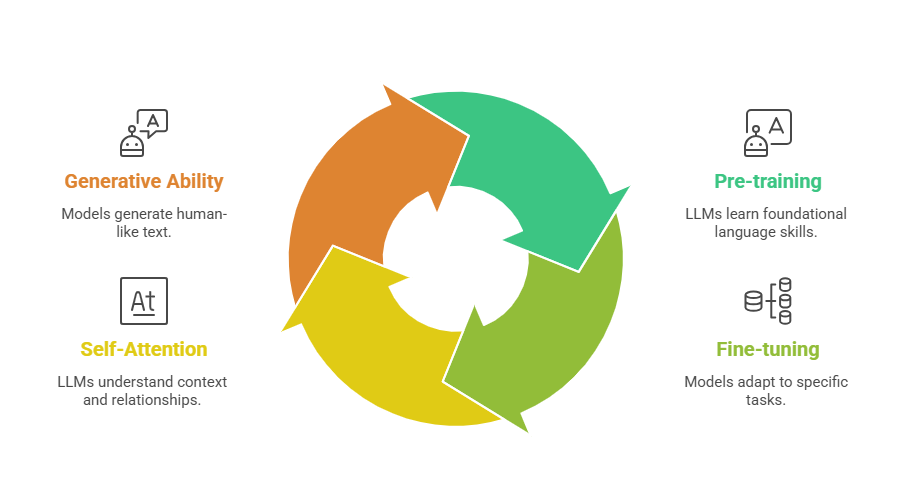 Here are the core functions that allow LLMs to process language effectively. They enable comprehension, contextual analysis, and the creation of fluent and relevant text outputs.
1. Pre-training: LLMs undergo extensive unsupervised training on diverse text corpora, learning to predict the next word or token based on preceding context. This stage establishes foundational language understanding, enabling recognition of grammar, syntax, semantics, and factual knowledge.
2. Fine-tuning: Models are adapted to specific downstream tasks using smaller labeled datasets. Techniques like supervised learning, reinforcement learning from human feedback (RLHF), or instruction tuning enhance their task-specific capabilities.
3. Self-Attention and Contextual Modeling: LLMs use transformer-based self-attention mechanisms to assess the relevance of all tokens in input text, making them adept at understanding context and relationships in long passages.
4. Generative Ability: They generate human-like text by probabilistically predicting coherent sequences, enabling sophisticated conversational agents, content creation, and code generation.
Impact Across Industries and Society
Below are the key ways AI and large language models are transforming industries and society. These impacts span communication, productivity, innovation, and ethical considerations.
1. Enhanced Communication and Accessibility: Break language barriers with real-time translation and multi-lingual support. Power intelligent chatbots and virtual assistants that offer personalized, context-aware interactions.
2. Automation and Productivity: Automate content generation, report writing, summarization, and code development. Accelerate research by analyzing scientific literature and proposing hypotheses.
3. Innovation in Specialized Domains: In healthcare, assist in diagnostic documentation and drug discovery. In the legal and financial sectors, streamline document analysis and fraud detection.
4. Ethical and Societal Considerations: Pose challenges such as bias amplification, misinformation generation, and privacy concerns. Drive ongoing research in safe, fair, and transparent AI deployment.
Technical and Operational Considerations
The following points highlight critical technical and operational elements for LLM implementation. Addressing these factors enables efficient training, fine-tuning, and deployment at scale.
1. Scale and Infrastructure
Training large language models (LLMs) demands extensive computational resources, including high-performance GPUs or TPUs and distributed computing frameworks. Techniques like model parallelism and data parallelism are crucial to manage both the size of the model and the large volumes of training data. Proper infrastructure ensures efficient training while maintaining scalability and performance.
2. Customization and Deployment
Organizations often fine-tune LLMs on domain-specific datasets to improve relevance, accuracy, and task-specific performance. Efficient deployment requires optimizing inference latency and carefully managing computational resources during serving. These considerations ensure that LLMs perform effectively in real-world applications while maintaining responsiveness.

Class Sessions
Sales Campaign

We have a sales campaign on our promoted courses and products. You can purchase 1 products at a discounted price up to 15% discount.