USD ($)
$
United States Dollar
Euro Member Countries
India Rupee
د.إ
United Arab Emirates dirham
ر.س
Saudi Arabia Riyal

Basics of Data Augmentation for Tabular, Image, and Text Data

Lesson 15/44 | Study Time: 20 Min

Data augmentation is a fundamental technique in machine learning aimed at increasing the diversity and size of training datasets by creating modified versions of existing data. This approach addresses challenges such as limited data availability, class imbalance, and overfitting by introducing controlled variations that help models generalize better to unseen data.

Augmentation techniques differ depending on the type of data—tabular, image, or text—each requiring tailored strategies to preserve data integrity while enhancing variability.

Introduction to Data Augmentation

Machine learning models perform best when trained on large, diverse datasets that capture the range of possible real-world variations. However, collecting sufficient data is often costly or impractical.

Data augmentation artificially expands datasets without acquiring new data by applying transformations that alter existing samples while preserving their original labels or meaning. This enriches the training process by exposing models to varied instances, improving robustness and predictive accuracy.

Data Augmentation for Tabular Data

Tabular data consists of structured rows and columns commonly found in spreadsheets and databases. Augmentation here must maintain logical consistency across features.
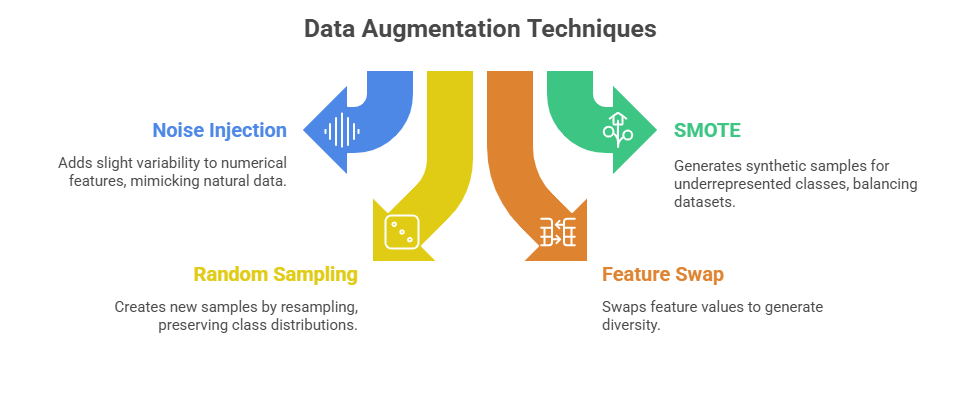

Considerations:

1. Maintain feature relationships and constraints (e.g., age must remain positive).

2. Avoid introducing unrealistic or impossible data points.

3. Evaluate augmented data with domain knowledge to ensure relevance.

Data Augmentation for Image Data

Image augmentation is widely used to increase training data size and improve computer vision models’ robustness against variations such as rotations, lighting, or occlusions.


Benefits:

1. Helps models become invariant to orientation, scale, and illumination.

2. Reduces overfitting by presenting varied but semantically equivalent images.

3. Facilitates augmentation on the fly during training, reducing storage needs.

Data Augmentation for Text Data

Textual data augmentation improves natural language processing (NLP) models by diversifying language inputs while preserving semantic meaning.


Considerations:

1. Preserve grammatical correctness and semantic coherence.

2. Avoid introducing bias or changing the original meaning.

3. Balance augmentation to prevent over-representation of synthetic data.

Chase Miller

Chase Miller

Product Designer
Profile

Class Sessions

1- What is Artificial Intelligence? Types of AI: Narrow, General, Generative 2- Machine Learning vs Deep Learning vs Data Science: Fundamental Differences 3- Key Concepts in Machine Learning: Models, Training, Inference, Overfitting, Generalization 4- Real-World AI Applications Across Industries 5- AI Workflow: Data Collection → Model Building → Deployment Process 6- Types of Data: Structured, Unstructured, Semi-Structured 7- Basics of Data Collection and Storage Methods 8- Ensuring Data Quality, Understanding Data Bias, and Ethical Considerations 9- Exploratory Data Analysis (EDA) Fundamentals for Insight Extraction 10- Data Splitting Strategies: Train, Validation, and Test Sets 11- Handling Missing Values and Outlier Detection/Treatment 12- Encoding Categorical Variables and Scaling Numerical Features 13- Feature Engineering: Selection vs Extraction 14- Dimensionality Reduction Techniques: PCA and t-SNE 15- Basics of Data Augmentation for Tabular, Image, and Text Data 16- Regression Algorithms: Linear Regression, Ridge/Lasso, Decision Trees 17- Classification Algorithms: Logistic Regression, KNN, Random Forest, SVM 18- Model Evaluation Metrics: Accuracy, Precision, Recall, AUC, RMSE 19- Cross-Validation Techniques and Hyperparameter Tuning Methods 20- Clustering Algorithms: K-Means, Hierarchical Clustering, DBSCAN 21- Association Rules and Market Basket Analysis for Pattern Mining 22- Anomaly Detection Fundamentals 23- Applications in Customer Segmentation and Fraud Detection 24- Neural Networks Fundamentals: Architecture and Key Components 25- Activation Functions and Backpropagation Algorithm 26- Overview of Deep Learning Architectures 27- Basics of Computer Vision: CNN Concepts 28- Fundamentals of Natural Language Processing: RNN and LSTM Concepts 29- Transformers Architecture 30- Attention Mechanism: Concept and Importance 31- Large Language Models (LLMs): Functionality and Impact 32- Generative AI Overview: Diffusion Models and Generative Transformers 33- Hyperparameter Tuning Methods: Grid Search, Random Search, Bayesian Approaches 34- Regularization Techniques: Purpose and Usage 35- Handling Imbalanced Datasets Effectively 36- Model Monitoring for Drift Detection and Maintenance 37- Fairness and Mitigation of Bias in AI Models 38- Interpretable Machine Learning Techniques: SHAP and LIME 39- Transparent and Ethical Model Development Workflows 40- Global Ethical Guidelines and AI Governance Trends 41- Introduction to Model Serving and API Development 42- Basics of MLOps: Versioning, Pipelines, and Monitoring 43- Deployment Workflows: Local Machines, Cloud Platforms, Edge Devices 44- Documentation Standards and Reporting for ML Projects